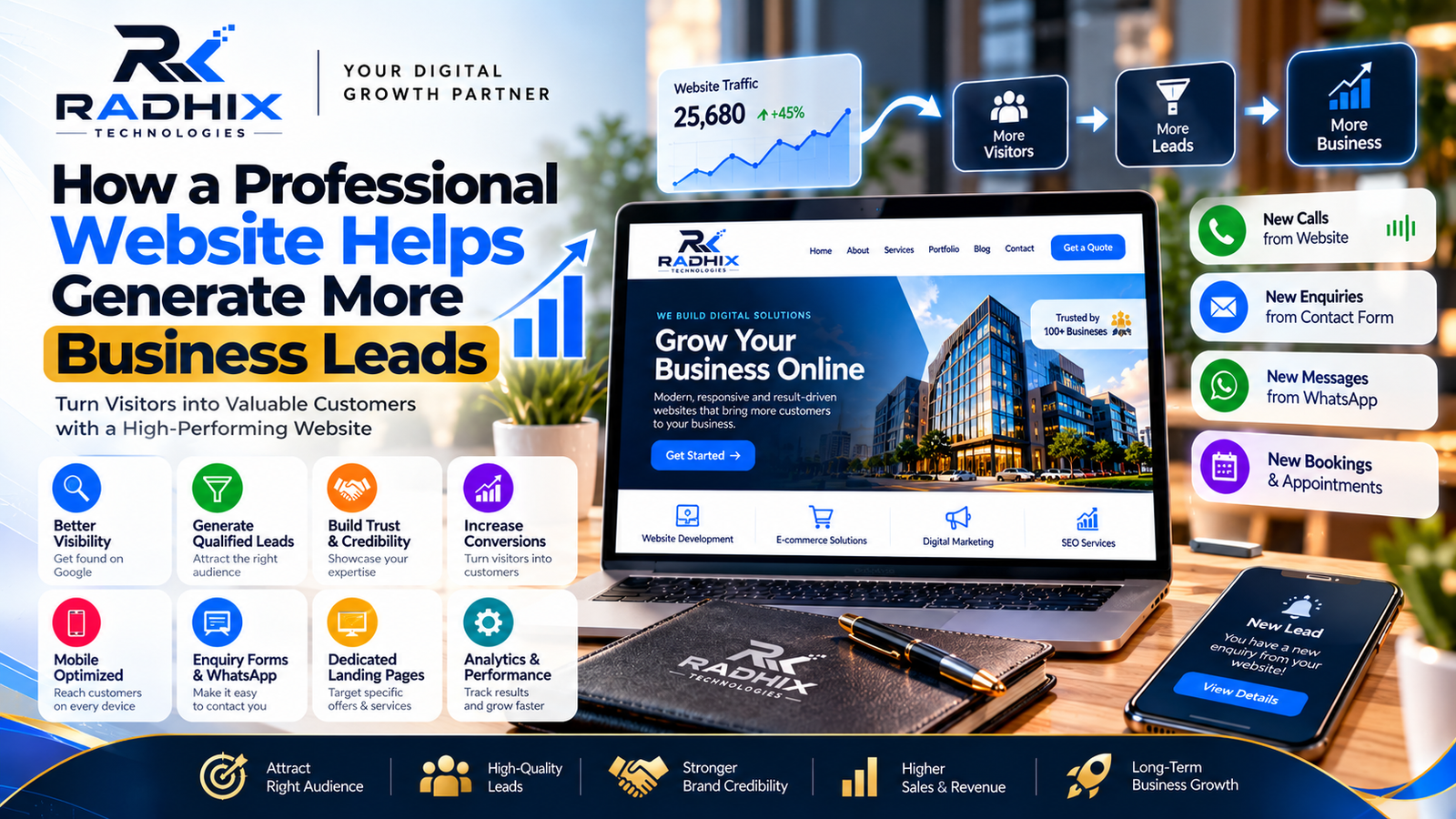
How a Professional Website Helps Generate More Business Leads
In today's competitive digital marketplace, businesses need effective ways to attract potential customers and convert their interest into genuine enquiries. Whether you run a startup, a local service company, a manufacturing business, or an established organization, a professional website can play an important role in your lead generation strategy.
A website is more than an online brochure. When designed strategically, it helps customers discover your business, understand your services, build trust in your brand, and take action. From search engine optimization (SEO) to enquiry forms and clear calls to action, the right website features can support a consistent flow of business opportunities.
At Radhix Technologies, we believe that a business website should combine professional design, useful content, and practical functionality to support measurable business goals.
What Is Website Lead Generation?
Website lead generation is the process of attracting potential customers to your website and encouraging them to share their contact information or enquire about your products and services.
A lead might be someone who submits a contact form, requests a quotation, books a consultation, calls your business, or signs up for a service demonstration.
The objective is not simply to attract more website visitors. It is to attract relevant visitors who are genuinely interested in what your business offers.
1. Builds Trust and Business Credibility
Before contacting a company, potential customers often research its services, experience, and reputation. A professional website gives them a convenient place to find this information.
A clear homepage, well-organized service pages, authentic testimonials, case studies, and accurate contact details help communicate your business value.
To strengthen credibility, your website should include:
- A clear introduction to your company.
- Detailed descriptions of your services.
- Genuine customer reviews or testimonials, where available.
- Relevant portfolio examples and case studies.
- Accurate contact information and business details.
- A secure HTTPS connection.
When visitors understand who you are and how you can help them, they have a stronger basis for deciding whether to contact your business.
2. Attracts Potential Customers Through SEO
Search engine optimization helps your website become discoverable when people search for relevant products, services, or solutions.
For example, a business offering website development in Faridabad may create useful pages explaining its website development services, project approach, and solutions for local businesses.
Effective SEO practices include:
- Researching relevant search terms.
- Creating helpful and original website content.
- Writing descriptive page titles and meta descriptions.
- Using logical headings and clean URLs.
- Improving mobile usability and page performance.
- Creating relevant internal links.
- Maintaining accurate local business information.
SEO can attract visitors who are already looking for a solution, making it a valuable long-term lead generation channel. However, rankings and enquiries are not guaranteed and depend on competition, content quality, authority, and other factors.
3. Converts Visitors With Clear Calls to Action
A call to action (CTA) tells visitors what they can do next. Without clear guidance, people may explore your website and leave without contacting you.
Effective CTAs include:
- Request a Free Consultation.
- Get a Project Quote.
- Book an Appointment.
- Contact Our Team.
- Request a Product Demo.
Place relevant CTAs on your homepage, service pages, and landing pages. Use concise wording and make sure each button leads to the expected action.
Your CTA should match the visitor's needs. Someone researching a service may prefer a consultation, while a visitor comparing providers may be ready to request a quotation.
4. Uses Contact Forms to Capture Enquiries
Contact forms allow interested visitors to send their details without needing to call your business immediately.
A useful lead generation form typically asks for only the information required to respond, such as a name, email address, phone number, and brief description of the enquiry.
To improve form usability:
- Keep the form short and straightforward.
- Use clear field labels.
- Make forms easy to complete on mobile devices.
- Display helpful validation messages.
- Explain how submitted information will be used.
- Provide a confirmation after successful submission.
Long or confusing forms can discourage visitors. Collecting only necessary information can make the process easier and help your team respond more efficiently.
5. Creates Dedicated Landing Pages
A landing page is designed around a specific service, offer, audience, or marketing campaign.
Instead of directing every visitor to the homepage, you can send relevant traffic to a page that directly addresses their needs.
For example, a web development company might create separate landing pages for corporate websites, e-commerce development, custom web applications, and website maintenance.
An effective landing page includes a clear headline, relevant benefits, supporting information, a prominent CTA, and an easy way to enquire.
Matching the landing page to the visitor's search or advertisement can make the experience more relevant and help your business evaluate which campaigns generate enquiries.
6. Reaches Customers on Mobile Devices
Many potential customers research businesses using smartphones. If your website is difficult to navigate on a mobile device, visitors may struggle to read your content, complete forms, or find contact details.
A responsive website adapts to different screen sizes and provides a consistent experience across smartphones, tablets, and desktop computers.
Mobile lead generation features may include click-to-call buttons, WhatsApp links, readable service pages, simple enquiry forms, and easy-to-use navigation.
A smooth mobile experience reduces unnecessary barriers between discovering your business and contacting your team.
7. Uses Content Marketing to Answer Customer Questions
Potential customers often research a problem before choosing a service provider. Helpful content allows your business to answer their questions and demonstrate relevant expertise.
Your website can include blog articles, buying guides, FAQs, tutorials, comparison pages, and industry insights.
For example, a website development company can publish articles about website costs, essential business website features, e-commerce platforms, and website maintenance.
Useful content can attract search traffic, support customer decisions, and direct readers toward relevant service pages.
Avoid publishing articles solely to repeat keywords. Focus on answering genuine customer questions with accurate, useful information.
8. Integrates WhatsApp, Calls, and Booking Tools
Some visitors prefer speaking directly with a business rather than completing a form. Offering suitable communication options can make it easier for different customers to reach your team.
Depending on your business model, you can integrate:
- Click-to-call buttons.
- WhatsApp enquiry links.
- Appointment booking forms.
- Calendar scheduling tools.
- Customer support chat.
- CRM integrations for lead management.
These features should be easy to use and connected to a clear follow-up process. For example, an enquiry submitted through a form should reach the appropriate team member without unnecessary delays.
9. Improves Lead Management With CRM Integration
Generating enquiries is only part of the process. Businesses also need to organize, track, and follow up on those enquiries.
A customer relationship management (CRM) system can help store lead details, assign enquiries to team members, record interactions, and track progress through the sales pipeline.
Depending on the tools used, a website can send form submissions directly to a CRM or notify the sales team when a new enquiry arrives.
This can reduce manual data entry and make it easier to identify which leads need attention. Appropriate access controls and data protection practices should be maintained when handling customer information.
10. Measures Results and Improves Conversion Rates
A professional website can be improved over time by measuring how visitors interact with it.
Useful metrics include:
- Number of relevant website visitors.
- Enquiry form submissions.
- Calls and booking requests.
- Landing page conversion rates.
- Traffic sources and campaign performance.
- Cost per lead for paid marketing campaigns.
- Lead quality and eventual sales outcomes.
Analytics tools can help identify pages that attract traffic but generate few enquiries. You can then test improvements to page content, forms, CTAs, or navigation.
A conversion rate is generally calculated by dividing the number of desired conversions by the number of relevant visitors or sessions, then multiplying by 100. Define the measurement consistently so that results can be compared meaningfully.
Essential Website Features for Better Lead Generation
A lead-focused business website should combine the following elements:
- Responsive design for mobile and desktop.
- Clear service and product pages.
- SEO-friendly structure and useful content.
- Prominent contact details and CTAs.
- Simple enquiry forms.
- Fast-loading pages.
- HTTPS security and appropriate privacy practices.
- Analytics and conversion tracking.
- CRM or notification integrations where needed.
- Regular maintenance and content updates.
Not every business needs every feature immediately. Start with the tools that address your most important customer needs and expand as your requirements grow.
Why Choose Radhix Technologies for Website Development?
Radhix Technologies helps businesses explore website development solutions tailored to their goals, customers, and budgets.
Whether you need a corporate website, an e-commerce platform, a service-based website, or a custom web application, your project should focus on more than appearance alone.
A lead-focused website can include user-friendly design, responsive layouts, clear calls to action, enquiry forms, SEO foundations, analytics, and suitable integrations according to the agreed project scope.
Before starting a project, discuss your target audience, key services, lead generation goals, technology requirements, timeline, budget, and post-launch support.
Conclusion
A professional website can support business lead generation by helping the right people discover your services, understand your value, and contact your team.
SEO, useful content, clear calls to action, mobile-friendly design, simple enquiry forms, and effective follow-up processes all contribute to a stronger customer journey.
However, a website alone cannot guarantee leads or sales. Results depend on the relevance of your audience, the quality of your offer, competition, marketing activities, and how effectively your business follows up with enquiries.
Ready to build a website that supports your business growth? Contact Radhix Technologies to discuss a website development solution aligned with your lead generation goals.
Frequently Asked Questions
1. How does a website generate business leads?
A website can attract relevant visitors through search engines and marketing campaigns, then encourage them to contact your business through enquiry forms, calls, bookings, or quotation requests.
2. Which website features help generate more leads?
Important features include clear CTAs, simple contact forms, dedicated landing pages, responsive design, relevant content, fast loading speeds, and appropriate analytics.
3. Does SEO help generate qualified leads?
SEO can attract people searching for relevant products or services. The quality of leads depends on search intent, content relevance, competition, and the effectiveness of your website.
4. Is a CRM necessary for website lead generation?
A CRM is not essential for every small business, but it can help organize enquiries, track follow-ups, and manage a growing number of leads.
5. How can I measure website lead generation?
Track enquiry submissions, calls, bookings, conversion rates, traffic sources, lead quality, and sales outcomes using suitable analytics and CRM tools.
6. How much does a lead generation website cost in India?
Costs vary according to design, pages, forms, integrations, analytics, and custom functionality. Request a quotation based on your specific requirements.