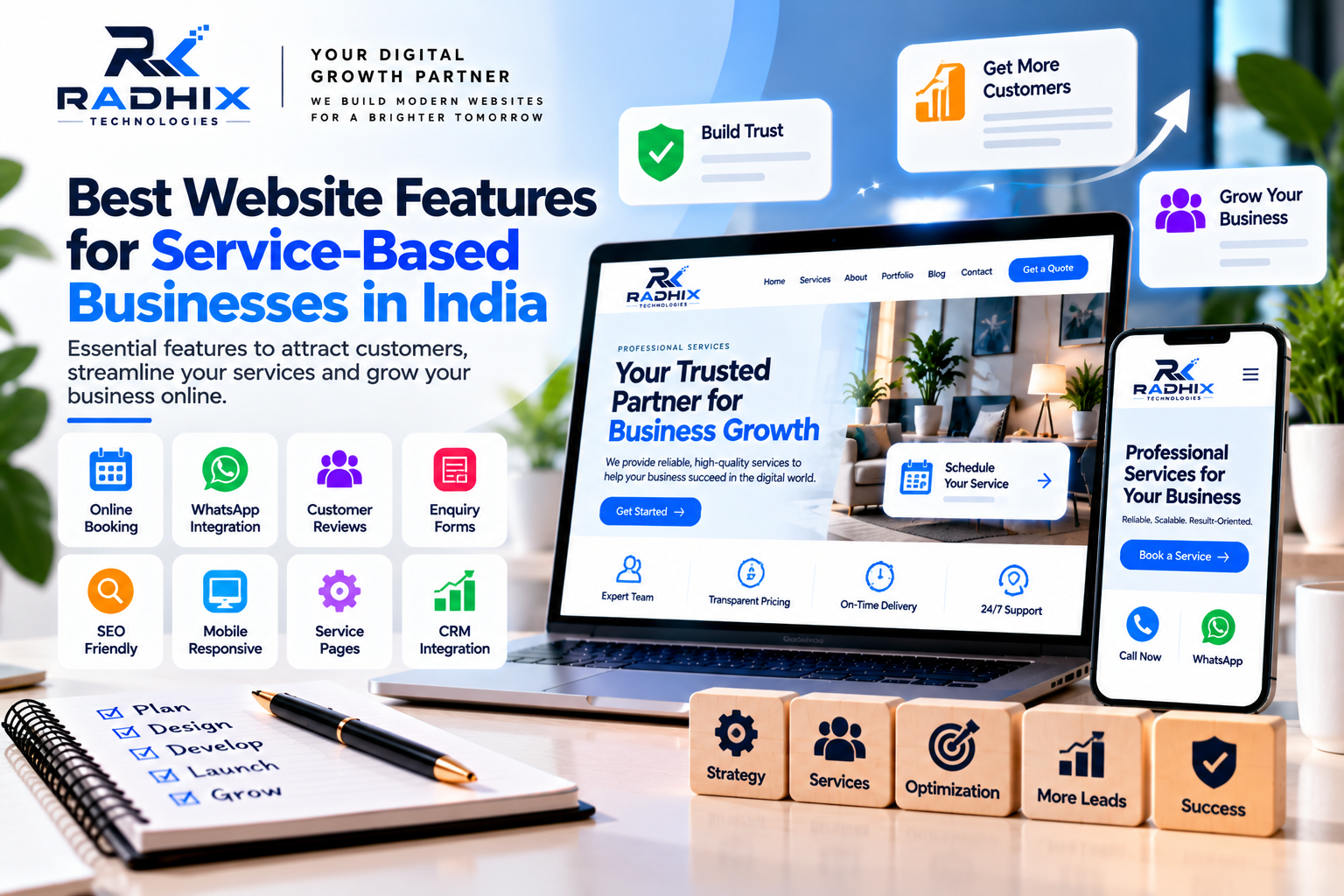
Best Website Features for Service-Based Businesses in India
In today's digital economy, customers often search online before choosing a service provider. Whether they need a digital marketing agency, a plumber, a consultant, a cleaning service, a software development company, or a professional trainer, they want to understand the services, compare options, and contact a reliable business.
For service-based businesses in India, a professional website can make this process easier. It provides a central place to showcase services, explain pricing, display customer feedback, answer questions, and generate enquiries.
However, an effective business website requires more than an attractive design. The right features should help customers find information quickly, communicate with your team, and take the next step.
In this guide, Radhix Technologies explores the best website features for service-based businesses in India and explains how to choose the right functionality for your business goals.
Why Do Service-Based Businesses Need a Professional Website?
A professional website helps customers understand what your business offers and how they can work with you.
Unlike relying exclusively on social media profiles or third-party directories, a website gives you greater control over your content, branding, service information, and customer journey.
A well-planned website can help your business:
- Build trust with potential customers.
- Showcase services and areas of expertise.
- Generate enquiries and quotation requests.
- Improve visibility through search engines.
- Accept appointments or bookings online.
- Provide important information around the clock.
- Support long-term business growth.
For businesses serving customers in Faridabad, Delhi NCR, or other Indian cities, a website can also help communicate local service availability and contact information.
1. Mobile-Responsive Website Design
Mobile responsiveness is one of the most important features of a modern business website.
Customers may visit your website using smartphones, tablets, laptops, and desktop computers. A responsive design adapts the layout to different screen sizes, helping visitors read content and navigate pages comfortably.
Your website should include readable text, accessible navigation, properly sized buttons, and mobile-friendly forms.
A consistent experience across devices makes it easier for potential customers to explore your services and contact your team.
2. Clear Service Pages
Your website should explain exactly what your business does.
Instead of placing every service on a single crowded page, consider creating dedicated pages for your major offerings.
For example, a digital agency might have separate pages for website development, e-commerce development, SEO, mobile app development, and digital marketing.
Each service page should explain:
- What the service includes.
- Which customers may benefit from it.
- The problems it helps solve.
- Your process and deliverables.
- Relevant examples or case studies.
- How customers can request more information.
Clear service pages help visitors understand your offerings and provide useful content for search engines.
3. Online Enquiry and Contact Forms
Contact forms allow potential customers to submit questions without needing to call your business immediately.
A useful enquiry form can collect a name, contact details, service requirement, and a short message.
Keep the form simple and ask only for information needed to respond. Too many mandatory fields can make it harder for visitors to complete the process.
Consider adding clear validation messages, a privacy notice, and a confirmation after successful submission.
For businesses that receive many enquiries, form submissions can also be connected to email notifications or a customer relationship management system.
4. WhatsApp Integration and Click-to-Call Buttons
Many Indian customers prefer communicating with businesses through WhatsApp or telephone calls.
Adding a WhatsApp contact link and a click-to-call button can make it easier for visitors to reach your team, especially on mobile devices.
These features can be useful for consultants, repair services, local agencies, healthcare service providers, and other businesses that depend on direct customer communication.
Make sure contact options are visible without overwhelming the page. Assign responsibility for responding to messages so enquiries do not go unanswered.
5. Online Booking and Appointment Scheduling
Businesses that provide consultations, repairs, home services, training, or appointments can benefit from online booking functionality.
A booking system may allow customers to select a service, choose an available date and time, provide contact details, and receive a confirmation.
Depending on the business, additional features may include calendar synchronization, appointment reminders, cancellation policies, and booking management.
Not every business needs a full booking system. If appointments are occasional or requirements are simple, a basic enquiry form may be sufficient at the beginning.
Choose the solution that matches your actual workflow and expected booking volume.
6. Search Engine Optimization (SEO)
SEO helps search engines discover and understand your website, making it easier for relevant customers to find your services through organic search.
Important website SEO features include descriptive page titles, useful meta descriptions, logical headings, readable URLs, internal links, optimized images, and a clear website structure.
Service-based businesses should also publish helpful content that answers customer questions.
For example, a website development company can create articles about website costs, mobile-friendly design, website maintenance, and choosing the right development platform.
Businesses serving particular locations can provide useful, accurate information about their service areas.
SEO requires ongoing work and does not guarantee a specific ranking. Content quality, competition, relevance, and technical implementation all influence search visibility.
7. Customer Testimonials and Reviews
Potential customers often want evidence that a service provider is reliable before making contact.
Genuine customer testimonials, verified reviews, case studies, and project examples can help demonstrate your experience and the value of your services.
When displaying testimonials, use accurate statements and obtain permission where necessary. Avoid inventing customer reviews or making claims that cannot be supported.
For service businesses, a detailed case study explaining the customer's challenge, the work completed, and the outcome can be more informative than a short promotional statement.
8. Portfolio and Case Studies
A portfolio is especially valuable for businesses whose work can be demonstrated visually or through project outcomes.
Website developers, architects, designers, consultants, marketing agencies, and creative professionals can showcase relevant projects to help potential customers evaluate their capabilities.
Each portfolio entry can include a project description, objectives, services delivered, technologies used where relevant, and measurable results when verified.
Organize examples by service category so visitors can find work related to their own requirements.
Remember to obtain permission before publishing confidential client information or project materials.
9. Transparent Pricing or Quotation Requests
Customers often want to understand the likely cost before contacting a service provider.
If your services have fixed prices, display them clearly. For customized services, provide indicative packages, explain the factors that affect pricing, or offer a quotation request form.
A quotation form can ask about the customer's requirements, budget range, expected timeline, and preferred contact method where appropriate.
Transparent pricing information can help attract relevant enquiries and reduce misunderstandings.
If prices vary significantly, explain why instead of displaying figures that could mislead potential customers.
10. Fast Loading Speed and Website Performance
A website should load efficiently and respond smoothly to visitor interactions.
Large images, unnecessary scripts, poorly configured hosting, and inefficient code can affect performance.
Useful optimization techniques include image compression, caching, suitable hosting, optimized code, and careful use of third-party integrations.
Google's Core Web Vitals can help evaluate loading performance, responsiveness, and visual stability.
A fast website supports a more convenient browsing experience, but performance should be measured rather than judged by appearance alone.
11. Secure Website and Privacy Features
Trust is essential when customers share contact details, business information, or payment data.
Your website should use HTTPS and follow appropriate security practices for its platform and functionality.
Depending on the website, security measures may include software updates, strong administrator access, reliable backups, spam protection, secure form handling, and appropriate access controls.
If you collect personal information, explain how it will be used and handle it according to applicable privacy requirements.
Businesses that accept online payments or manage customer accounts may require additional security controls.
12. CRM Integration and Lead Management
Generating enquiries is only the first step. Businesses also need a reliable process for managing and following up on potential customers.
A customer relationship management (CRM) system can organize contact information, assign leads to team members, record conversations, and track sales opportunities.
A website can be connected to a CRM so that submitted enquiries reach the appropriate team.
Smaller businesses may begin with email notifications or a simple tracking system, then introduce a CRM as enquiry volume increases.
The right approach depends on your sales process, team size, and operational requirements.
13. FAQ Section and Helpful Blog Content
Customers frequently ask similar questions about pricing, delivery timelines, service availability, warranties, and project requirements.
An FAQ section can answer these questions before visitors contact your team.
A business blog can provide more detailed guidance through tutorials, industry insights, comparison articles, and practical advice.
Useful content helps customers make informed decisions and can support organic search visibility.
Focus on accuracy and usefulness rather than publishing articles simply to repeat keywords.
14. Analytics and Conversion Tracking
Analytics tools help you understand how visitors discover your website and interact with its pages.
Depending on your goals, you can track page views, enquiry form submissions, booking requests, calls, and other important actions.
This information can help identify which services attract interest and which pages need improvement.
For example, if a service page receives relevant traffic but few enquiries, you might review the page content, CTA placement, form usability, or pricing information.
Use appropriate privacy notices and configure tracking tools in accordance with applicable requirements.
15. Easy-to-Use Admin Panel
An administrative dashboard allows authorized team members to manage website content without editing code for every change.
Depending on the platform, an admin panel may support service updates, blog publishing, image uploads, testimonials, enquiry management, and basic website settings.
For a small business, a simple and secure content management system may be sufficient.
Custom dashboards are more appropriate when the business requires specialized workflows or integrations that standard platforms cannot support effectively.
How Much Does a Service-Based Business Website Cost in India?
The cost depends on the number of pages, design complexity, functionality, platform, and integrations.
The following are illustrative planning estimates, not fixed quotations.
Website TypeEstimated Cost
- Basic service website₹10,000–₹25,000
- Professional business website₹20,000–₹60,000
- Website with booking functionality₹30,000–₹1,00,000+
- Custom service platform₹1,00,000–₹5,00,000+
Actual costs vary by provider and project requirements. Domain registration, hosting, premium software, content creation, maintenance, and taxes may be charged separately.
Before starting, request a written quotation that defines the included features, timeline, deliverables, ownership, and support arrangements.
How to Choose the Right Website Features
You do not need to add every feature at launch. Start with the functionality that helps customers understand your services and contact your business.
For a basic service company, responsive design, clear service pages, contact forms, WhatsApp integration, and essential SEO may be sufficient.
For appointment-based businesses, booking tools may be a priority. For businesses handling large numbers of enquiries, CRM integration can become more valuable.
Prioritize features according to customer needs, budget, and expected business growth.
Why Consider Radhix Technologies?
Radhix Technologies helps businesses explore website development solutions tailored to their goals, audiences, and operational requirements.
Whether you need a corporate website, a service-based website, an e-commerce platform, or a custom web application, the development approach should balance usability, functionality, performance, and maintainability.
A project may include responsive design, service pages, enquiry forms, SEO foundations, integrations, testing, deployment, and ongoing maintenance according to the agreed scope.
Before beginning, discuss your business objectives, required features, budget, timeline, hosting, and support expectations.
Conclusion
The best website features for service-based businesses in India are those that make it easier for customers to understand your services, trust your business, and contact your team.
Responsive design, clear service pages, enquiry forms, WhatsApp integration, online booking, SEO, testimonials, performance optimization, and analytics can create a strong foundation.
Start with essential features, measure how customers use your website, and add functionality as your business grows.
Ready to build a professional website for your service business? Contact Radhix Technologies to discuss a website solution that fits your requirements and budget.
Frequently Asked Questions
1. Which features are essential for a service business website?
A responsive design, clear service pages, contact details, enquiry forms, useful content, and basic SEO are good starting points. Booking and CRM tools can be added when needed.
2. Is WhatsApp integration useful for Indian businesses?
It can make direct communication easier for customers who prefer messaging. Businesses should ensure that messages are handled promptly and customer information is managed appropriately.
3. Does every service business need online booking?
No. Booking is useful for appointment-based services, but a contact form or quotation request may be more appropriate for businesses with customized projects.
4. How much does a service business website cost in India?
A basic website may cost around ₹10,000–₹25,000, while a more customized website can cost significantly more depending on its features and complexity.
5. Can a service website generate leads through Google?
Yes, a website can attract relevant search traffic through useful content and sound SEO practices. Actual enquiries depend on search visibility, customer demand, competition, and the quality of the website experience.
6. Can I add more features later?
Yes, provided the chosen platform and architecture support the changes. Planning for likely future requirements can help avoid unnecessary redevelopment.