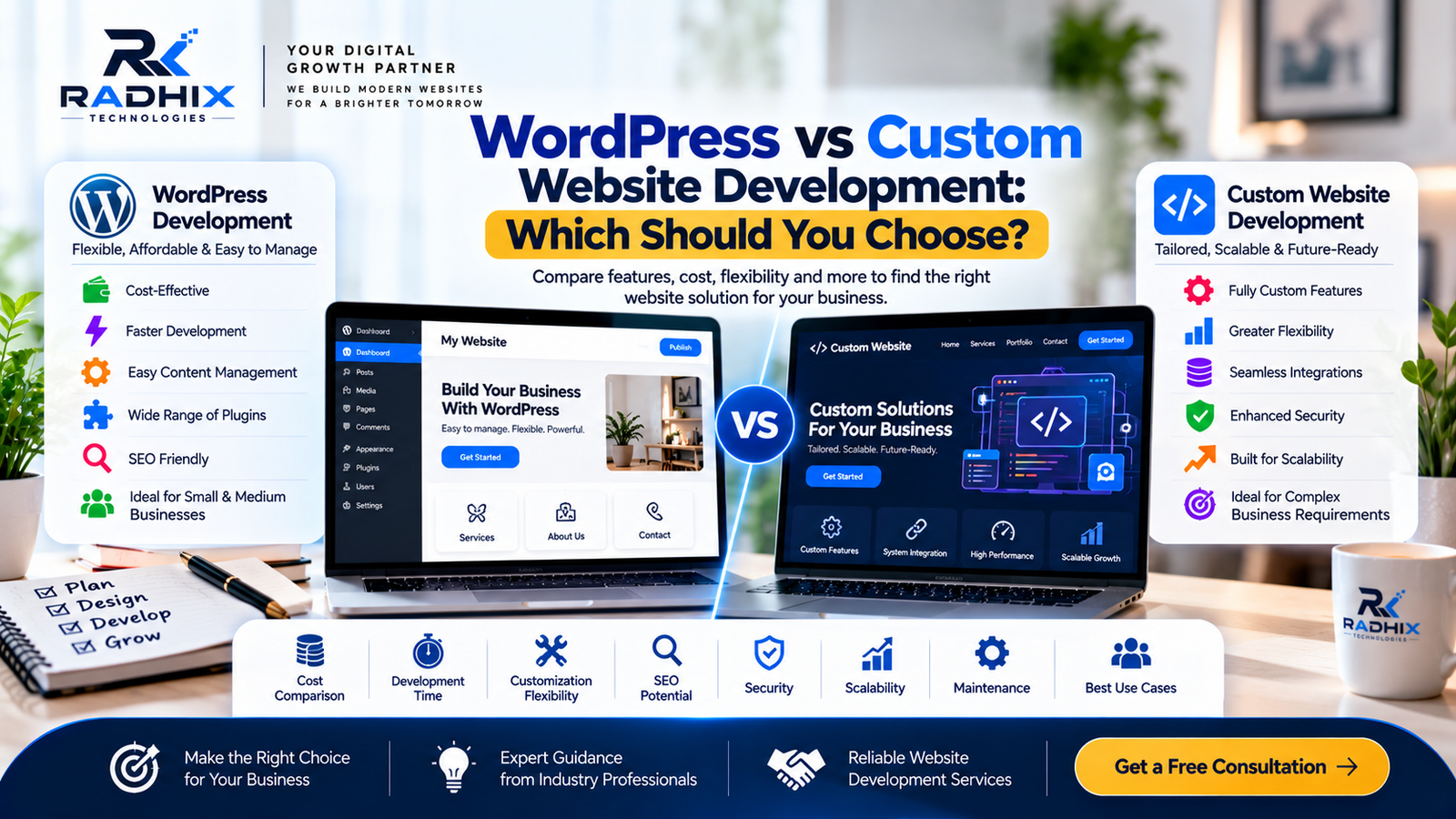
WordPress vs Custom Website Development: Which Should You Choose?
Choosing the right technology for your business website is an important decision. Whether you are launching a startup, building a corporate website, opening an online store, or developing a specialized web application, the platform you choose can affect your development budget, flexibility, maintenance, and future growth.
Two popular approaches are WordPress website development and custom website development. WordPress provides a flexible content management system with themes and plugins, while custom development allows a website to be built around specific business requirements.
But which option is right for your business?
In this guide, Radhix Technologies compares WordPress vs custom website development, including cost, features, SEO, security, scalability, and maintenance, to help you make an informed decision.
What Is WordPress Website Development?
WordPress is a content management system (CMS) that allows businesses to create and manage website content through an administrative dashboard. It supports themes, plugins, and customization options for a wide range of website types.
Businesses can use WordPress to build company websites, blogs, portfolios, service websites, and e-commerce stores with WooCommerce.
Benefits of WordPress Website Development
1. Cost-Effective Development
WordPress can reduce initial development effort because many website components, themes, and plugins are already available. This can make it a practical choice for startups and small businesses.
The final cost still depends on design customization, premium extensions, content, hosting, and the developer's work.
2. Faster Website Launch
A website with standard requirements can often be developed faster using an existing WordPress theme or a suitable starter framework.
This can be useful for businesses that need a professional online presence without building every component from scratch.
3. Easy Content Management
WordPress provides tools for managing pages, publishing blogs, updating images, and organizing website content.
With appropriate user permissions, business owners and marketing teams can maintain much of the website without editing code.
4. Extensive Plugin Ecosystem
WordPress supports plugins for SEO, forms, analytics, backups, security, e-commerce, and other functionality.
However, plugins should be selected carefully. Too many unnecessary or poorly maintained extensions can increase compatibility, security, and performance risks.
5. SEO-Friendly Features
WordPress supports SEO-friendly URLs, editable page titles, meta descriptions, headings, and SEO plugins.
Good search performance still requires helpful content, technical optimization, a logical site structure, and ongoing SEO work. Using WordPress alone does not guarantee high Google rankings.
Limitations of WordPress
WordPress may require additional customization when a business needs highly specialized workflows, complex permissions, or extensive application functionality.
The quality of a WordPress website also depends on its theme, plugins, hosting, configuration, and maintenance. Poorly chosen extensions can make a website harder to manage.
For complex projects, the development team should assess whether WordPress can support the requirements reliably before selecting it.
What Is Custom Website Development?
Custom website development involves building a website or web application according to specific business requirements. Developers can create tailored interfaces, workflows, integrations, and database structures rather than relying entirely on a standard theme or plugin ecosystem.
Depending on the project, technologies may include React, Next.js, Node.js, PHP/Laravel, Python, and suitable database systems.
Custom development is often considered for booking platforms, customer portals, specialized business systems, SaaS products, and applications with complex functionality.
Benefits of Custom Website Development
1. Tailored Functionality
Custom development allows features to be designed around your business processes, such as advanced booking rules, specialized dashboards, customer workflows, or custom reporting.
2. Greater Design Flexibility
The interface can be created around your brand, audience, and customer journey. This is helpful when a standard theme cannot deliver the required experience.
3. Integration With Business Systems
A custom website can connect with CRM, ERP, payment gateways, inventory systems, and third-party APIs according to the project's requirements.
4. Architecture Designed for Growth
Developers can plan the architecture, database, and infrastructure around expected traffic and future functionality. Actual scalability depends on implementation, hosting, and ongoing engineering.
5. Greater Control Over Implementation
A custom solution gives the development team more control over code, data structures, and application behaviour. However, this also creates responsibility for testing, documentation, security, and maintenance.
Limitations of Custom Website Development
Custom websites generally require more planning and development effort than straightforward WordPress projects.
Initial costs may be higher, development can take longer, and ongoing changes may require technical support. The business should also consider testing, documentation, backups, and future developer availability.
Custom development is most valuable when its flexibility solves real business requirements rather than adding unnecessary complexity.
WordPress vs Custom Website Development: Key Differences
FeatureWordPressCustom DevelopmentInitial development costOften lowerOften higherTime to launchOften fasterDepends on complexityContent managementBuilt-in CMSMust be selected or developedDesign flexibilityThemes and customizationTailored to requirementsFeaturesPlugins and custom codeBuilt around specific needsSEOPlugins and technical configurationDepends on implementationSecurityRequires updates and secure configurationRequires secure engineering and maintenanceMaintenanceCMS, theme, and plugin updatesCode, dependencies, and infrastructureBest suited forStandard business websites and many online storesSpecialized platforms and complex workflows
These differences are general guidelines. A highly customized WordPress project can be expensive, while a small custom website may be relatively straightforward. Compare actual project scope rather than assuming that every WordPress or custom project has the same cost.
WordPress vs Custom Website Development Cost in India
The cost of website development depends on the number of pages, design requirements, features, integrations, and the level of customization.
The following ranges are indicative planning estimates for India, not fixed quotations.
Project Type Estimated Cost
- Basic WordPress website₹10,000–₹30,000
- Customized WordPress business website₹30,000–₹1,50,000
- WordPress e-commerce website₹40,000–₹2,50,000+
- Custom business website₹40,000–₹1,50,000+
- Custom web application₹2,00,000–₹15,00,000+
Actual prices vary significantly by provider and requirements. Domain registration, hosting, premium plugins, content creation, third-party integrations, GST, and maintenance may be charged separately.
Ask for a written quotation that lists the included features, development milestones, payment schedule, and post-launch support.
Which Option Is Better for SEO?
Both WordPress and custom websites can perform well in search engines when they are developed and maintained correctly.
WordPress offers convenient content publishing and SEO plugins. Custom development offers control over technical implementation and can be useful for specialized site structures or performance requirements.
For either option, important SEO practices include:
- Creating useful, original content.
- Writing descriptive page titles and meta descriptions.
- Using clear headings and readable URLs.
- Optimizing images and page loading speed.
- Ensuring mobile responsiveness.
- Creating relevant internal links.
- Maintaining a valid XML sitemap and appropriate indexing settings.
- Implementing structured data where suitable.
SEO results depend on relevance, content quality, competition, authority, and ongoing work. Neither platform guarantees higher rankings automatically.
Which Option Is More Secure?
Security depends on how the website is built, configured, hosted, and maintained.
WordPress websites need timely updates to the CMS, themes, and plugins, along with strong administrator access, reliable backups, and appropriate security controls.
Custom websites require secure coding, dependency updates, access controls, input validation, testing, and infrastructure monitoring.
If your website accepts payments or handles sensitive customer information, discuss the appropriate security and privacy requirements before development begins.
Neither WordPress nor custom development is automatically secure without proper implementation and maintenance.
Which Option Is Best for Different Businesses?
Choose WordPress If:
- You need a company or service website.
- You want to publish blogs regularly.
- Your requirements are relatively standard.
- You need an administrative dashboard for content updates.
- You want to control initial development costs.
- Your required features are available through reliable plugins or reasonable customization.
Choose Custom Development If:
- Your business requires specialized workflows.
- You need complex user roles and permissions.
- Your platform depends on custom business logic.
- You need extensive integrations with internal systems.
- You are developing a SaaS product or specialized web application.
- Standard CMS functionality cannot meet your requirements reliably.
Consider a Hybrid Approach
You do not always have to choose between a completely standard WordPress website and a fully custom application.
A business might use WordPress for marketing pages and blogs while using a separate custom application for booking, account management, or complex internal workflows.
This approach can provide a useful balance, but it requires careful planning for integrations, authentication, maintenance, and the user experience.
How to Make the Right Decision
Before choosing a development approach, answer these questions:
- What is the main purpose of the website?
- Which features are essential at launch?
- Who will update website content?
- What is your initial development budget?
- Will the website need custom integrations?
- What security and data requirements apply?
- How might your business needs change over the next few years?
- Who will maintain the website after launch?
Start with your actual requirements, then select the technology that meets them with the least unnecessary complexity.
Why Consider Radhix Technologies?
Radhix Technologies helps businesses explore website development solutions based on their goals, budget, audience, and technical requirements.
Whether you need a WordPress business website, an e-commerce store, a corporate website, or a custom web application, the development approach should match your functionality and future plans.
A project can include requirement analysis, UI/UX design, development, responsive layouts, SEO foundations, testing, deployment, and maintenance according to the agreed scope.
Before starting, discuss your requirements, delivery timeline, technology stack, hosting, source-code ownership, and support arrangements with your development partner.
Conclusion
The choice between WordPress and custom website development depends on your business goals, functionality, budget, and long-term plans.
WordPress is often a practical choice for business websites, blogs, and many e-commerce projects because it offers convenient content management and an established ecosystem.
Custom website development is worth considering when specialized functionality, complex workflows, or tailored integrations are essential.
The best website is not necessarily the one built with the most advanced technology. It is the one that serves your customers, supports your business objectives, and can be maintained effectively.
Ready to build your business website? Contact Radhix Technologies to discuss your requirements and choose a website development solution that fits your goals.
Frequently Asked Questions
1. Is WordPress better than custom website development?
WordPress is often suitable for standard business websites and blogs. Custom development is more appropriate when specialized functionality or complex business workflows are required.
2. Is WordPress cheaper than custom development?
WordPress often costs less initially because it provides ready-made themes and plugins. Extensive customization can increase the cost, so compare complete project quotations.
3. Which option is better for SEO?
Both can support effective SEO. Results depend on technical implementation, content quality, website performance, and ongoing optimization rather than the platform alone.
4. Can WordPress handle e-commerce?
Yes. WordPress with WooCommerce can support many online stores. Advanced requirements may need extensions or custom development.
5. Is custom website development better for scalability?
Custom development can be designed around specific growth requirements, but scalability depends on architecture, code quality, infrastructure, and maintenance. WordPress can also support many growing websites.
6. Can I switch from WordPress to a custom website later?
Yes. Migration is possible, but it requires planning for content, URLs, databases, integrations, redirects, and functionality. The effort depends on the existing website and the new system.
7. What should I ask a website development company before hiring?
Ask about relevant experience, technology recommendations, project scope, timeline, pricing, SEO, security, source-code ownership, maintenance, and post-launch support.