Best Technology Stack for Developing a Modern Business Application
Introduction
Developing a modern business application requires more than an attractive user interface. A successful application must be fast, secure, scalable, reliable and easy to maintain. Whether you are planning a CRM system, ERP software, e-commerce platform, SaaS product, booking portal or business management application, choosing the right technology stack is one of the most important decisions.
A technology stack is a combination of programming languages, frameworks, databases, cloud services and development tools used to build and operate an application.
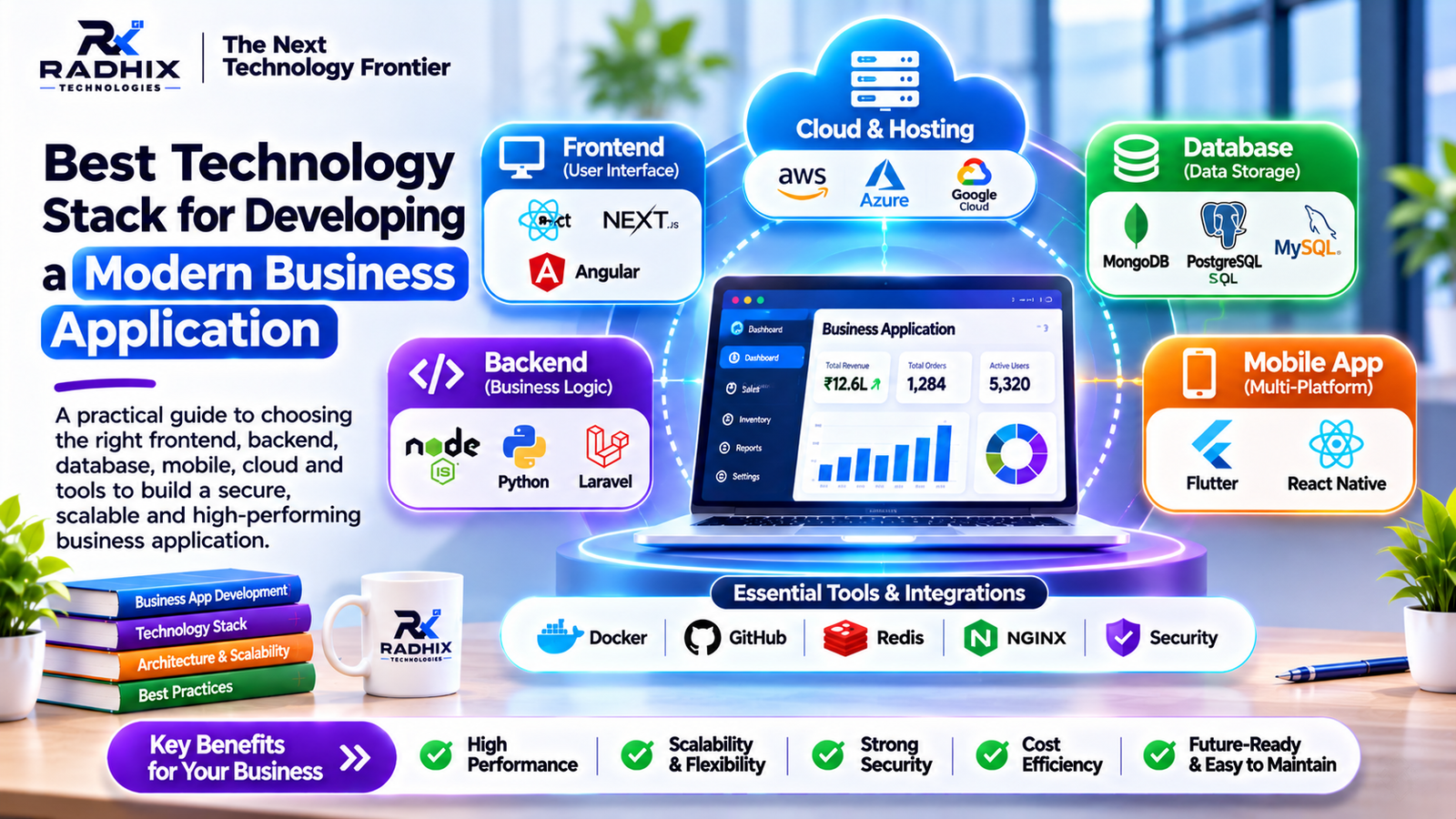
In 2026, businesses have several technology options, including React, Next.js, Node.js, Python, MongoDB, PostgreSQL, Flutter and cloud platforms such as AWS and Microsoft Azure.
But which technology stack is best for your business application? Let's explore the major technologies, their benefits and how to select the right combination for your project.
1. What Is a Technology Stack?
A technology stack refers to the collection of technologies used to develop an application. Each technology performs a specific role, and all components work together to deliver the final product.
A typical business application technology stack includes:
- Frontend: The visual interface that users interact with.
- Backend: Handles business logic, application functionality and server-side operations.
- Database: Stores and manages application data.
- API: Connects the frontend, backend and third-party services.
- Cloud Hosting: Provides the infrastructure required to run the application.
- Security Tools: Protect user accounts, business information and transactions.
- Development Tools: Support testing, deployment, monitoring and maintenance.
For example, an online booking application may use React for its interface, Node.js for backend operations, MongoDB for data storage and AWS for cloud hosting.
2. Best Frontend Technologies for Business Applications
The frontend is the part of an application that customers, employees and administrators see and use. A good frontend should be responsive, user-friendly and compatible with different screen sizes.
React.js
React.js is a popular JavaScript library used to develop interactive user interfaces.
Key Benefits:
- Reusable UI components.
- Fast and responsive interfaces.
- Large developer community.
- Easy integration with backend APIs.
- Suitable for dashboards, CRM and SaaS applications.
Best For: Admin panels, customer portals, dashboards, e-commerce platforms and interactive business applications.
Next.js
Next.js is a React-based framework that provides additional features for building modern web applications.
Key Benefits:
- Server-side rendering and static generation.
- SEO-friendly public pages.
- Improved application structure.
- API and server-side development capabilities.
- Support for modern web application architectures.
Best For: SaaS platforms, business portals, customer-facing applications and applications that combine public website pages with private dashboards.
Angular
Angular is a frontend framework suitable for large and structured applications.
Key Benefits:
- Structured development architecture.
- Built-in routing and form capabilities.
- TypeScript support.
- Suitable for complex enterprise interfaces.
Best For: Enterprise applications, large administrative systems and applications with multiple modules.
3. Best Backend Technologies for Business Applications
The backend manages the core functionality of an application. It processes requests, applies business rules, manages users, connects databases and communicates with external services.
Node.js
Node.js allows developers to build server-side applications using JavaScript or TypeScript.
Key Benefits:
- Efficient handling of multiple concurrent requests.
- Suitable for real-time functionality.
- Large ecosystem of packages.
- Easy integration with React and Next.js.
- Supports API-driven applications.
Best For: E-commerce applications, booking systems, CRM software, SaaS platforms, delivery applications and real-time dashboards.
Python (Django and FastAPI)
Python is widely used for backend development, automation, data processing and artificial intelligence integrations.
Django: Provides a structured framework with built-in tools for authentication, database operations and administration.
FastAPI: Suitable for building modern APIs, especially where asynchronous operations and AI integrations are important.
Best For: AI-powered applications, analytics platforms, automation software, data-driven applications and business management systems.
PHP (Laravel)
Laravel is a PHP framework used to develop secure and structured web applications.
Key Benefits:
- Built-in authentication support.
- Database management through Eloquent ORM.
- Organized application structure.
- Useful development tools.
- Suitable for traditional business portals.
Best For: Business websites, management portals, e-commerce applications and custom web software.
4. Best Database Technologies
A database stores important business information, including customer details, products, orders, transactions, employee records and application settings.
Choosing the right database depends on the structure and type of information your application handles.
MongoDB
MongoDB is a NoSQL document-oriented database that stores information in flexible document formats.
Key Benefits:
- Flexible data structure.
- Suitable for changing data requirements.
- Supports document-based application models.
- Useful for product catalogues and content-heavy applications.
Best For: E-commerce catalogues, content management systems, flexible business applications and applications with document-oriented data.
PostgreSQL
PostgreSQL is an open-source relational database management system.
Key Benefits:
- Strong data consistency.
- Supports complex queries.
- Handles relationships between business records.
- Supports transactions and advanced database features.
- Suitable for structured business information.
Best For: ERP systems, financial applications, CRM software, inventory management and enterprise applications.
MySQL
MySQL is another widely used relational database.
Key Benefits:
- Established ecosystem.
- Reliable relational data management.
- Good compatibility with many web technologies.
- Suitable for structured application data.
Best For: Business portals, websites, inventory systems and traditional web applications.
Important: MongoDB is not automatically better than SQL databases. For applications involving invoices, payments, inventory and complex relationships, PostgreSQL or MySQL may be more appropriate. The choice should depend on the application's data structure.
5. Best Mobile App Development Technologies
If your business application needs Android and iOS apps, selecting the right mobile development technology can help control development time and maintenance costs.
Flutter
Flutter is Google's UI toolkit for building applications across multiple platforms.
Key Benefits:
- Single codebase for Android and iOS.
- Customizable user interfaces.
- Consistent design across devices.
- Supports web and desktop targets.
Best For: Customer applications, booking apps, delivery platforms and business mobile applications.
React Native
React Native is a framework for developing mobile applications using React and JavaScript or TypeScript.
Key Benefits:
- Reusable development skills from React.
- Shared code across mobile platforms.
- Integration with native device features.
- Large development ecosystem.
Best For: E-commerce apps, customer portals, service booking applications and business mobile solutions.
6. Cloud Hosting and Infrastructure
Cloud hosting provides the servers, storage and infrastructure needed to run an application online.
A business application should have reliable hosting, regular backups, security controls and the ability to handle increasing traffic.
Popular cloud platforms include:
Amazon Web Services (AWS)
AWS offers cloud computing, databases, storage, networking and application deployment services.
Suitable For: Scalable business applications, SaaS platforms, e-commerce systems and enterprise solutions.
Microsoft Azure
Azure provides cloud infrastructure and services for application hosting, databases, identity management and enterprise integration.
Suitable For: Enterprise software, Microsoft-based business environments and large organizational applications.
Google Cloud Platform (GCP)
Google Cloud provides computing, storage, database, analytics and AI-related services.
Suitable For: Data-driven applications, AI-powered platforms and scalable web services.
The best hosting provider depends on the application's workload, budget, technical requirements and the availability of suitable support.
7. Essential Supporting Technologies
A modern application requires more than frontend, backend and database technologies. Supporting tools improve performance, security and maintainability.
TechnologyPurposeRedisCaching and temporary data storageDockerApplication containerizationGitHubSource code managementGitHub ActionsAutomated testing and deployment workflowsNGINXWeb server and reverse proxyPostmanAPI testingFirebase Cloud MessagingPush notificationsCloudflareCDN and additional security servicesPrometheus and GrafanaMonitoring and metrics
Not every project needs all these tools. Select them according to the application's actual requirements.
8. Recommended Technology Stack for Different Business Applications
There is no single technology stack that is ideal for every project. Different applications have different functional and technical requirements.
Application TypeRecommended Technology StackCRM SoftwareReact, Node.js, PostgreSQLERP SoftwareReact or Angular, Node.js or .NET, PostgreSQLE-commerce PlatformNext.js, Node.js, PostgreSQL or MongoDBSaaS ApplicationNext.js, Node.js or Python, PostgreSQLAI-Powered ApplicationReact or Next.js, Python FastAPI, PostgreSQLTaxi Booking ApplicationReact Native or Flutter, Node.js, PostgreSQLInventory ManagementReact, Node.js, PostgreSQLBusiness Management PortalReact, Laravel or Node.js, MySQL or PostgreSQL
These are practical starting combinations, not fixed rules. The final selection should be based on features, integrations, development-team expertise and future requirements.
9. Important Factors to Consider Before Selecting a Technology Stack
Before starting application development, businesses should evaluate the following factors.
1. Business Requirements
Identify the application's purpose, target users, important features and expected workflows. A simple internal dashboard may not require the same architecture as a multi-vendor marketplace.
2. Scalability
Choose technologies that can support future growth. Consider increasing users, transactions, data volume and additional application modules.
3. Development Budget
The technology stack should match the available budget. More complex architecture and infrastructure can increase development and maintenance costs.
4. Security
Implement secure authentication, role-based access control, encrypted communication, database protection and regular backups.
5. Integration Requirements
Check whether the application needs payment gateways, WhatsApp automation, email services, maps, third-party APIs or AI integrations.
6. Maintenance and Support
Choose technologies with good documentation, community support and developers available for future improvements.
7. Performance
Evaluate application response time, database queries, caching requirements and expected traffic before finalizing the architecture.
10. Why Choosing the Right Development Partner Matters
Selecting the right technology is important, but successful implementation also depends on the development team's technical expertise and understanding of business requirements.
A professional software development partner should help you with:
- Requirement analysis and technical planning.
- UI/UX design and application architecture.
- Frontend and backend development.
- Database design and API integration.
- Testing and deployment.
- Security implementation.
- Technical documentation and maintenance.
Businesses should review a development company's actual projects, application functionality, user experience and technical capabilities before making a decision.
11. Build Your Business Application with Radhix Technologies
Radhix Technologies Pvt. Ltd. provides software development and digital solutions for businesses looking to improve their operations through technology.
From custom business applications and web portals to mobile applications and automation solutions, selecting the right technology and development approach is essential for building reliable software.
Our development approach focuses on understanding business requirements, selecting suitable technologies, creating user-friendly interfaces and developing applications that can evolve with changing business needs.
Whether you are planning a CRM, ERP, e-commerce platform, booking portal, SaaS product or custom business application, the right technical foundation can help turn your business idea into a practical digital solution.
Visit https://www.radhix.com/ to explore software development solutions.
Conclusion
Choosing the best technology stack for a modern business application is not about selecting the most popular programming language or the latest framework. It is about finding the right combination of technologies that matches your business requirements, budget, security expectations and long-term growth plans.
React or Next.js can be strong frontend choices, Node.js and Python offer flexible backend development options, and PostgreSQL or MongoDB can manage different types of business data. Flutter and React Native are useful options for cross-platform mobile applications, while AWS, Azure and Google Cloud provide scalable infrastructure.
Before beginning development, define your requirements, evaluate technology options and work with an experienced development team. A well-planned technology stack can make your application easier to maintain, improve user experience and support long-term business growth.
Frequently Asked Questions (FAQs)
1. Which technology stack is best for developing a business application?
There is no universal best stack. React or Next.js with Node.js and PostgreSQL is a strong starting option for many modern business applications. The final choice depends on the project's requirements.
2. Is MERN stack good for business application development?
Yes. MERN (MongoDB, Express.js, React.js and Node.js) is suitable for many interactive web applications, dashboards, portals and e-commerce platforms.
3. Which backend technology is best: Node.js or Python?
Node.js is a good option for API-driven and real-time applications, while Python is particularly useful for AI, automation and data-intensive applications. Both can support business software.
4. Which database is better for business applications: MongoDB or PostgreSQL?
PostgreSQL is often suitable for structured data and complex relationships. MongoDB is useful when application data has a flexible document structure. The right choice depends on the data model.
5. Which technology is best for developing Android and iOS applications?
Flutter and React Native are popular cross-platform options. They allow businesses to develop applications for Android and iOS using a shared codebase.
6. How much does it cost to develop a modern business application?
The cost depends on application complexity, features, platforms, integrations, design, security and development time. A detailed requirement analysis is necessary to estimate the budget accurately.
7. Can AI features be integrated into a business application?
Yes. AI APIs and Python-based services can be integrated to provide chatbots, document processing, intelligent search, recommendations, reporting and automation features.