How to Turn a Business Idea into a Scalable Software Product
Every successful software product starts with an idea. It could be a simple solution to a problem you have noticed in your industry, a platform that makes an existing process easier, or a completely new digital service. But having a promising idea and building a product that can support thousands of users are two very different things.
Many businesses rush into development because they want to launch quickly. They focus on screens, features and technology before understanding what customers actually need. As a result, the product may work at first but struggle when more users, transactions and business requirements are added.
Turning a business idea into a scalable software product requires more than coding. It involves understanding the market, validating the idea, planning the right features, selecting suitable technology and improving the product based on real user feedback.
Let's look at how businesses can move from an initial idea to a software product that is ready to grow.
1. Start by Understanding the Problem
Before thinking about development, be clear about the problem your idea is supposed to solve.
A software product should make something easier, faster, more affordable or more convenient for its users. If the problem is not clearly defined, it becomes difficult to decide which features are actually necessary.
For example, imagine a business owner who wants to build an online platform for booking home services. The first thought might be to create an app with customer registration, service listings and online payments.
However, the actual problem may be much bigger. Customers may struggle to find reliable professionals, service providers may have difficulty managing bookings, and business owners may lack a proper system to track orders.
Understanding these challenges gives the product a clear direction.
Before moving ahead, ask:
- Who is facing this problem?
- How are people solving it today?
- What makes the current solution inconvenient?
- Would customers be willing to use or pay for a better solution?
The clearer the problem, the stronger the foundation of the product.
2. Research the Market and Your Target Audience
An idea may sound excellent internally, but its real value becomes clear only when potential customers respond to it.
Market research helps you understand whether people actually need your product. It also shows what competitors are offering and where your proposed solution could stand out.
Start by identifying your target audience. Are you building software for individual customers, small businesses, large organisations or a specific industry?
Next, study existing products. Look at their pricing, features, customer reviews and common complaints. Negative reviews can be particularly useful because they often reveal problems that existing solutions have not addressed properly.
You do not need an expensive research project to get started. Conversations with potential customers, short surveys and a basic competitor analysis can provide useful insights.
The objective is not to copy another product. It is to understand what customers expect and identify an opportunity to serve them better.
3. Validate the Idea Before Investing Heavily
One of the biggest mistakes businesses make is investing a large amount of money in development without checking whether the idea has demand.
Idea validation helps reduce this risk.
You can validate a software concept through:
- Customer interviews and feedback.
- A simple landing page explaining the product.
- A clickable UI/UX prototype.
- A small pilot with selected users.
- A basic demonstration of the main functionality.
For example, if you are planning to develop a subscription-based business management platform, you could first demonstrate its proposed dashboard and billing workflow to a few business owners.
Their feedback may reveal that automated invoices are essential, while some advanced reporting features can wait.
This early feedback can save considerable development time and money.
4. Decide Which Features Should Be Included in the First Version
Once the idea is validated, the next step is to decide what the first version should contain.
This is where the concept of a Minimum Viable Product (MVP) becomes useful.
An MVP is an initial working version of a product that includes the essential features required to solve the main customer problem. It is not an incomplete product with random functionality. It is a focused version designed to test the business idea in the real market.
For a service booking platform, the first version might include:
- Customer registration and login.
- Service listing and search.
- Booking management.
- Service provider registration.
- Basic payment integration.
- Admin dashboard.
- Booking status notifications.
Features such as advanced analytics, loyalty programmes, AI-based recommendations and complex automation can be introduced later if customer demand justifies them.
A focused launch helps businesses collect feedback without spending time building features that users may never need.
5. Plan the UI/UX Around Real User Behaviour
A software product can have excellent functionality and still struggle if people find it difficult to use.
User interface (UI) defines how the product looks, while user experience (UX) focuses on how easily people can complete tasks.
Think about the journey a customer follows when using your software. Can they find the information they need? Is registration simple? Can they complete a purchase or booking without confusion?
A good design should make important actions easy to understand.
Before development begins, prepare wireframes and interactive prototypes. These help business owners and developers review the product flow before investing in the complete application.
It is also important to consider mobile users. A product should provide a consistent experience across different screen sizes and devices wherever those platforms are part of the project scope.
6. Choose the Right Technology for Future Growth
Technology decisions made during the early stages can affect the product for years.
The right technology depends on the type of software, expected users, security requirements, integrations and available development resources.
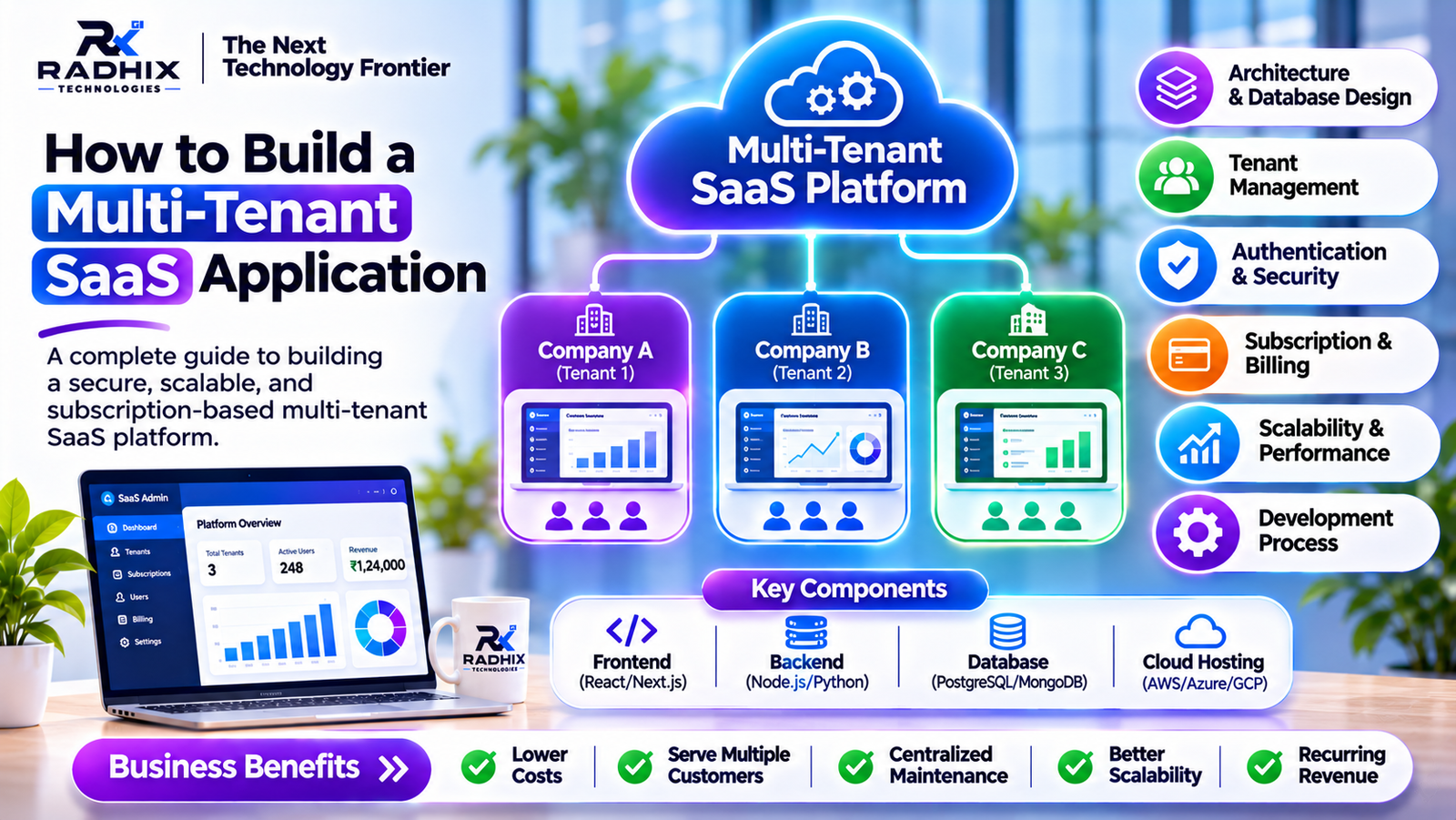
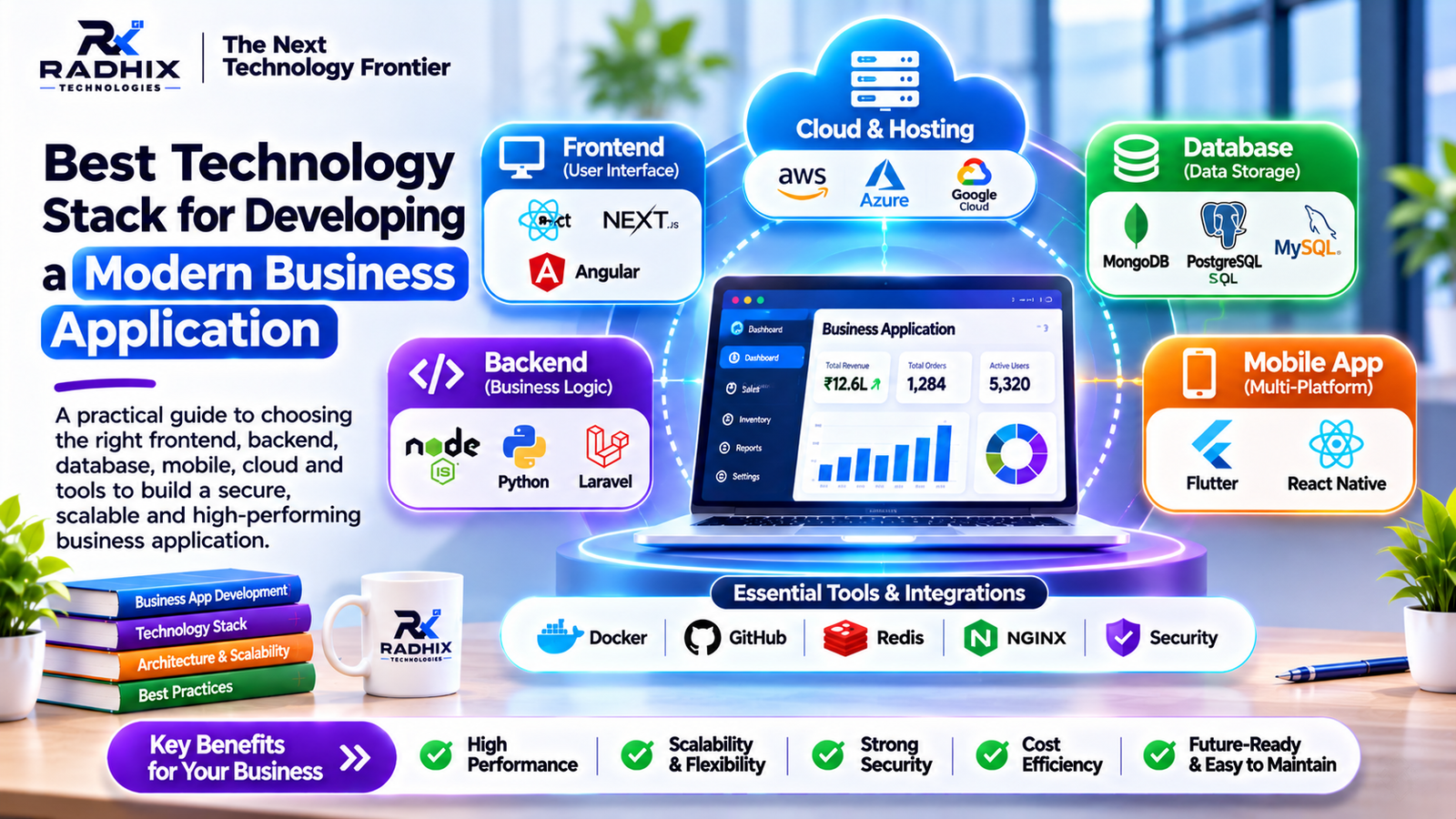
For example, a web-based SaaS product may use:
- Frontend: React.js or Next.js.
- Backend: Node.js with Express.js.
- Database: MongoDB or PostgreSQL.
- Cloud infrastructure: AWS, Microsoft Azure or Google Cloud.
- APIs: For payment gateways, notifications and third-party services.
A mobile application may require technologies such as Flutter or React Native, depending on the project requirements.
However, choosing popular technologies does not automatically make a product scalable. The architecture, database design, security practices and deployment strategy matter just as much.
Avoid selecting technology only because it is trending. Choose tools that fit the actual product and can be maintained as the business grows.
7. Build a Scalable Software Architecture
Scalability means the product can handle increasing users, data and transactions without becoming unreliable or unnecessarily expensive.
A system designed only for a small number of users may face performance problems when usage increases.
Some important architectural considerations include:
Modular development: Divide the application into logical modules so individual features can be updated without affecting the entire system.
Database planning: Organise data properly and use suitable indexing, relationships and query optimisation.
API-based communication: Well-designed APIs make it easier to connect mobile apps, web platforms and external services.
Cloud infrastructure: Cloud services can help businesses adjust computing resources as demand changes.
Security: Protect user information through appropriate authentication, authorisation, encryption and secure data handling.
A scalable architecture does not mean building an unnecessarily complicated system from day one. It means making sensible decisions that leave room for future expansion.
8. Develop, Test and Improve the Product
Once planning and architecture are ready, development can begin.
The development process should be divided into manageable stages. Instead of waiting until every feature is complete, businesses can review working modules regularly.
Testing is equally important. It should cover more than whether buttons work or pages open.
A proper testing process may include:
- Functional testing.
- Mobile and browser compatibility testing.
- Performance and load testing.
- Security testing.
- API and integration testing.
- User acceptance testing.
For example, an e-commerce platform should be tested for product browsing, cart management, payment processing, order confirmation and refund scenarios.
Testing real-world situations before launch helps prevent problems that could affect customer trust.
9. Launch, Collect Feedback and Monitor Performance
Launching the product is not the end of development. It is the beginning of learning from actual users.
After launch, monitor how people use the product. Check where they spend time, which features they use frequently and where they leave the process.
Useful performance indicators may include:
- Number of active users.
- User registration and conversion rates.
- Customer retention.
- Application response time.
- Failed transactions or errors.
- Customer support requests.
- Revenue and recurring subscriptions.
Feedback should guide future improvements. If users repeatedly struggle with a particular process, improving that workflow may be more valuable than adding several new features.
10. Scale Gradually as the Business Grows
Once the product has a stable user base and a clear market response, the business can start expanding its capabilities.
Depending on customer requirements, future development may include:
- Advanced reporting and analytics.
- AI-powered recommendations.
- Automated workflows.
- Multi-language support.
- Additional payment options.
- Third-party software integrations.
- Multi-branch or multi-vendor management.
- Advanced admin and partner dashboards.
Scaling also requires attention to infrastructure, customer support, data security and maintenance.
Growth should be planned around actual business demand. Adding features simply to make the product look more advanced can increase costs and make the user experience unnecessarily complicated.
Common Mistakes to Avoid
Businesses often face avoidable challenges when converting an idea into software. Some common mistakes include:
Building too many features initially: A large feature list increases development time and makes it harder to identify the product's core value.
Ignoring customer feedback: Decisions based only on assumptions may lead to features that users do not need.
Choosing technology without proper planning: A technology stack should support the product's requirements, not just current trends.
Underestimating maintenance: Software needs regular updates, security improvements, bug fixes and performance monitoring.
Skipping documentation: Proper technical documentation makes future development and maintenance easier.
Avoiding these mistakes can make the development journey more predictable.
How Radhix Technologies Helps Turn Ideas into Software Products
At Radhix Technologies, we understand that businesses often begin with an idea rather than a complete technical plan. The challenge is to convert that idea into a practical digital solution that supports real business operations.
Our software development approach focuses on understanding business requirements, planning the product structure, designing user-friendly interfaces and developing solutions around the intended workflow.
Whether the requirement involves a web application, mobile app, SaaS platform, business automation system or custom software, the development process should be guided by the product's purpose and future growth plans.
A well-planned software product can help businesses improve operations, serve customers more effectively and build a stronger digital presence.
Conclusion
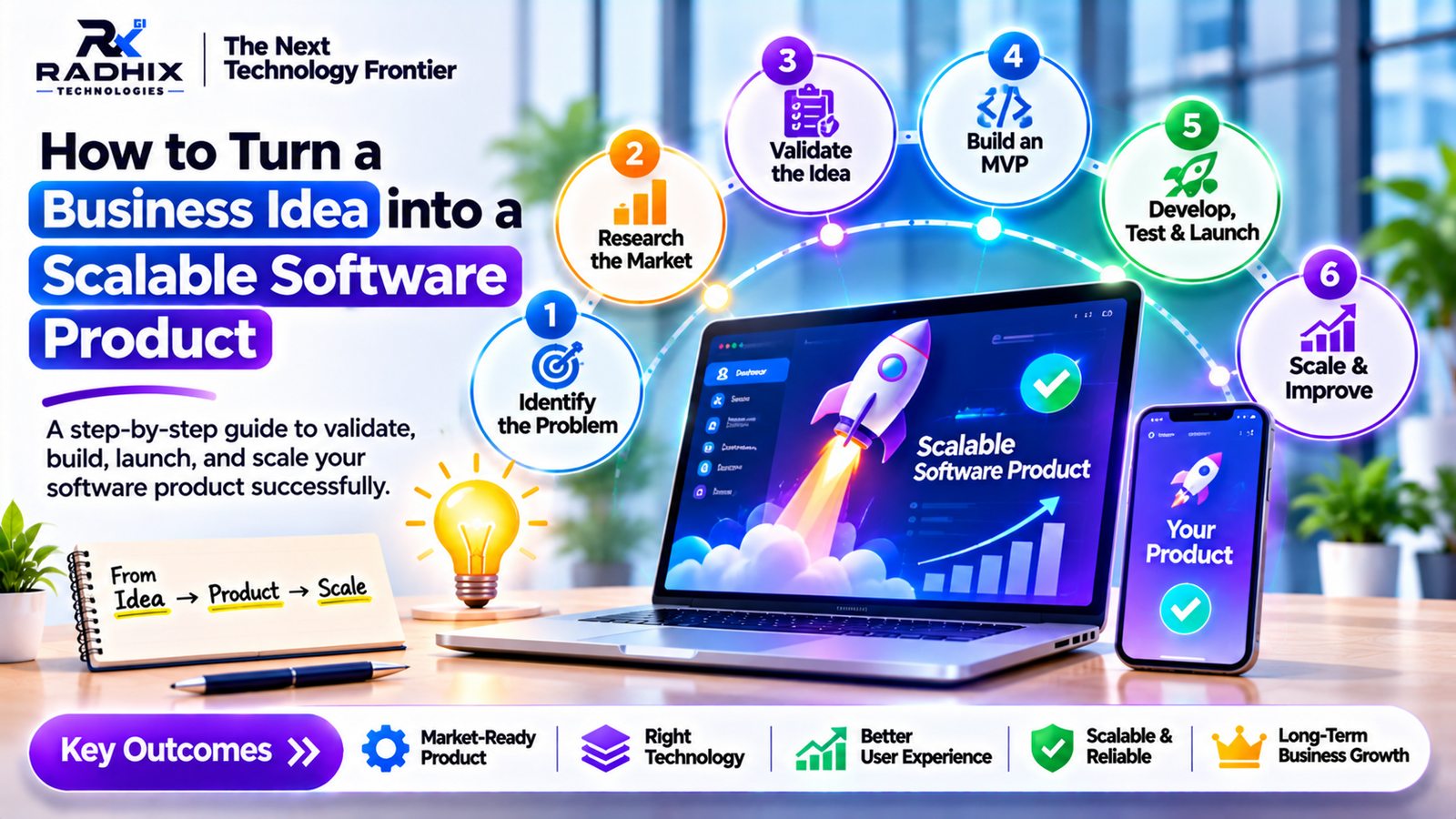
Turning a business idea into a scalable software product is a step-by-step process. It begins with understanding a real problem, validating the market and deciding what customers actually need. From there, businesses can plan an MVP, choose suitable technology, build a reliable architecture and improve the product through regular feedback.
The goal should not be to build the biggest application in the shortest possible time. It should be to build something useful, reliable and flexible enough to grow with the business.
A strong idea gives you a starting point. Careful planning, the right development approach and continuous improvement turn that idea into a product with long-term potential.
Frequently Asked Questions (FAQs)
1. How do I convert a business idea into a software product?
Start by identifying the problem, researching your target audience, validating demand and defining the essential features. Then plan the UI/UX, select suitable technology, develop the first version and improve it using customer feedback.
2. What is an MVP in software development?
A Minimum Viable Product (MVP) is the first working version of software that contains the essential features needed to solve the main customer problem. It helps businesses test their idea before investing in a larger product.
3. How much does it cost to develop a software product?
The cost depends on the product's complexity, features, platforms, integrations, technology and development timeline. A basic MVP generally requires less investment than a complete enterprise-level platform.
4. How long does it take to develop a software product?
A simple MVP may take a few weeks or months, while a complex platform can require several months or longer. The timeline depends on the scope, integrations, testing and development requirements.
5. What makes software scalable?
Good architecture, efficient database design, secure APIs, suitable cloud infrastructure and performance optimisation help software handle increasing users, data and transactions.
6. Can a software product be expanded after launch?
Yes. A well-planned product can be improved with new features, integrations, automation and additional platforms as customer needs and business requirements change.