SEO vs Google Ads: Which Marketing Strategy Should Your Business Use?
When businesses want to attract more customers online, two popular marketing strategies often come into consideration: Search Engine Optimisation (SEO) and Google Ads.
Both help businesses reach people who are searching for products, services, or information. However, they work differently, require different types of investment, and serve different business objectives.
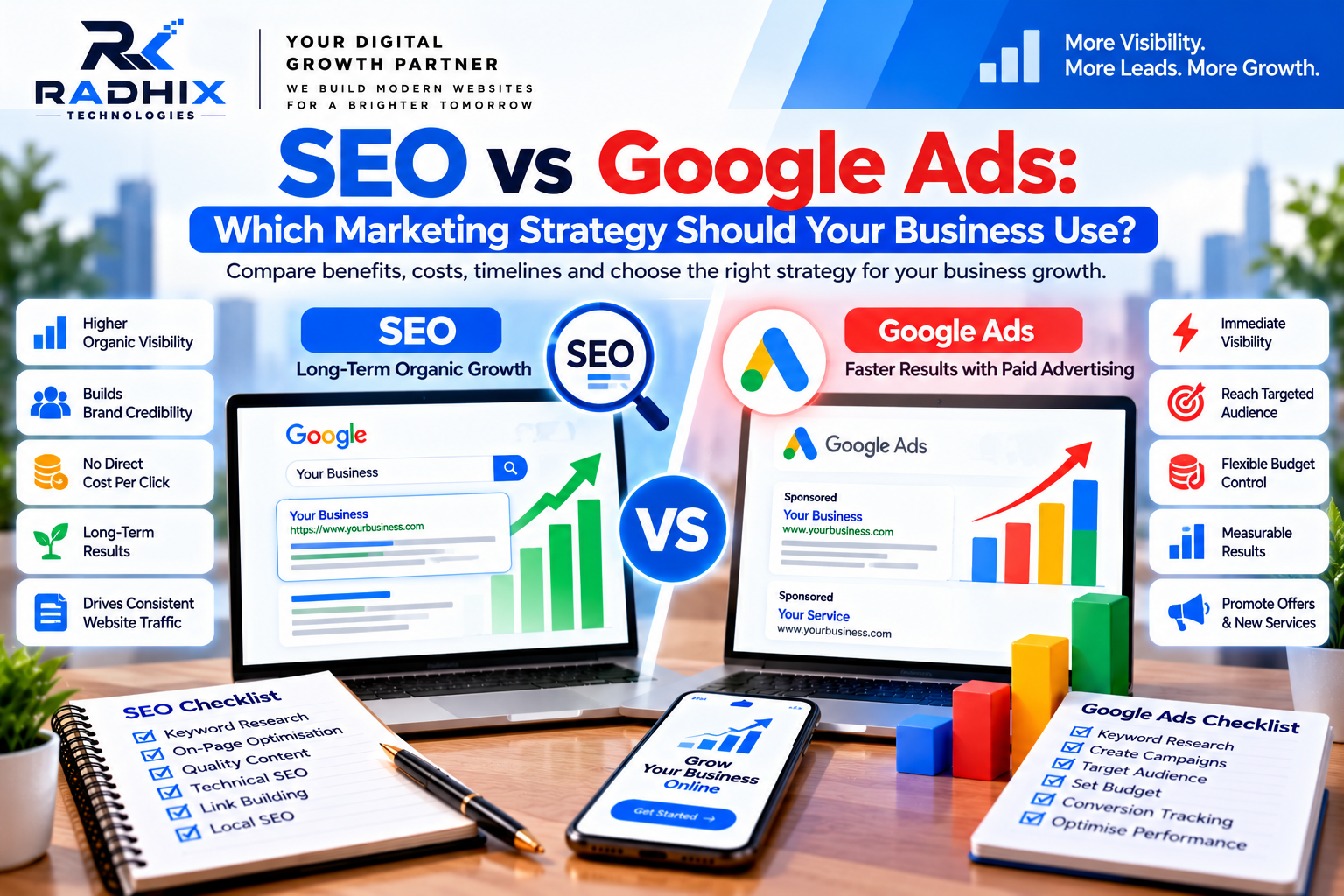
SEO focuses on improving your website's visibility in unpaid search results, while Google Ads allows you to pay for advertising placements that can bring targeted visitors to your website.
So, which strategy should your business choose?
The answer depends on your goals, budget, competition, timeline, and the way your customers make purchasing decisions.
In this guide, Radhix Technologies explains the differences between SEO and Google Ads, their benefits and limitations, their costs, and how to choose the right strategy for your business.
1. What Is SEO?
Search Engine Optimisation (SEO) is the process of improving your website so that search engines can understand its content and users can discover it through relevant unpaid search results.
For example, if someone searches for "website development company in Faridabad," a well-optimised website may appear among the organic search results when its content and relevance match the query.
SEO generally involves several activities.
Key SEO Services
- Keyword research: Understanding what your potential customers search for.
- On-page SEO: Improving page titles, headings, content, and internal links.
- Technical SEO: Addressing crawlability, indexing, performance, and other technical issues.
- Content marketing: Publishing useful blogs, guides, FAQs, and service pages.
- Local SEO: Improving visibility for relevant local searches.
- Website optimisation: Improving usability, navigation, and mobile experience.
- Performance monitoring: Reviewing search impressions, clicks, and organic traffic.
Benefits of SEO
Long-term visibility: Useful, well-optimised pages can continue attracting organic visitors over time.
No direct charge per organic click: You do not pay Google for each click on an unpaid search result, although SEO requires time, expertise, content, and maintenance.
Brand credibility: Appearing in relevant organic search results can help potential customers discover your business and evaluate your expertise.
Content value: Helpful pages and articles can answer customer questions at different stages of the buying journey.
Multiple traffic opportunities: A well-structured website can target different services, products, locations, and informational topics.
Limitations of SEO
SEO is not an instant solution. Improving organic visibility can take months, particularly for new websites or competitive search terms. Results also depend on your website, content quality, competition, and implementation.
There is no guaranteed ranking position or fixed timeline for success.
SEO is generally more suitable for businesses that want to build a sustainable online presence and can invest in ongoing improvement.
2. What Is Google Ads?
Google Ads is Google's paid advertising platform. It allows businesses to advertise through eligible placements, including Google Search, and other supported advertising formats.
For example, a business offering website development can run a Search campaign targeting relevant queries from potential customers in Faridabad or other selected locations.
Depending on the campaign type, advertisers can select targeting options, define budgets, create advertisements, and direct visitors to relevant landing pages.
Key Google Ads Activities
- Keyword and audience research
- Campaign planning and setup
- Advertisement writing
- Location and language targeting
- Budget and bidding configuration
- Landing page selection
- Conversion tracking
- Search-term analysis
- Campaign optimisation
- Performance reporting
Benefits of Google Ads
Faster visibility: Eligible ads can begin appearing after a campaign is approved and becomes eligible to serve, subject to targeting, bidding, budget, and other factors.
Budget control: Advertisers can set campaign budgets and manage spending.
Targeted reach: Campaigns can target relevant searches and selected locations or audiences, depending on the campaign type.
Campaign flexibility: Advertisements, targeting, and budgets can be adjusted as results are reviewed.
Useful performance data: Advertisers can measure clicks, costs, conversions, and other campaign metrics when tracking is configured correctly.
Promotion of specific offers: Google Ads can be useful for promoting a particular service, product, launch, or seasonal offer.
Limitations of Google Ads
Google Ads requires an advertising budget, and costs vary depending on competition, targeting, campaign quality, and other factors.
Traffic can decline when campaigns are paused or the budget is exhausted. Paid clicks also do not guarantee qualified leads, purchases, or profitable returns.
Successful campaigns need relevant advertisements, suitable landing pages, conversion tracking, and ongoing management.
3. SEO vs Google Ads: Key Differences
FactorSEOGoogle AdsMain approachOrganic search visibilityPaid advertisingSpeed of visibilityUsually builds graduallyCan begin soon after approval and launchCost modelInvestment in expertise, content, and maintenanceAdvertising spend plus any management feesPayment per clickNo direct payment to Google for organic clicksCommonly pay-per-click for Search campaignsTraffic continuityCan continue without paying for each click, but requires maintenanceDepends on campaign eligibility, budget, and deliveryTargetingPrimarily based on content relevance and search engine systemsOffers campaign targeting and bidding controlsTesting offersCan take time to evaluate organic performanceCan provide quicker campaign feedbackContent requirementsImportant for relevance and organic visibilityLanding pages and relevant ad content remain importantLong-term strategyBuilds organic visibility over timeSupports paid reach while campaigns runBest suited forSustainable organic growthTargeted, time-sensitive, or paid acquisition goals
Both approaches can bring visitors who are actively searching for relevant solutions. The main difference is how your website gains visibility and how that visibility is funded.
Google's own guidance explains that paid search advertising does not improve a website's organic ranking. SEO and Google Ads operate as separate channels.
4. SEO vs Google Ads: Which Is Better for Lead Generation?
Both strategies can generate leads, but their effectiveness depends on your audience, offer, website, and sales process.
How SEO Generates Leads
SEO can attract people searching for relevant services, solutions, and information.
For example, a business searching for a website development partner may discover your service page through an organic search result. If the page clearly explains your services and includes an effective enquiry form, the visitor may contact your company.
SEO can support lead generation through:
- Service-specific landing pages
- Local search visibility
- Helpful blog content
- Case studies and project examples
- Clear contact options
- Relevant internal links
How Google Ads Generates Leads
Google Ads can help your business reach relevant searchers through paid placements.
For example, you can create a campaign for a specific service and direct visitors to a dedicated landing page that explains the offer and encourages them to request a quotation.
Paid campaigns can support lead generation through:
- Targeted search advertisements
- Service-specific landing pages
- Location targeting
- Call and enquiry options
- Conversion tracking
- Campaign optimisation
Which Should You Choose?
Choose SEO when you want to develop organic visibility and attract relevant visitors over time.
Consider Google Ads when you need faster access to targeted search traffic, want to test an offer, or have a time-sensitive campaign.
If generating qualified leads is your primary goal, evaluate both channels based on cost per qualified lead, lead quality, conversion rate, and actual sales—not just traffic volume.
5. SEO vs Google Ads: Which Is More Affordable?
There is no universal answer because the cost structure is different.
With SEO, businesses generally pay for activities such as technical improvements, content development, keyword research, optimisation, and ongoing monitoring.
With Google Ads, businesses pay for advertising according to their campaign and billing arrangements. If an agency manages the campaigns, its service fee may be additional.
Illustrative Monthly Budget Comparison
The following ranges are examples for planning purposes, not fixed market rates or a quotation from Radhix Technologies.
Marketing investmentIllustrative budget
- Basic SEO services₹5,000–₹12,000/month
- Standard SEO services₹12,000–₹25,000/month
- Google Ads management₹5,000–₹15,000+/month
- Google Ads media spendSet separately according to goalsCombined SEO and Ads services₹15,000–₹40,000+/month,
plus any separate ad spend
Actual costs depend on competition, scope, industry, content requirements, locations, and service provider.
Example: Understanding Google Ads Costs
Suppose your business allocates ₹20,000 per month for advertising and pays an additional ₹8,000 for campaign management.
- Advertising spend: ₹20,000
- Campaign management fee: ₹8,000
- Total before applicable taxes: ₹28,000
This is an illustrative example. Actual clicks, costs, and conversions will depend on campaign performance.
Which Provides Better Value?
SEO may provide strong long-term value when organic visibility develops and useful pages continue attracting visitors.
Google Ads may be valuable when targeted traffic and campaign feedback are needed quickly.
Neither is automatically cheaper. Compare the total investment with the number and quality of leads generated, sales completed, and revenue attributable to the channel.
6. How Long Does SEO Take Compared with Google Ads?
The timeline is one of the most important differences between these strategies.
SEO Timeline
SEO requires time for technical improvements, content development, crawling, indexing, and changes in search visibility.
Some changes may be reflected relatively quickly, while meaningful results for competitive queries can take months or longer. New websites may need additional time to establish visibility.
SEO should be treated as an ongoing process rather than a one-time activity.
Google Ads Timeline
Google Ads can start generating impressions and clicks soon after campaigns are approved and eligible to serve.
However, a campaign may need time to gather data, test advertisements, improve targeting, and understand conversion performance.
A campaign can receive clicks quickly without generating profitable sales. Therefore, fast traffic should not be confused with guaranteed business results.
Practical recommendation: If your business needs enquiries in the short term, consider Google Ads while developing your SEO strategy for longer-term growth.
7. Which Strategy Is Best for Different Types of Businesses?
Small Local Businesses
Examples include salons, repair services, consultants, clinics, and local service providers.
Recommended approach: Begin with a professional website, accurate local business information, and local SEO. Add Google Ads when you want to reach customers searching for particular services and can measure the results.
Startups and New Businesses
New businesses often need visibility while building awareness and credibility.
Recommended approach: Use carefully budgeted Google Ads to test demand and offers while building your website, useful content, and organic search presence.
E-commerce Businesses
Online stores need to attract shoppers while making product discovery and purchasing easy.
Recommended approach: Improve product pages, technical SEO, site usability, and relevant content. Consider paid campaigns when product margins, conversion tracking, and fulfilment capabilities support the investment.
B2B and Manufacturing Companies
B2B sales often involve research, comparisons, and longer decision-making processes.
Recommended approach: Build detailed service or product pages, publish useful industry content, and invest in SEO. Use Google Ads for high-intent searches where potential customers are looking for relevant suppliers or services.
Businesses Launching a New Service
If you are introducing a new service, you may want to understand whether customers are interested before investing heavily.
Recommended approach: Use targeted advertising to test messages and landing pages while researching search demand and preparing useful organic content.
The best combination depends on your business model, target customers, budget, and sales cycle.
8. Can You Use SEO and Google Ads Together?
Yes. In many cases, using both strategies creates a more balanced digital marketing approach.
SEO can support long-term organic visibility, while Google Ads can help you reach relevant audiences through paid campaigns.
How to Combine SEO and Google Ads
Step 1: Identify valuable search terms.
Research the queries your customers use and determine which are relevant to your products or services.
Step 2: Create strong landing pages.
Develop pages that explain your offering clearly, answer customer questions, and provide a straightforward way to enquire or purchase.
Step 3: Launch carefully targeted campaigns.
Use Google Ads to test relevant search terms, offers, and landing pages within a defined budget.
Step 4: Build organic visibility.
Optimise your website and publish useful content to address relevant search intent over time.
Step 5: Review both channels together.
Compare organic traffic, paid clicks, qualified leads, conversion rates, and sales.
Step 6: Improve your strategy.
Use performance data to identify opportunities for better content, more relevant advertisements, and improved landing pages.
For example, if a paid campaign reveals that a particular service generates qualified enquiries, you can consider creating more comprehensive organic content around that service.
This does not mean Google Ads improves organic rankings directly. Instead, both channels can provide complementary ways to reach customers and understand demand.
9. How to Measure SEO and Google Ads Performance
The right metrics depend on your business objectives.
SEO Metrics
- Organic search clicks
- Search impressions
- Relevant organic traffic
- Performance of important landing pages
- Qualified organic leads
- Organic conversion rate
- Technical SEO issues
- Sales attributed to organic search, where measurable
Google Ads Metrics
- Advertising spend
- Impressions and clicks
- Cost per click
- Click-through rate
- Conversions
- Cost per conversion
- Qualified leads
- Sales and return on ad spend, where reliably tracked
Measure Business Outcomes
Suppose one channel generates 100 enquiries and another generates 40. The first channel is not necessarily better.
If most of the 100 enquiries are irrelevant, while the 40 enquiries lead to more sales, the second channel may provide greater value.
Track lead quality, completed sales, revenue, and customer acquisition cost wherever possible. Ensure that conversion tracking is configured correctly and that duplicate or low-quality enquiries are handled appropriately.
10. Common Mistakes Businesses Should Avoid
Expecting Instant SEO Rankings
SEO requires ongoing work, and no provider can guarantee a specific Google ranking within a fixed period.
Running Ads Without Conversion Tracking
Clicks do not necessarily translate into enquiries or sales. Measure meaningful actions and lead quality.
Choosing Keywords Without Understanding Intent
A keyword may attract traffic without attracting potential customers. Select terms that match your services and the needs of your target audience.
Sending Every Advertisement to the Homepage
A dedicated landing page can provide a more relevant experience when it matches the advertisement and visitor intent.
Ignoring Website Performance
A confusing, slow, or poorly designed website can reduce the value of both organic and paid traffic.
Stopping SEO After a Few Weeks
Organic visibility often takes time to develop. Evaluate progress using realistic timelines and meaningful data.
Failing to Review Advertising Spend
Monitor campaign costs, search terms, and conversion quality. Adjust campaigns based on evidence rather than continuing to spend without review.
Focusing Only on Rankings or Clicks
Business growth depends on relevant customers, qualified leads, sales, and profitability—not only visibility.
How Radhix Technologies Can Help
At Radhix Technologies, we understand that businesses need a digital marketing strategy aligned with their objectives, audience, and budget.
Our digital solutions include website development, custom software, e-commerce development, and support for building a stronger online presence.
A successful SEO or Google Ads strategy starts with understanding your website, services, target audience, competition, and lead generation requirements.
Whether you want to improve your website's organic visibility, create dedicated landing pages, or plan a digital presence that supports paid campaigns, it is important to choose an approach that matches your business goals.
Planning to improve your online visibility and lead generation? Contact Radhix Technologies to discuss your website and digital marketing requirements.
Conclusion
SEO and Google Ads are both valuable digital marketing strategies, but they serve different purposes.
SEO helps build organic search visibility over time through useful content, website optimisation, and ongoing improvements. Google Ads allows businesses to pay for targeted advertising and can provide faster access to search traffic when campaigns are eligible to run.
If your priority is long-term organic growth, SEO deserves attention. If you need to test an offer or attract targeted traffic quickly, Google Ads may be suitable. If your budget and objectives support both, a combined strategy can provide a more balanced approach.
Before making a decision, consider your business goals, budget, competition, website quality, and the time available to achieve results.
The right marketing strategy is the one that generates relevant opportunities and supports measurable business growth.
Frequently Asked Questions
1. Which is better, SEO or Google Ads?
Neither is universally better. SEO is suitable for building organic visibility over time, while Google Ads can provide paid visibility more quickly. The right choice depends on your goals, budget, and timeline.
2. Is SEO cheaper than Google Ads?
SEO does not involve a direct payment to Google for organic clicks, but it still requires investment in content, expertise, technical work, and maintenance. Google Ads involves advertising spend and potentially separate management fees. Compare total costs with business outcomes.
3. Can Google Ads improve my organic Google rankings?
No. Paying for Google Ads does not directly improve organic search rankings. Paid advertising and organic search rankings operate separately.
4. How quickly can Google Ads generate leads?
Ads can begin receiving traffic after approval and launch, provided the campaigns are eligible to serve. Lead generation depends on targeting, budget, competition, the offer, landing page quality, and conversion tracking.
5. How long does SEO take to show results?
Timelines vary according to website condition, competition, content quality, and implementation. SEO improvements can take weeks or months to become apparent, and significant gains may take longer.
6. Should a small business invest in SEO or Google Ads first?
If you need to test demand or attract enquiries quickly, a controlled Google Ads campaign may be useful. If you want to develop long-term organic visibility, start building your SEO foundation. Many small businesses benefit from prioritising one channel and expanding as resources allow.
7. Can I run SEO and Google Ads at the same time?
Yes. They can complement each other by supporting organic visibility and paid reach. Track performance separately and together to understand how each channel contributes to enquiries and sales.
8. What should I check before hiring an SEO or Google Ads agency?
Ask about the proposed strategy, deliverables, reporting, account ownership, advertising budget, management fees, conversion tracking, and realistic expectations. Avoid providers promising guaranteed rankings or guaranteed sales without a credible basis.