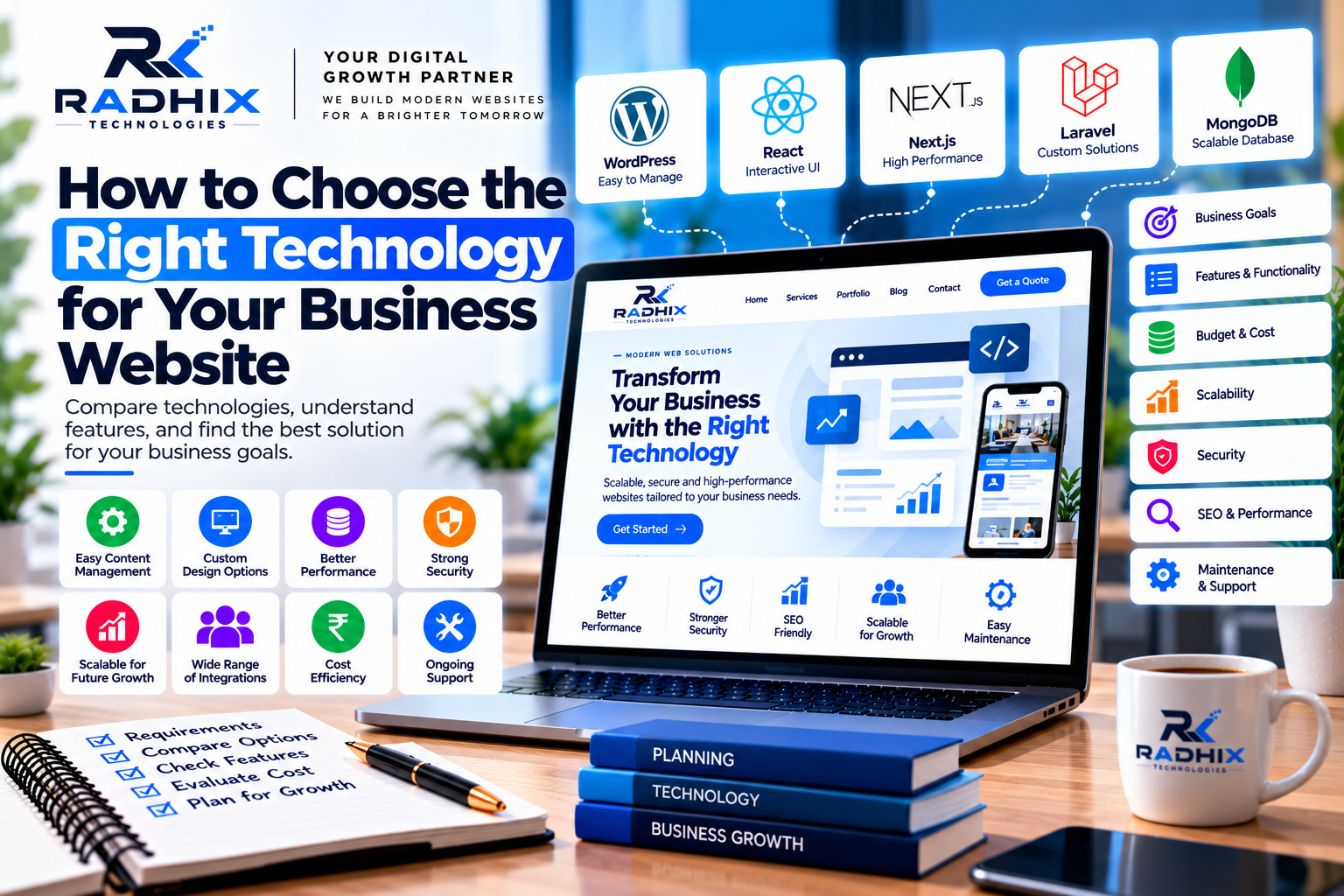
How to Choose the Right Technology for Your Business Website
Building a business website is an important step toward establishing a strong online presence. However, before starting development, one important decision must be made: which technology should you use to build your website?
There are many options available, including WordPress, React, Next.js, PHP, and custom website development. Each technology offers different benefits depending on your business requirements, budget, functionality, and future growth plans.
Choosing the wrong technology can lead to unnecessary expenses, maintenance difficulties, slow performance, or limitations when adding new features. On the other hand, selecting the right technology can help your business attract customers, generate leads, improve user experience, and grow digitally.
In this guide, we will explain how to choose the right technology for your business website.
1. Understand Your Business Requirements
Before selecting a technology, identify the main purpose of your website. Different businesses require different features, so the technology should match your actual needs.
For example:
- Small businesses: Need a professional website with service pages, contact information, and enquiry forms.
- Service-based companies: Need service descriptions, lead generation forms, appointment booking, and customer enquiries.
- E-commerce businesses: Need product listings, shopping carts, payments, inventory management, and order tracking.
- Corporate companies: May require custom dashboards, CRM integrations, multilingual content, and advanced security.
- Startups: May need scalable technology that supports future features and business expansion.
Create a list of essential features before choosing the development platform. This helps you avoid paying for unnecessary functionality.
2. Choose Between WordPress and Custom Development
One of the most common decisions is whether to use a ready-made content management system or build a custom website.
WordPress
WordPress is a content management system that allows businesses to manage pages, blogs, images, and other website content through an administrative dashboard.
Best suited for:
- Small and medium-sized business websites
- Company profiles and portfolio websites
- Blogs and content-driven websites
- Basic business websites with enquiry forms
- Websites that require frequent content updates
Advantages:
- Easy content management
- A large selection of themes and plugins
- Faster development for many standard websites
- Suitable for businesses with limited development budgets
However, website performance and security depend on the quality of the theme, plugins, hosting, configuration, and ongoing maintenance.
Custom Website Development
Custom development is suitable when your business requires a unique design, specialised workflows, advanced integrations, or features that ready-made solutions cannot easily support.
Best suited for:
- Customer portals and business dashboards
- Complex booking platforms
- Custom CRM integrations
- Marketplaces and multi-vendor platforms
- Businesses with specialised operational requirements
Custom development offers greater control over functionality, but the initial development cost and ongoing technical support requirements may be higher.
3. Understand React and Next.js
React and Next.js are popular options for building modern, interactive websites and web applications. Although related, they serve different roles.
React
React is a JavaScript library used to build interactive user interfaces.
It is useful for:
- Interactive dashboards
- Customer portals
- Dynamic user interfaces
- Web applications with complex interactions
React alone does not provide the same complete website framework and content-management system as some other options. Additional tools may be needed for routing, SEO, and content management.
Next.js
Next.js is a framework built on React that supports features such as server rendering, static page generation, routing, and website metadata management.
It can be a good choice for:
- Modern corporate websites
- SEO-focused business websites
- High-performance landing pages
- Custom web applications
- Websites that integrate with APIs and business systems
The final performance and SEO results still depend on how the website is designed, developed, hosted, and maintained.
4. Compare the Technologies Before Making a Decision
TechnologyBest use caseMain advantageWordPressBusiness websites and blogsEasy content managementReactInteractive web applicationsFlexible user interfacesNext.jsModern websites and custom applicationsFlexible rendering and SEO controlsPHP with a frameworkCustom business systemsBackend flexibilityHTML, CSS and JavaScriptSimple informational websitesLightweight implementation
There is no single technology that is best for every business. The right choice depends on your functionality, content workflow, development budget, and technical support requirements.
5. Consider Your Website Development Budget
Budget is an important factor when choosing website technology. However, businesses should consider the total cost of ownership rather than only the initial development price.
Your budget may need to cover:
- UI/UX design
- Frontend and backend development
- Domain and hosting
- Database setup
- Third-party integrations
- Security configuration
- Testing and deployment
- Maintenance and future improvements
A simple business website may be developed efficiently using WordPress or a lightweight custom solution. A website with customer accounts, payment processing, advanced workflows, or external API integrations may require a more extensive custom development approach.
Request a detailed quotation that clearly separates development, hosting, third-party subscriptions, maintenance, and future enhancements.
6. Make Website Speed and Performance a Priority
Website visitors expect pages to load quickly and interactions to work smoothly. Slow performance can frustrate users and make it harder for them to complete important actions.
When choosing a technology, consider whether it supports:
- Optimised images and media
- Efficient page rendering
- Browser caching
- Content delivery networks where appropriate
- Clean and efficient code
- Mobile performance optimisation
- Performance monitoring
Remember that a technology name alone does not guarantee a fast website. Hosting quality, page design, image sizes, scripts, and implementation decisions also affect performance.
7. Select Technology That Supports SEO
Search engine optimisation helps potential customers discover your website through relevant searches.
Your website technology should support:
- Custom page titles and meta descriptions
- Search-engine-friendly URLs
- XML sitemap generation
- Robots directives
- Canonical URLs
- Structured data where appropriate
- Mobile-friendly layouts
- Fast-loading pages
- Crawlable and meaningful page content
WordPress can support these requirements through suitable configuration and plugins. Next.js and other custom solutions can provide detailed control through development.
Important: No technology automatically guarantees higher Google rankings. Search performance also depends on content quality, technical implementation, user experience, competition, and ongoing SEO work.
8. Check Security and Maintenance Requirements
A business website may collect enquiry details, customer information, account credentials, or payment-related data. Security should therefore be considered from the beginning.
Look for a development approach that includes:
- HTTPS configuration
- Secure authentication and authorisation
- Input validation and protection against common attacks
- Regular software updates
- Secure database access
- Appropriate backups and recovery procedures
- Access control for administrators
- Monitoring and maintenance planning
WordPress websites require attention to core, theme, and plugin updates. Custom websites also need dependency updates, secure coding practices, server maintenance, and testing.
Choose a technology your team or development partner can maintain reliably over time.
9. Think About Future Business Growth
Your website should be able to support your business as its needs change.
You may later want to add online payments, customer accounts, booking functionality, multilingual pages, CRM integration, analytics, or a customer dashboard.
Before development, discuss these possibilities with your development team.
A scalable solution should have a clear structure, maintainable code, suitable database design, and well-defined integration points. It should also allow new features to be introduced without unnecessarily rebuilding the entire website.
However, avoid overengineering a simple website for growth that may never happen. Start with the features your business needs today and plan sensibly for likely future requirements.
10. Choose the Right Technology for Your Business Type
Here are some practical starting points:
For small businesses: WordPress is often a practical choice when you need a professional website, blog, and enquiry forms that your team can manage.
For service-based companies: WordPress or a custom website can work well, depending on whether you need standard enquiry forms or more advanced booking and workflow features.
For e-commerce businesses: Consider a suitable e-commerce platform or a custom solution if you need specialised pricing, inventory, integrations, or order workflows.
For technology startups: React and Next.js can be useful when you need custom interfaces, integrations, or an application-style user experience.
For large or complex business systems: A custom architecture may be appropriate when multiple user roles, business processes, APIs, and operational dashboards are required.
These are starting points, not fixed rules. Your requirements should determine the final technology selection.
11. Questions to Ask Your Website Development Company
Before finalising a development partner, ask these questions:
- Which technology do you recommend for my business, and why?
- Can I update website content without contacting a developer?
- Will the website be mobile-friendly and performance-optimised?
- How will SEO settings, redirects, and sitemaps be managed?
- What security measures and backup procedures are included?
- What are the hosting and annual maintenance costs?
- Can new features and integrations be added in the future?
- Will I receive source code, documentation, and administrative access?
- Who will own the website, domain, and associated accounts?
- What support is available after launch?
Clear answers to these questions help you compare proposals based on long-term business value rather than price alone.
How Radhix Technologies Can Help
At Radhix Technologies, we understand that every business has different digital requirements. The right website solution should support your business goals, deliver a smooth user experience, and provide a practical foundation for future growth.
Our services include website development, custom software solutions, e-commerce development, web application development, and digital marketing.
We help businesses evaluate their requirements, select suitable technologies, plan website functionality, and develop digital solutions aligned with their operational needs.
Whether you need a professional company website, an e-commerce platform, or a custom web application, choosing the right development approach is the first step toward building a useful digital presence.
Conclusion
Choosing the right technology for your business website requires more than following the latest trend. You need to evaluate your business goals, required features, budget, content management needs, SEO requirements, security, and future growth plans.
WordPress can be an excellent choice for content-driven business websites, while React and Next.js are useful for interactive interfaces and custom digital experiences. Other technologies may be more appropriate for specialised systems.
The best technology is the one that solves your business problems, fits your budget, and can be maintained effectively as your business grows.
Planning a new business website? Contact Radhix Technologies to discuss your requirements and find a suitable website development solution.
Frequently Asked Questions
1. Which technology is best for a business website?
There is no universal answer. WordPress is suitable for many content-driven websites, while Next.js and other custom technologies may be better for specialised functionality, integrations, or interactive experiences.
2. Is WordPress good for small businesses?
Yes. WordPress can be a practical option for small businesses that need company pages, blogs, enquiry forms, and straightforward content management.
3. Is Next.js better than WordPress?
Not in every situation. Next.js offers development flexibility and control over rendering, while WordPress provides a built-in content management experience. The best option depends on your website's needs and who will maintain it.
4. How much does it cost to develop a business website?
The cost depends on the number of pages, design complexity, functionality, integrations, hosting, and ongoing support. A simple informational website generally requires less investment than a custom web application or advanced e-commerce platform.
5. Can I change my website technology in the future?
Yes, but migration may require redesigning pages, transferring content, rebuilding functionality, and setting up redirects. Planning for maintainability from the beginning can make future changes easier.
6. Does website technology affect Google rankings?
Technology can influence performance, crawlability, and technical SEO, but rankings also depend on useful content, search intent, website quality, competition, and other factors.
7. Should I choose a ready-made platform or custom development?
Choose a ready-made platform when it meets your requirements efficiently. Consider custom development when your business needs specialised workflows, integrations, or functionality that existing platforms cannot reasonably provide.