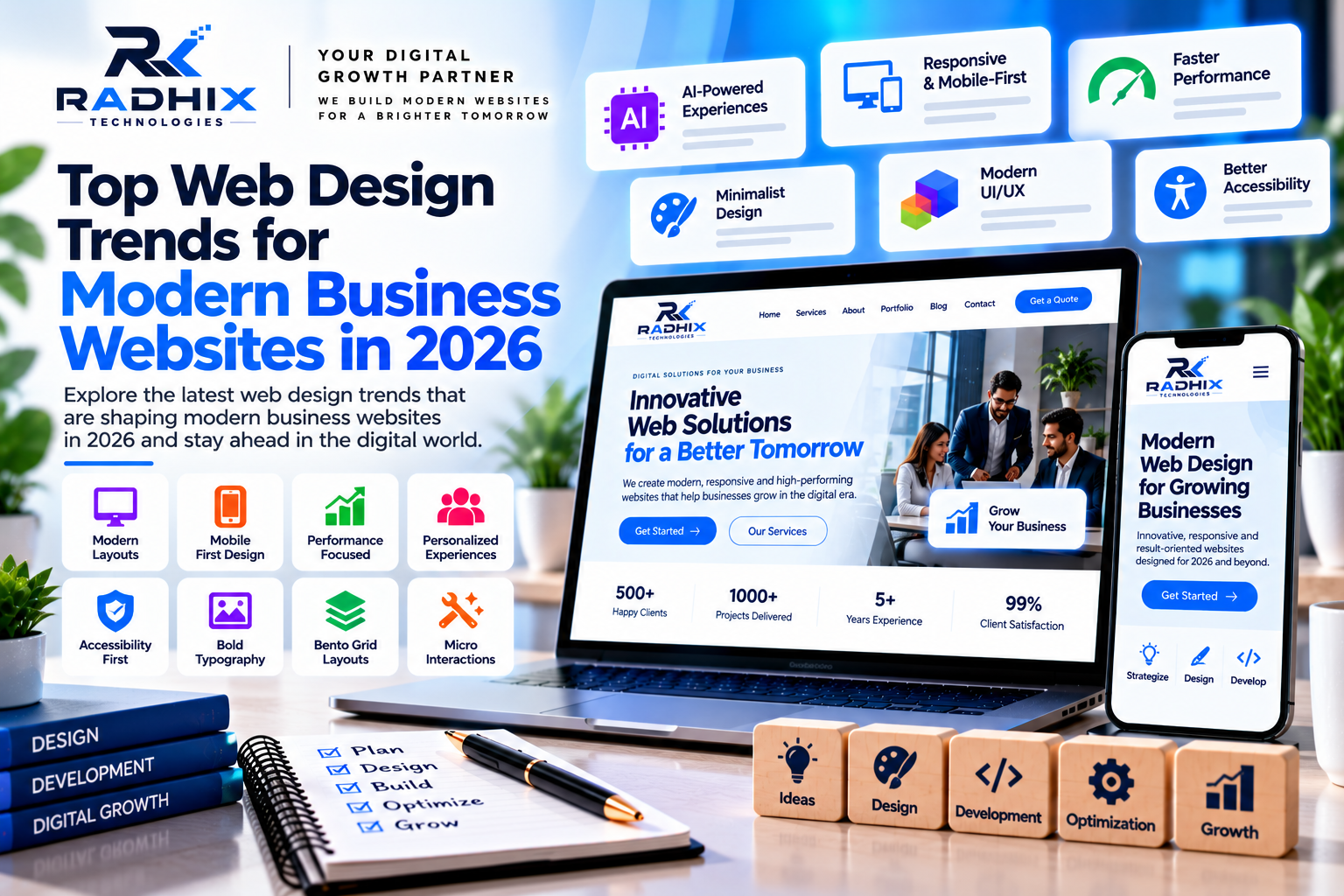
Top Web Design Trends for Modern Business Websites in 2026
The way businesses present themselves online continues to evolve. In 2026, a successful business website needs more than an attractive appearance. It should deliver a smooth user experience, load quickly, work across devices, communicate brand value, and help convert visitors into customers.
Modern web design increasingly combines clean layouts, thoughtful animations, AI-powered features, accessibility, and performance-focused development. For businesses in India, these improvements can help create a more professional digital presence and make it easier for customers to discover and understand their services.
Whether you run a startup, a service-based business, an e-commerce company, or an established enterprise, understanding current website design trends can help you make better decisions when building or redesigning your website.
In this guide, Radhix Technologies explores the top web design trends for modern business websites in 2026 and explains how to use them effectively.
Why Modern Web Design Matters for Businesses
Your website is often one of the first places potential customers interact with your brand. A confusing layout, outdated design, or slow-loading page can make it harder for visitors to find information and take action.
A modern business website should help visitors understand what your company offers, why it is relevant to them, and how they can get in touch.
Effective web design can help businesses:
- Build a consistent and professional brand identity.
- Make services and products easier to understand.
- Improve navigation across mobile and desktop devices.
- Support search engine visibility.
- Generate enquiries and sales.
- Create a foundation for future business growth.
The objective is not to follow every new trend. It is to select design improvements that provide genuine value to your customers.
1. Minimalist and Clean Website Layouts
Minimalist web design continues to be useful for business websites because it places greater emphasis on clarity and content.
Instead of filling every section with animations, images, and decorative elements, a clean layout uses purposeful spacing, readable typography, and clear visual hierarchy.
A professional homepage might feature a strong headline, a concise description, a primary call-to-action button, and a carefully selected visual.
This approach works well for corporate websites, consulting firms, software companies, and professional service providers.
How to use this trend:
- Remove unnecessary decorative elements.
- Use consistent spacing and typography.
- Highlight important services and benefits.
- Keep navigation simple.
- Make contact and enquiry options easy to find.
Minimalism does not mean making every website look identical. Your layout should still reflect your company's industry, personality, and audience.
2. AI-Powered Website Experiences
Artificial intelligence is creating new opportunities to improve website interactions and customer support.
Depending on the business and implementation, AI-powered features can help visitors find relevant information, receive answers to common questions, discover products, or navigate complex service offerings.
For example, a software company might use a website assistant to answer questions about its services, while an online store could offer personalized product recommendations.
AI can also assist website teams with content organization, customer support workflows, and analysis of user behaviour.
However, AI features should solve a real problem rather than exist purely because they are fashionable.
Best practices:
- Use AI assistants for clearly defined customer needs.
- Provide a way to contact a human when necessary.
- Avoid presenting unverified AI-generated information as fact.
- Protect customer information and respect privacy.
- Monitor response quality and usefulness.
AI can enhance a website, but it should not replace clear navigation, accurate content, or reliable customer support.
3. Mobile-First and Responsive Design
Mobile-responsive design remains essential for modern business websites. Customers may research a company, compare services, or submit enquiries using smartphones before returning to a desktop computer.
A responsive website adapts its layout to different screen sizes while keeping important content and functionality accessible.
Mobile-first design takes this a step further by considering small screens early in the design process rather than treating mobile as an afterthought.
Important features include:
- Readable text without unnecessary zooming.
- Touch-friendly buttons and menus.
- Forms that are easy to complete on mobile.
- Optimized images and media.
- Clear contact options.
- Consistent functionality across devices.
Businesses serving customers throughout India should test their websites under different network conditions and on a range of devices.
4. Bold Typography and Strong Visual Hierarchy
Typography plays an important role in communicating a company's identity.
In 2026, business websites can use expressive headlines, contrasting font weights, and carefully arranged text to guide attention and make important information easier to understand.
A clear headline tells visitors what the company does or what value it offers. Supporting text explains the details, while buttons guide users toward the next step.
How to apply it:
- Choose readable fonts that match your brand.
- Use headings to organize information.
- Maintain sufficient contrast between text and background.
- Keep body text comfortable to read.
- Use decorative fonts selectively.
- Test typography on mobile screens.
Strong typography should improve communication rather than make a page difficult to read.
5. Bento Grid and Modular Layouts
Bento grid layouts organize information into separate rectangular cards of different sizes. They are useful for presenting multiple services, features, statistics, and project highlights within a structured visual layout.
For example, a corporate website could use a modular grid to showcase its services, client industries, case studies, and key capabilities.
This layout helps visitors scan information without navigating through long blocks of text.
Where it works well:
- Corporate service sections.
- SaaS product feature pages.
- Portfolio websites.
- Business dashboards.
- Technology company homepages.
Avoid placing too many cards on one screen. A well-organized grid should make information easier to scan, not create visual clutter.
6. Subtle Animations and Micro-Interactions
Micro-interactions are small visual responses that occur when visitors interact with a website.
Examples include a button changing appearance when clicked, a form displaying a success message, or a menu opening with a smooth transition.
These details can make an interface feel responsive and help users understand what is happening.
For example, after a visitor submits an enquiry form, a clear confirmation message can reassure them that their request has been received.
Best practices:
- Use animations to communicate feedback.
- Keep transitions short and purposeful.
- Avoid excessive scrolling effects.
- Respect reduced-motion preferences.
- Ensure animations do not delay important content.
Heavy animations and unnecessary effects can affect performance. Subtle, purposeful interactions are usually more practical for business websites.
7. Website Speed and Performance-Focused Design
A visually impressive website is not effective if visitors have to wait too long for it to load.
Performance should be considered during the design stage because large images, complex animations, excessive scripts, and poorly optimized fonts can slow down pages.
Google's Core Web Vitals provide useful measures of loading performance, interaction responsiveness, and visual stability.
The commonly recommended good thresholds are:
- Largest Contentful Paint (LCP): 2.5 seconds or less.
- Interaction to Next Paint (INP): 200 milliseconds or less.
- Cumulative Layout Shift (CLS): 0.1 or less.
These thresholds are evaluated at the 75th percentile of visits when sufficient field data is available.
Ways to improve website performance:
- Compress and resize images.
- Use suitable modern image formats.
- Remove unnecessary scripts.
- Optimize fonts and stylesheets.
- Configure caching appropriately.
- Choose suitable hosting.
- Test performance on mobile devices.
Fast performance supports usability, but strong Core Web Vitals scores alone do not guarantee higher search rankings.
8. Accessibility-First Web Design
Accessible web design helps people with different abilities use a website more comfortably.
Accessibility should be considered from the beginning rather than added only after development.
Important practices include clear text contrast, keyboard-accessible navigation, descriptive form labels, visible focus indicators, meaningful image descriptions, and understandable error messages.
For example, a contact form should explain which field needs attention instead of displaying a vague error.
Accessibility can improve usability for many visitors, including people using mobile devices or navigating under difficult conditions.
Businesses should review applicable accessibility requirements and use recognized guidance, such as the Web Content Accessibility Guidelines (WCAG), when planning and testing their websites.
9. Personalization and Relevant Content
Personalization involves presenting relevant information based on a visitor's needs, preferences, or context.
Depending on the website, this could include service recommendations, relevant product categories, location-specific information, or tailored onboarding experiences.
For example, a business serving multiple industries could help visitors navigate to the service pages most relevant to their sector.
Personalization should be useful, transparent, and respectful of privacy.
Implementation ideas:
- Organize services by customer type.
- Provide helpful filters for large product catalogs.
- Show relevant recommendations where appropriate.
- Use clear location and service-area information.
- Avoid collecting unnecessary personal information.
Not every business needs advanced personalization technology. Clear service categories and useful navigation can deliver substantial value on their own.
10. Dark Mode and Flexible Color Themes
Dark mode uses darker backgrounds with lighter text and interface elements. It can create a distinctive visual style for technology companies, software platforms, creative brands, and selected business applications.
Some websites also offer a theme switcher that lets users select light or dark mode.
However, dark mode is not suitable for every brand or every situation. The priority should be readability, contrast, and consistency.
Design considerations:
- Use accessible text contrast.
- Check icons and images against both backgrounds.
- Ensure buttons remain easy to recognize.
- Test forms and navigation in each theme.
- Respect the visitor's display preference when practical.
A carefully designed light theme can be just as professional. Choose the option that suits your audience and brand identity.
11. Trust-Focused Design and Authentic Social Proof
Customers want to know whether a business is reliable before contacting it or making a purchase.
Modern business websites should make it easy to evaluate the company's experience and credibility.
Useful trust-building elements include genuine customer testimonials, project case studies, relevant certifications, clear contact information, and transparent service descriptions.
For business-to-business companies, detailed case studies can explain the challenge, the solution delivered, and the results achieved.
Avoid fabricated testimonials, misleading statistics, or logos that imply partnerships that do not exist.
Place relevant proof close to important calls to action so visitors can evaluate the information while deciding what to do next.
12. Conversion-Focused Calls to Action
A business website should guide visitors toward useful next steps.
Depending on your goals, these may include requesting a quotation, booking a consultation, calling your team, downloading a guide, or purchasing a product.
A call to action (CTA) should be clear, relevant, and easy to find.
For example, a software development company might use a “Request a Quote” button, while a consultant might encourage visitors to “Book a Consultation.”
CTA best practices:
- Use action-oriented labels.
- Make buttons easy to identify.
- Place them where visitors need them.
- Avoid overwhelming users with competing actions.
- Test different wording and placements.
- Ensure the destination works correctly on mobile.
Measure form submissions, bookings, or purchases to understand whether your design changes are improving business outcomes.
13. Regional Language and Localized Experiences
India has a diverse audience with different language preferences and browsing habits.
Depending on your target market, offering important information in Hindi or another relevant regional language may make your website more accessible to potential customers.
Localization can also include accurate service-area details, relevant contact options, appropriate currency formats, and information that reflects local customer needs.
If your website supports multiple languages, ensure translations are accurate and that visitors can switch languages easily.
Avoid automatic translations that create confusing service descriptions or incorrect business information.
14. Content Designed for Search Engines and AI Discovery
Customers increasingly use different tools to research companies, compare services, and find answers to questions.
A well-structured website makes its information easier for both people and search systems to understand.
Useful practices include descriptive headings, clear explanations, informative FAQs, accurate company details, meaningful internal links, and technically accessible pages.
For example, a web development company can publish a helpful guide explaining website development costs, technology choices, maintenance, and project timelines.
Focus on original, accurate, useful information rather than writing content solely to repeat keywords.
There is no special design that guarantees inclusion in AI-generated answers. Clear content and sound technical foundations are sensible starting points.
How to Choose the Right Web Design Trends for Your Business
Not every trend will benefit every company. The right design depends on your audience, industry, budget, and business objectives.
Use this simple framework:
For small businesses: Prioritize responsive design, clear service pages, fast loading, contact forms, and strong calls to action.
For corporate websites: Focus on brand consistency, clear navigation, accessible layouts, service pages, case studies, and lead generation.
For e-commerce websites: Prioritize product discovery, mobile usability, secure checkout, performance, and clear product information.
For SaaS and technology companies: Consider modular layouts, interactive product demonstrations, carefully selected AI features, and accessible dashboards.
For local service providers: Make contact details, service areas, customer reviews, appointment booking, and WhatsApp communication easy to find.
Start with essential improvements and add advanced features when they solve a clear customer problem.
Why Consider Radhix Technologies for Modern Website Design?
Radhix Technologies helps businesses explore website design and development solutions tailored to their goals, audience, and technical requirements.
Whether you need a corporate website, a service-based business website, an e-commerce store, or a custom web application, the design process should balance visual quality, usability, performance, and maintainability.
Depending on the agreed project scope, website development may include responsive UI/UX design, service pages, content management, SEO foundations, enquiry forms, integrations, testing, deployment, and ongoing maintenance.
Before beginning a project, discuss your target audience, required features, budget, timeline, content needs, and support expectations.
Conclusion
The top web design trends for modern business websites in 2026 focus on making digital experiences more useful, accessible, responsive, and effective.
Minimalist layouts, AI-powered assistance, responsive design, modular grids, subtle animations, accessible interfaces, and performance optimization can all contribute to a stronger website when used thoughtfully.
The best approach is not to follow every trend. Instead, identify your customers' needs, choose features that support your business goals, and measure the results after launch.
A professional website should communicate your brand clearly, help visitors find the right information, and make it easy to take the next step.
Ready to modernize your business website? Contact Radhix Technologies to discuss a website design and development solution that fits your company's goals and budget.
Frequently Asked Questions
1. What are the biggest web design trends in 2026?
Important trends include responsive design, minimalist layouts, AI-powered features, modular grids, subtle animations, accessibility, personalization, and performance-focused development.
2. Is responsive web design still important in 2026?
Yes. Responsive design helps visitors access your website across smartphones, tablets, and desktops. Mobile usability should be considered from the beginning of a project.
3. Should every business website use AI?
No. AI is useful when it solves a specific problem, such as answering common questions or helping customers discover services. Many businesses can succeed with simpler, well-designed websites.
4. Does website design affect SEO?
Website structure, mobile usability, performance, accessibility, and content organization can support a good user experience and technical SEO. Rankings also depend on relevance, content quality, competition, and other factors.
5. How much does modern website design cost in India?
Costs depend on page count, custom design, functionality, platform, integrations, and maintenance. Request a project-specific quotation with clearly defined deliverables.
6. How often should a business website be redesigned?
There is no universal redesign schedule. Review performance, usability, branding, technology, and customer feedback regularly, then redesign when meaningful improvements are needed.
7. What is the most important feature of a business website?
There is no single feature for every business. A strong foundation includes clear messaging, responsive design, fast performance, useful content, security, and an obvious way for customers to contact the company.