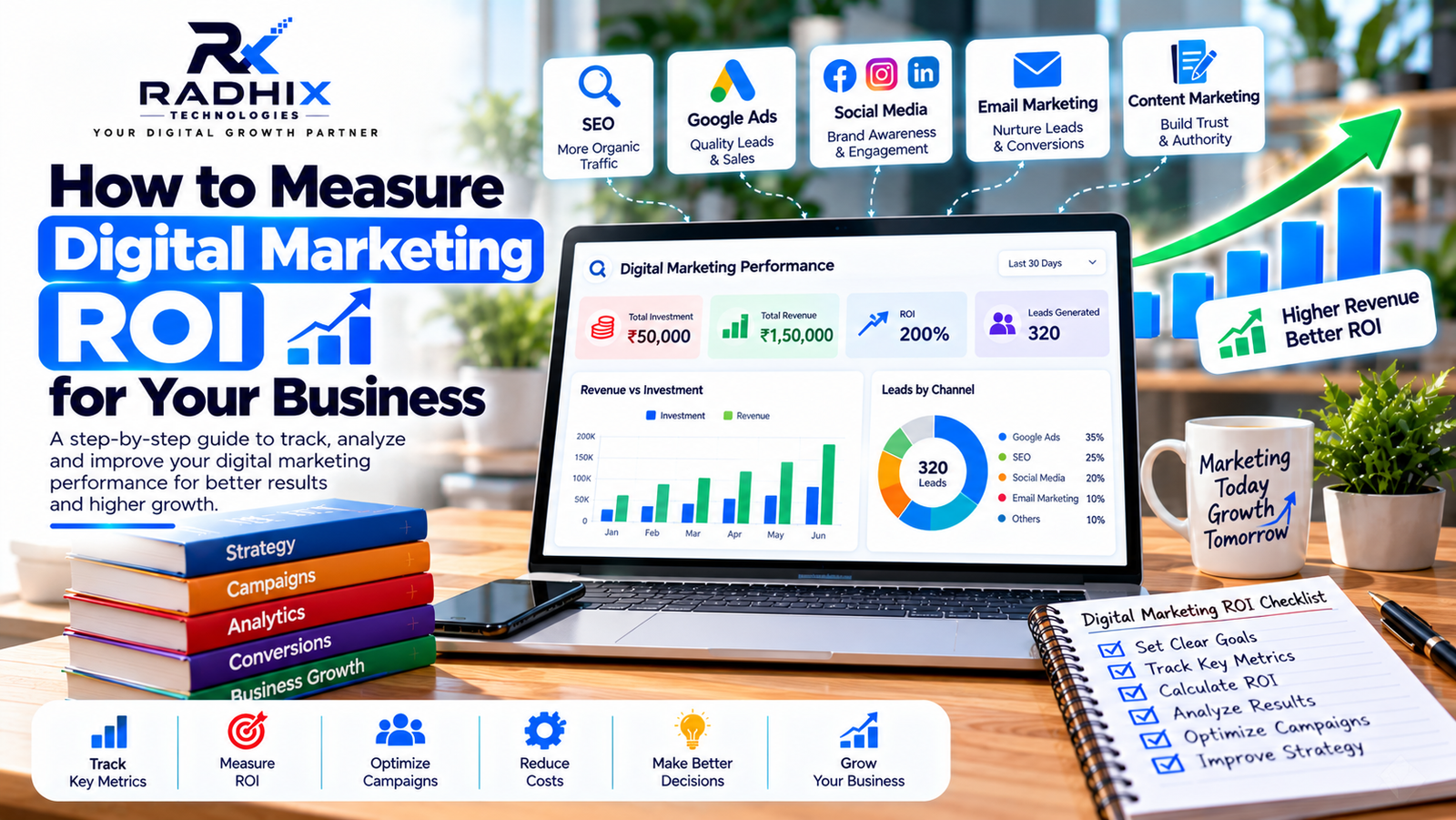
How to Measure Digital Marketing ROI for Your Business
Digital marketing has become an important part of business growth. Companies invest in SEO, social media marketing, Google Ads, Facebook Ads, email marketing, and content marketing to attract customers and increase sales. But how do you know whether these marketing activities are actually delivering results?
This is where Digital Marketing ROI (Return on Investment) becomes important.
Measuring digital marketing ROI helps businesses understand how much revenue they generate compared to the amount they spend on marketing. It also helps identify successful campaigns, control advertising costs, and make better marketing decisions.
Whether you run a small business, startup, ecommerce store, or established company, understanding marketing ROI can help you use your budget more effectively.
In this guide, we will explain what digital marketing ROI is, how to calculate it, which metrics you should track, and how to improve your marketing performance.
What Is Digital Marketing ROI?
Digital Marketing ROI measures the financial return generated from your digital marketing investment.
It helps businesses evaluate whether their marketing campaigns are generating enough value compared to their costs.
For example, suppose your business spends ₹20,000 on a digital marketing campaign and generates ₹80,000 in revenue directly attributed to that campaign.
You can use the ROI formula to calculate the return on your investment.
A positive ROI generally indicates that the campaign generated more revenue than its investment, while a negative ROI indicates that the measured return was lower than the cost.
However, businesses should also consider profit margins, customer acquisition costs, and the time required to convert leads into customers.
Why Is Measuring Digital Marketing ROI Important?
Tracking marketing ROI is essential because it helps businesses understand where their money is going and what results they are receiving.
Here are some important benefits:
1. Understand Marketing Performance
ROI helps you evaluate whether your marketing campaigns are contributing to business objectives such as sales, enquiries, and customer acquisition.
2. Identify Profitable Marketing Channels
You can compare the performance of SEO, Google Ads, social media campaigns, and email marketing to understand which channels deliver the most valuable results.
3. Improve Marketing Budget Allocation
When you understand campaign performance, you can make informed decisions about where to increase, reduce, or reallocate your marketing budget.
4. Reduce Unnecessary Marketing Costs
Measuring performance helps identify campaigns that generate clicks or impressions but fail to produce meaningful enquiries or sales.
5. Support Business Growth
Consistent ROI tracking helps businesses make data-driven marketing decisions and build more effective long-term strategies.
How to Calculate Digital Marketing ROI
The basic formula for calculating digital marketing ROI is:
ROI (%) = [(Revenue Generated − Marketing Investment) ÷ Marketing Investment] × 100
Let's understand this with an example.
Suppose your business spends ₹30,000 on a digital marketing campaign and generates ₹90,000 in attributed revenue.
- Marketing Investment = ₹30,000
- Revenue Generated = ₹90,000
- Net Return Before Other Costs = ₹60,000
ROI = [(90,000 − 30,000) ÷ 30,000] × 100
ROI = 200%
This means the campaign generated ₹2 in return above the marketing investment for every ₹1 spent, using the basic revenue-based calculation.
Remember that this is a simplified calculation. Revenue is not the same as profit. For a more accurate business evaluation, include product costs, service delivery costs, salaries, agency fees, and other relevant expenses.
8 Important Metrics to Measure Digital Marketing ROI
To understand the actual performance of your campaigns, you should monitor more than just revenue and website traffic.
Here are eight important metrics.
1. Customer Acquisition Cost (CAC)
Customer Acquisition Cost measures how much your business spends to acquire one new customer.
Formula:
CAC = Total Customer Acquisition Costs ÷ Number of New Customers Acquired
Example:
If your business spends ₹50,000 on marketing and sales activities and acquires 25 new customers:
CAC = ₹50,000 ÷ 25
CAC = ₹2,000 per customer
This metric helps you understand how much it costs to bring a new customer to your business.
2. Conversion Rate
Conversion rate measures the percentage of website visitors or campaign users who complete a desired action.
Conversions may include:
- Purchasing a product.
- Submitting an enquiry form.
- Booking an appointment.
- Requesting a quotation.
- Signing up for a newsletter.
Formula:
Conversion Rate = (Number of Conversions ÷ Total Visitors) × 100
Example:
If 1,000 people visit your landing page and 50 submit an enquiry form:
Conversion Rate = (50 ÷ 1,000) × 100
Conversion Rate = 5%
A higher conversion rate may indicate that your landing page and marketing message are effectively encouraging visitors to take action.
3. Cost Per Lead (CPL)
Cost Per Lead measures how much you spend to generate one potential customer enquiry.
Formula:
CPL = Total Marketing Campaign Cost ÷ Number of Leads Generated
Example:
If you spend ₹15,000 on advertising and receive 150 leads:
CPL = ₹15,000 ÷ 150
CPL = ₹100 per lead
However, a low CPL does not automatically mean a successful campaign. You should also evaluate lead quality and how many leads become paying customers.
4. Return on Ad Spend (ROAS)
Return on Ad Spend measures the revenue generated for every rupee spent specifically on advertising.
Formula:
ROAS = Revenue Attributed to Ads ÷ Advertising Spend
Example:
If you spend ₹10,000 on Google Ads and generate ₹50,000 in attributed revenue:
ROAS = ₹50,000 ÷ ₹10,000
ROAS = 5x
This means the campaign generated ₹5 in attributed revenue for every ₹1 spent on advertising.
ROAS does not account for all business costs, so it should not be confused with profit or overall ROI.
5. Customer Lifetime Value (CLV)
Customer Lifetime Value estimates the total revenue or contribution a business expects to receive from a customer throughout the relationship.
It helps businesses understand the long-term value of customer acquisition.
For example, if a customer purchases a service worth ₹10,000 every year for three years, the total revenue from that customer is ₹30,000 before considering delivery costs and other expenses.
Comparing customer lifetime value with acquisition cost can help businesses evaluate the sustainability of their marketing strategy.
6. Organic Traffic
Organic traffic refers to visitors who reach your website through unpaid search engine results.
For SEO campaigns, monitor:
- Organic website sessions.
- Search impressions.
- Search clicks.
- Relevant keyword visibility.
- Organic enquiries and conversions.
Google Search Console and website analytics tools can help you understand how organic search contributes to business goals.
7. Click-Through Rate (CTR)
Click-through rate measures the percentage of people who click on a link or advertisement after seeing it.
Formula:
CTR = (Total Clicks ÷ Total Impressions) × 100
Example:
If an advertisement receives 10,000 impressions and 300 clicks:
CTR = (300 ÷ 10,000) × 100
CTR = 3%
CTR helps evaluate how effectively your advertising message, headline, or search result encourages people to click.
8. Lead-to-Customer Conversion Rate
This metric measures how many generated leads eventually become paying customers.
Formula:
Lead-to-Customer Rate = (Number of New Customers ÷ Total Leads) × 100
Example:
If your business receives 100 leads and converts 10 into customers:
Lead-to-Customer Rate = (10 ÷ 100) × 100
Lead-to-Customer Rate = 10%
This metric is particularly useful for service-based businesses with enquiry forms, consultations, and sales follow-ups.
How to Measure ROI for Different Digital Marketing Channels
Every digital marketing channel has different goals and performance indicators. Therefore, businesses should use suitable metrics to evaluate each channel.
1. SEO (Search Engine Optimization)
SEO focuses on improving organic search visibility and attracting relevant website visitors.
Important metrics include:
- Organic traffic.
- Search impressions and clicks.
- Keyword visibility.
- Organic conversion rate.
- Qualified leads from organic search.
- Revenue attributed to organic search.
SEO is generally a long-term investment. Evaluate its contribution over an appropriate period rather than expecting immediate returns.
2. Social Media Marketing
Social media marketing helps businesses build brand awareness, engage audiences, and generate potential customers.
Track metrics such as:
- Reach and impressions.
- Engagement rate.
- Profile visits.
- Link clicks.
- Website traffic.
- Leads and sales generated.
For paid social campaigns, also monitor cost per lead, customer acquisition cost, and attributed revenue.
3. Google Ads
Google Ads can help businesses reach people searching for specific products or services.
Important metrics include:
- Advertising spend.
- Impressions and clicks.
- Cost per click (CPC).
- Conversion rate.
- Cost per conversion.
- Revenue and ROAS.
Make sure conversion tracking is configured correctly before using campaign data to make budget decisions.
4. Email Marketing
Email marketing helps businesses communicate with existing customers and potential buyers.
Useful metrics include:
- Delivery rate.
- Click-through rate.
- Conversion rate.
- Unsubscribe rate.
- Revenue attributed to email campaigns.
Track meaningful actions such as purchases, bookings, and enquiries instead of relying only on email opens.
5. Content Marketing
Content marketing focuses on attracting and educating audiences through useful information.
Measure:
- Blog traffic.
- Content engagement.
- Organic search visibility.
- Downloads and enquiries.
- Assisted conversions.
- Revenue influenced by content.
Some content may support a customer decision without being the final interaction before a sale. Consider this when evaluating its contribution.
Step-by-Step Guide to Measure Digital Marketing ROI
Follow these steps to create a practical ROI measurement process for your business.
Step 1: Define Your Marketing Goals
Before launching a campaign, decide what you want to achieve.
Your objectives may include:
- Increasing website traffic.
- Generating business enquiries.
- Increasing online sales.
- Improving brand awareness.
- Acquiring new customers.
- Increasing repeat purchases.
Set measurable targets so that you can evaluate campaign performance.
Step 2: Calculate Your Total Marketing Investment
Record all relevant costs associated with the campaign.
These may include:
- Advertising spend.
- Agency or marketing management fees.
- Content creation expenses.
- Graphic design and video production.
- Marketing software subscriptions.
- Landing page development.
- Other campaign-related costs.
Choose a consistent cost definition. If you include only advertising spend, your calculation measures a different investment from one that also includes creative production and management fees.
Step 3: Set Up Conversion Tracking
Conversion tracking helps you understand which marketing activities generate meaningful actions.
Set up suitable tracking for:
- Enquiry form submissions.
- Phone calls.
- Online purchases.
- Appointment bookings.
- Consultation requests.
- Newsletter registrations.
Tools such as Google Analytics 4, Google Tag Manager, and advertising platform conversion tracking can support this process.
Where relevant, connect your website forms and CRM to track what happens after a lead is generated.
Step 4: Track Leads and Revenue
Record how many leads each channel generates and how many become paying customers.
For service-based businesses, a CRM can help track:
- Lead source.
- Enquiry date.
- Lead status.
- Sales follow-up.
- Quotation value.
- Deal closure.
- Revenue generated.
This helps you evaluate lead quality rather than focusing only on enquiry volume.
Step 5: Calculate ROI and Related Metrics
Use the appropriate formulas to calculate ROI, CAC, CPL, conversion rate, and ROAS.
Compare performance across channels while keeping the measurement period and cost definitions consistent.
Step 6: Review and Optimize Campaigns
Use your results to identify what is working and what needs improvement.
For example:
- Reduce spending on campaigns that consistently generate poor-quality leads.
- Improve landing pages with low conversion rates.
- Test different advertising messages.
- Improve content targeting relevant search queries.
- Follow up with leads more effectively.
- Invest more in channels that deliver sustainable business value.
Review performance regularly and avoid making major decisions based on a small amount of data.
Example: Digital Marketing ROI Calculation for a Business
Let's understand how a business can evaluate its marketing investment.
Suppose a service-based company invests ₹40,000 in a monthly digital marketing campaign.
The campaign generates:
- Total Leads: 100
- New Customers: 10
- Average Revenue per Customer: ₹10,000
- Total Attributed Revenue: ₹1,00,000
- Marketing Investment: ₹40,000
Using the basic revenue-based ROI formula:
ROI = [(₹1,00,000 − ₹40,000) ÷ ₹40,000] × 100
ROI = 150%
Other useful calculations:
- MetricResultMarketing Investment₹40,000
- Attributed Revenue₹1,00,000
- Leads Generated100
- New Customers10Cost Per Lead₹400
- Customer Acquisition Cost*₹4,000
- Lead-to-Customer Rate10%
- Revenue-Based ROAS2.5xRevenue-Based ROI150%
The CAC above uses only the stated ₹40,000 marketing investment. A fully loaded CAC should include other relevant sales and acquisition costs.
This example shows why businesses should track multiple metrics instead of evaluating marketing campaigns only by clicks or impressions.
Best Tools to Measure Digital Marketing ROI
Several tools can help businesses collect and analyze marketing performance data.
1. Google Analytics 4
<italic>Google Analytics 4</italic> helps businesses measure website traffic, user interactions, and conversions. It can provide insights into how visitors interact with your website.
2. Google Search Console
<italic>Google Search Console</italic> helps monitor organic search performance, including clicks, impressions, queries, and indexing information.
3. Google Ads
<italic>Google Ads</italic> provides campaign performance information such as clicks, advertising costs, conversions, and conversion value when tracking is configured.
4. Meta Ads Manager
<italic>Meta Ads Manager</italic> helps measure Facebook and Instagram advertising performance, including reach, impressions, clicks, costs, and tracked conversions.
5. CRM Software
A CRM helps businesses manage enquiries, monitor sales follow-ups, track customer journeys, and understand how marketing leads turn into customers.
6. Marketing Dashboards
A reporting dashboard can combine data from different channels to help businesses monitor marketing costs, leads, conversions, and revenue in one place.
Common Mistakes to Avoid When Measuring Marketing ROI
Businesses can make incorrect marketing decisions when they measure the wrong metrics or overlook important costs.
Avoid these common mistakes:
- Focusing only on website traffic: More visitors do not always mean more customers.
- Ignoring lead quality: A campaign with many enquiries may still generate very few sales.
- Not tracking conversions: Without proper tracking, it becomes difficult to evaluate campaign performance.
- Ignoring hidden costs: Excluding management, creative, and other relevant expenses can overstate ROI.
- Confusing ROAS with ROI: ROAS measures attributed advertising revenue against ad spend, while ROI evaluates return against investment.
- Using incorrect attribution: A customer may interact with multiple channels before purchasing.
- Expecting immediate returns from SEO: Organic search performance often requires sustained work.
- Not reviewing performance regularly: Campaigns should be monitored and optimized using reliable data.
How Radhix Technologies Can Help Your Business
Radhix Technologies helps businesses strengthen their online presence through website development and digital solutions.
A well-planned digital marketing strategy should not focus only on generating traffic. It should also help businesses attract relevant audiences, generate enquiries, and evaluate the value of their marketing investments.
Depending on your requirements, digital solutions may include:
- SEO and organic visibility improvements.
- Website development and optimization.
- Digital marketing strategy.
- Social media marketing.
- Paid advertising support.
- Landing page optimization.
- Website performance and conversion improvements.
Whether you want to improve your existing campaigns or build a stronger digital presence, Radhix Technologies can help you explore suitable solutions.
Visit https://www.radhix.com/ to learn more about Radhix Technologies and its services.
Conclusion
Measuring digital marketing ROI is essential for understanding whether your marketing investments are contributing to business growth.
By tracking revenue, marketing costs, customer acquisition cost, conversion rates, cost per lead, and return on ad spend, businesses can evaluate their campaigns more effectively.
Start by defining clear marketing goals, setting up accurate conversion tracking, and monitoring performance across different channels. Review your results regularly and invest in strategies that attract relevant customers and deliver sustainable value.
Remember: Successful digital marketing is not just about spending money on advertisements or increasing website traffic. It is about understanding what works, measuring meaningful results, and making smarter business decisions.
Want to improve your digital marketing performance? Connect with Radhix Technologies to discuss your website development and digital marketing requirements.