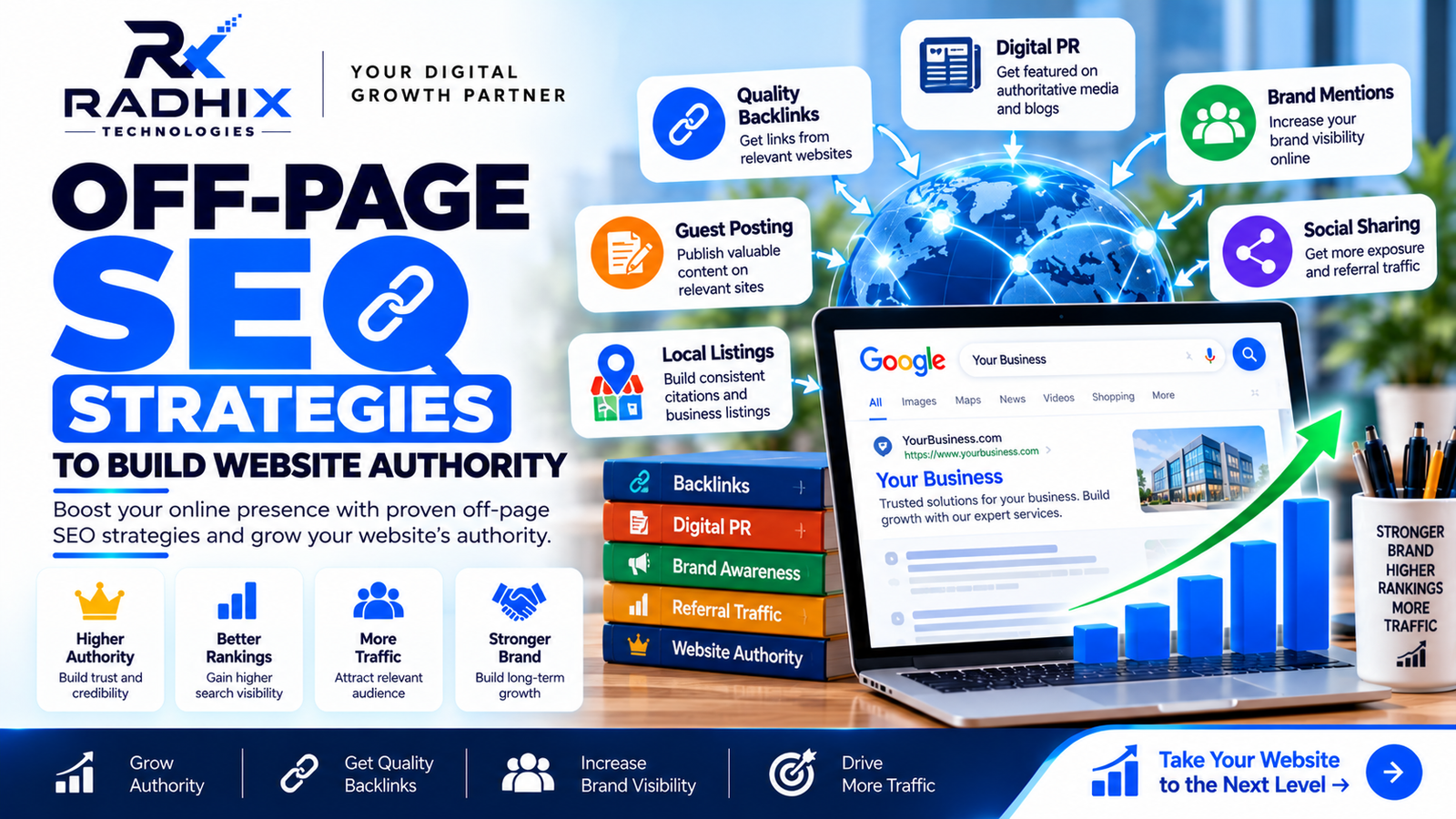
Off-Page SEO Strategies to Build Website Authority
Introduction
Building a successful website requires more than publishing quality content and optimising individual webpages. Businesses also need to establish credibility, build relationships within their industry, and help potential customers discover their websites through relevant external sources.
This is where off-page SEO becomes important. Off-page SEO includes activities performed outside your website that can support your online reputation, visibility, and authority.
Strategies such as earning quality backlinks, digital PR, creating shareable content, building relevant industry relationships, and managing your brand's online presence can contribute to a stronger SEO strategy.
In this guide, we will explore effective off-page SEO strategies to build website authority, attract relevant visitors, and support long-term organic growth.
What Is Off-Page SEO?
Off-page SEO refers to activities outside your own website that can influence how people discover, evaluate, and reference your business online.
One of its most important elements is backlink building. A backlink is a link from another website to your website. Relevant, editorially earned links can help search engines discover content and understand how webpages are connected.
Off-page SEO may also include:
- Earning backlinks from relevant websites
- Digital public relations (digital PR)
- Publishing expert contributions on reputable websites
- Building relationships with industry publications
- Creating content that people naturally reference
- Maintaining a consistent and trustworthy brand presence
- Participating meaningfully in relevant industry communities
Off-page SEO is not simply about collecting as many links as possible. The quality, relevance, context, and natural acquisition of links matter more than a high link count.
Why Is Off-Page SEO Important?
A website may have well-written content and sound technical foundations, but it still needs to compete with other websites for attention and visibility.
A thoughtful off-page SEO strategy can help businesses in several ways.
1. Build Website Credibility
When reputable websites reference your business or content, potential customers may view your brand as a useful source of information. Editorial links and genuine industry recognition can contribute to your website's credibility.
2. Support Search Engine Visibility
Relevant backlinks can help search engines discover webpages and understand relationships between websites. Link signals are one part of Google's ranking systems, alongside many other factors.
3. Increase Referral Traffic
A useful link on a relevant website may bring visitors who are already interested in your services, products, or expertise.
4. Improve Brand Awareness
Mentions in industry publications, interviews, professional communities, and relevant media can introduce your business to new audiences.
5. Build Long-Term Business Relationships
Partnerships with publishers, industry professionals, and complementary businesses can create opportunities for collaboration, referrals, and useful content.
Remember that no off-page SEO technique guarantees higher rankings. Results depend on many factors, including content quality, competition, relevance, and the overall strength of your website.
1. Earn High-Quality Backlinks
Backlinks remain an important consideration in SEO, but not every link provides the same value. A relevant, editorially earned link from a trusted website is generally more useful than a large number of links from unrelated or low-quality sources.
How to Earn Quality Backlinks
- Publish original research, surveys, or useful industry insights.
- Create detailed guides that solve common customer problems.
- Develop free tools, templates, or practical resources.
- Share expert commentary with relevant publications.
- Build relationships with journalists, editors, and industry professionals.
- Promote genuinely useful content to people who may find it valuable.
For example, a web development company could publish a practical guide explaining website maintenance costs. Industry blogs or business publications may reference it if the information is useful to their readers.
Focus on creating something worth referencing instead of pursuing links solely for SEO purposes.
2. Create Link-Worthy Content
The easiest content to promote is often content that provides unique value. If your website contains information that is already available everywhere else, other publishers may have little reason to reference it.
Link-worthy content gives readers something useful, original, or difficult to find elsewhere.
Content Ideas That May Attract Backlinks
Original research: Publish findings from a genuine survey or analysis.
Comprehensive guides: Explain a complicated topic in a clear, practical way.
Industry statistics: Collect and present accurate data with transparent sources.
Free resources: Create checklists, calculators, templates, or downloadable guides.
Case studies: Explain a real project, the approach taken, and the results that can be substantiated.
Visual resources: Develop original charts, diagrams, and infographics that clarify complex ideas.
For example, Radhix Technologies could publish a detailed website development checklist for small businesses. If the checklist helps business owners prepare for a project, relevant websites may choose to share or reference it.
Do not invent research findings, statistics, testimonials, or project results. Accuracy is essential for building long-term credibility.
3. Use Guest Posting Strategically
Guest posting involves contributing useful content to another website or publication. It can introduce your expertise to a new audience, build professional relationships, and sometimes earn appropriate editorial links.
However, guest posting primarily to obtain backlinks at scale, especially through low-quality or unrelated websites, can violate Google's link spam policies.
Best Practices for Guest Posting
- Identify reputable websites relevant to your industry.
- Review their audience, editorial standards, and existing content.
- Pitch original topics that offer value to their readers.
- Provide accurate information and practical examples.
- Follow the publisher's editorial and linking policies.
- Disclose commercial relationships when required.
- Avoid websites that sell links or publish large volumes of unrelated guest articles.
The goal should be to contribute meaningful expertise, not to publish the same promotional article across many websites.
4. Use Digital PR to Build Brand Authority
Digital PR focuses on earning online coverage, mentions, and references through useful stories, expert commentary, and newsworthy information.
Unlike traditional link-building campaigns that focus mainly on backlinks, digital PR can also help improve brand awareness and establish relationships with publishers.
Digital PR Strategies
- Share expert opinions on relevant industry developments.
- Publish original data or research that addresses a real question.
- Respond to journalist requests when you have relevant expertise.
- Announce meaningful business milestones.
- Offer expert interviews or useful commentary.
- Create reports that provide genuinely new insights.
- Build relationships with relevant media outlets and industry publications.
For example, a technology company could publish an evidence-based report about website performance challenges faced by small businesses. If the findings are useful and well-supported, industry publications may reference the report.
Avoid sending mass, irrelevant pitches. A focused, personalised approach is more likely to build lasting relationships.
5. Optimise Relevant Business Directories and Citations
Business listings can help customers discover your company and verify its contact information. They are especially useful for local businesses and service providers.
A citation generally refers to a business mention that includes information such as its name, address, and phone number. Citations may include a link, but not every citation is a backlink.
Business Listing Optimisation Checklist
- List your business on reputable, relevant directories.
- Use accurate business details.
- Keep your website URL and phone number current.
- Correct outdated addresses or opening hours.
- Avoid duplicate listings where possible.
- Prioritise recognised industry and local directories.
- Review listing quality before submitting your information.
For local businesses, maintaining an accurate Google Business Profile can also help customers find business information on Google Search and Maps.
Avoid submitting your website to hundreds of low-quality directories simply to generate links. Relevance and accuracy are more important than directory quantity.
6. Strengthen Local SEO and Community Relationships
Local businesses can build online visibility by participating in relevant community activities and developing genuine relationships with other organisations.
Local Off-Page SEO Ideas
- Join relevant business associations.
- Participate in local industry events.
- Collaborate with complementary businesses.
- Sponsor legitimate community initiatives where appropriate.
- Share useful information with local publications.
- Encourage satisfied customers to provide honest reviews.
- Maintain accurate business listings across relevant platforms.
For example, a website development company in Faridabad could collaborate with a local business association to deliver a website security workshop. If the association publishes an event recap and links to the company as a resource, that link may provide genuine referral and brand value.
Do not create fake local relationships or use misleading addresses to manipulate local search visibility.
7. Build Relationships With Industry Websites
Effective link earning often begins with relationships rather than link requests.
When your business develops genuine connections with relevant publishers, professional communities, and complementary organisations, there may be more opportunities to share useful information.
How to Build Industry Relationships
- Follow relevant publications and understand their audiences.
- Comment thoughtfully on industry discussions.
- Share useful research with professionals who may benefit from it.
- Participate in webinars, podcasts, or expert panels.
- Offer genuine feedback or collaboration opportunities.
- Keep outreach relevant and personalised.
- Maintain relationships even when there is no immediate marketing benefit.
Do not ask for links in every interaction. Focus first on contributing value and building trust.
8. Promote Your Content Through Relevant Channels
Publishing a blog is only the first step. Relevant people need to discover it before they can read, share, reference, or link to it.
Content promotion can increase exposure and help your business reach people who may benefit from your expertise.
Content Promotion Channels
- LinkedIn posts for professional and B2B audiences
- Relevant industry newsletters
- Email updates to subscribers who have consented to receive them
- Professional communities that permit useful resource sharing
- Social media posts tailored to each platform
- Partnerships with relevant publishers
- Webinars and online events
Share content with an explanation of why it matters to the audience. Avoid repetitive promotional messages or posting links in unrelated communities.
Social shares and likes are not direct Google ranking factors in themselves, but social distribution can help useful content reach people who may eventually reference it.
9. Recover Relevant Broken Link Opportunities
Broken link building involves identifying broken links on relevant websites and suggesting a suitable replacement resource.
This strategy works best when your content genuinely provides a useful alternative to the missing resource.
A Responsible Broken Link Building Process
- Identify reputable websites that publish resources related to your industry.
- Find relevant pages containing broken outbound links.
- Confirm that the destination is actually unavailable or no longer appropriate.
- Check whether your website has a genuinely relevant replacement resource.
- Contact the website owner with a concise, helpful message.
- Accept that the publisher may choose a different replacement or make no change.
Do not create a replacement page solely to target an unrelated link opportunity. The resource should be useful to the publisher's audience.
10. Monitor Your Backlink Profile
Monitoring backlinks helps you understand which websites reference your content and identify unusual link patterns.
A backlink report can also help you find potential partnership opportunities or investigate sudden changes in your website's link profile.
What to Review
- Referring domains and linking pages
- Relevance of linking websites
- Links to important pages
- Changes in new and lost backlinks
- Referral traffic from external websites
- Unusual or unexpected link patterns
- Links that appear to be part of a paid or manipulative scheme
Google Search Console provides a links report, while other SEO tools may offer additional backlink data. Different tools use different indexes, so their counts may not match.
Do not panic about every low-quality link. Google's systems can often ignore many spammy links. Use the disavow tool cautiously and generally only when there is a substantial pattern of artificial links and a clear reason to believe they may cause a manual action issue.
11. Encourage Genuine Customer Reviews and Brand Mentions
Customer feedback can help prospective buyers understand other people's experiences with your business. Brand mentions can also introduce your company to new audiences.
Reviews and mentions are not interchangeable with backlinks, and not every brand mention creates a direct SEO ranking benefit.
How to Encourage Genuine Feedback
- Ask customers for honest reviews after a real transaction or service.
- Make the review process straightforward.
- Respond professionally to feedback.
- Use feedback to improve your products or services.
- Request permission before publishing customer stories or testimonials.
- Keep claims accurate and avoid revealing confidential information.
Never purchase fake reviews, post fabricated testimonials, or offer rewards in exchange for positive ratings. Follow the applicable platform's review policies.
12. Avoid Black-Hat Link-Building Techniques
Black-hat SEO techniques attempt to manipulate search rankings rather than earn recognition through genuine value. Some practices can violate Google's spam policies and put a website at risk of ranking losses or manual actions.
Practices to Avoid
- Buying links intended to manipulate rankings
- Participating in link farms or private blog networks
- Excessive reciprocal link exchanges
- Automated link creation
- Mass article submissions to low-quality websites
- Keyword-rich links placed through paid arrangements without appropriate qualification
- Hacked links placed on unrelated websites
- Spam comments or forum posts created solely for backlinks
Paid advertising and legitimate sponsorships can be part of a marketing strategy. However, links involving payment or other commercial arrangements should be appropriately qualified, such as with rel="sponsored" or rel="nofollow" where applicable.
A sustainable approach prioritises useful content, genuine relationships, and editorially earned recognition.
13. Measure Off-Page SEO Performance
Off-page SEO should be evaluated using a combination of link, visibility, referral, and business metrics.
Important Metrics to Monitor
Referring domains: The number of distinct websites linking to your site, as reported by your chosen tool.
Relevant backlinks: Links from pages and websites that are meaningfully related to your business or content.
Referral traffic: Visits arriving from links on external websites.
Organic search performance: Search clicks, impressions, and query data available in Google Search Console.
Brand visibility: Relevant mentions, media coverage, and audience engagement.
Qualified enquiries: Leads that match your business requirements and originate from relevant marketing activity where attribution is available.
Conversions: Enquiries, consultations, or sales that can be measured reliably.
Avoid judging success only by total backlinks or third-party authority scores. These scores are estimates created by SEO tools, not official Google ranking metrics.
The real goal is to build credible visibility and attract relevant visitors who may become customers.
14. A Practical 30-Day Off-Page SEO Plan
A structured plan can help businesses begin improving their online authority without trying every tactic at once.
Week 1: Review and Plan
- Review your current backlink profile.
- Identify your most valuable pages and resources.
- Research relevant industry websites.
- Check important business listings for accuracy.
- Identify content that deserves additional promotion.
Week 2: Create Link-Worthy Resources
- Improve one useful guide or service resource.
- Add original insights, examples, or evidence where available.
- Prepare a helpful checklist, report, or visual resource.
- Make sure the content is accurate and easy to reference.
Week 3: Build Relevant Relationships
- Contact a small number of relevant publishers or industry professionals.
- Pitch useful guest contributions where editorially appropriate.
- Share relevant content with interested audiences.
- Explore legitimate local or industry collaboration opportunities.
Week 4: Measure and Refine
- Review new and lost backlinks.
- Check referral traffic and available search performance data.
- Identify outreach that generated meaningful engagement.
- Review listing accuracy and customer feedback.
- Plan the next month around the most promising opportunities.
This plan is a starting point rather than a guarantee of backlink growth or ranking improvements. Results depend on your industry, content quality, relationships, competition, and consistency.
How Radhix Technologies Can Help Build Your Website Authority
Radhix Technologies helps businesses strengthen their online presence through website development and digital solutions. A strong SEO strategy combines useful on-page content, technical foundations, and responsible off-page activities.
Depending on your business needs, support may include:
- Off-page SEO strategy
- Backlink profile analysis
- Digital PR and content promotion planning
- Competitor backlink research
- Link-worthy content development
- Local SEO and business listing optimisation
- On-page and technical SEO improvements
- Organic performance monitoring
The right strategy depends on your website's current condition, industry, target audience, and business goals.
Want to strengthen your website's online presence? Visit Radhix Technologies to explore digital solutions for your business.
Frequently Asked Questions (FAQs)
1. What is off-page SEO?
Off-page SEO includes activities outside your website that support brand visibility, credibility, and online discovery. Common examples include earning relevant backlinks, digital PR, industry relationships, and managing accurate business listings.
2. Why are backlinks important for SEO?
Relevant backlinks can help search engines discover content and provide signals about relationships between websites. However, link quality, context, and natural acquisition matter more than simply increasing the number of backlinks.
3. How can I build website authority?
Create useful, original content, earn editorial references from relevant websites, develop industry relationships, promote resources to suitable audiences, and maintain accurate business information. Avoid manipulative link schemes.
4. How long does off-page SEO take to show results?
There is no fixed timeline. Some referral traffic may arrive soon after a publication links to your content, while organic search changes can take longer and depend on multiple factors.
5. Are social media links useful for SEO?
Social media can help people discover and share your content. However, social likes and shares are not direct Google ranking factors in themselves. Their value often comes from exposure, engagement, and opportunities to reach people who may reference your content.
6. Can buying backlinks harm my website?
Buying links intended to manipulate search rankings can violate Google's spam policies and may lead to ranking problems or manual actions. Commercially arranged links should be appropriately qualified. Focus on earning relevant editorial links through genuine value.
7. What is the difference between on-page SEO and off-page SEO?
On-page SEO focuses on elements within your website, such as content, titles, headings, internal links, and page structure. Off-page SEO focuses on external signals and activities, such as relevant backlinks, digital PR, and industry relationships.
Conclusion
Off-page SEO helps businesses build visibility beyond their own websites. By earning relevant backlinks, creating useful resources, developing industry relationships, promoting content, and maintaining an accurate online presence, businesses can strengthen their overall SEO strategy.
The most sustainable approach is to focus on genuine value instead of shortcuts. Avoid manipulative link schemes, measure meaningful results, and prioritise activities that help real audiences discover and trust your business.
With consistent effort and a strong website foundation, off-page SEO can support long-term brand visibility, referral traffic, and organic growth opportunities.