Custom Business Software vs Ready-Made Software: Key Differences
Introduction
Every business needs the right technology to manage operations, improve productivity, and serve customers efficiently. Whether you run a startup, retail store, manufacturing company, or growing enterprise, software plays an important role in your business success.
But when it comes to choosing the right solution, business owners often face one important question: Should you invest in custom business software or choose ready-made software?
Ready-made software provides pre-built features that businesses can start using quickly. Custom business software, on the other hand, is developed according to specific business requirements, workflows, and future goals.
Both options have advantages and limitations. The right choice depends on your business size, budget, operational needs, and long-term growth plans.
Let's explore the key differences and understand which solution is better for your business.
1. What Is Ready-Made Software?
Ready-made software is a pre-developed application designed for a broad range of businesses and users. It comes with standard features that are available immediately after purchasing a subscription or licence.
Some common examples include:
- Accounting and billing software
- Customer relationship management (CRM) tools
- Inventory management applications
- Project management software
- HR and payroll systems
- Email marketing platforms
Example: A small retail business can use ready-made billing software to generate invoices, track sales, and manage basic inventory without investing in software development.
The biggest advantage is convenience. Businesses can start using the software quickly without going through a complete development process.
However, the available features and workflows are generally limited to what the software provider offers.
2. What Is Custom Business Software?
Custom business software is developed specifically for an organisation's requirements. Instead of adjusting your business operations to match an existing application, the software is designed around your actual business workflow.
It can include:
- Custom admin dashboards
- Employee and role management
- Customer and vendor portals
- Automated business workflows
- Inventory and order management
- Payment gateway integration
- Reports and analytics
- Third-party API integrations
- Web applications and mobile apps
Example: A distribution company managing multiple warehouses, dealers, sales representatives, and deliveries may need a specialised platform. Custom software can bring these operations together in one central system.
Its biggest advantage is flexibility. Businesses can decide which features are required, how the system should work, and how it can evolve as the organisation grows.
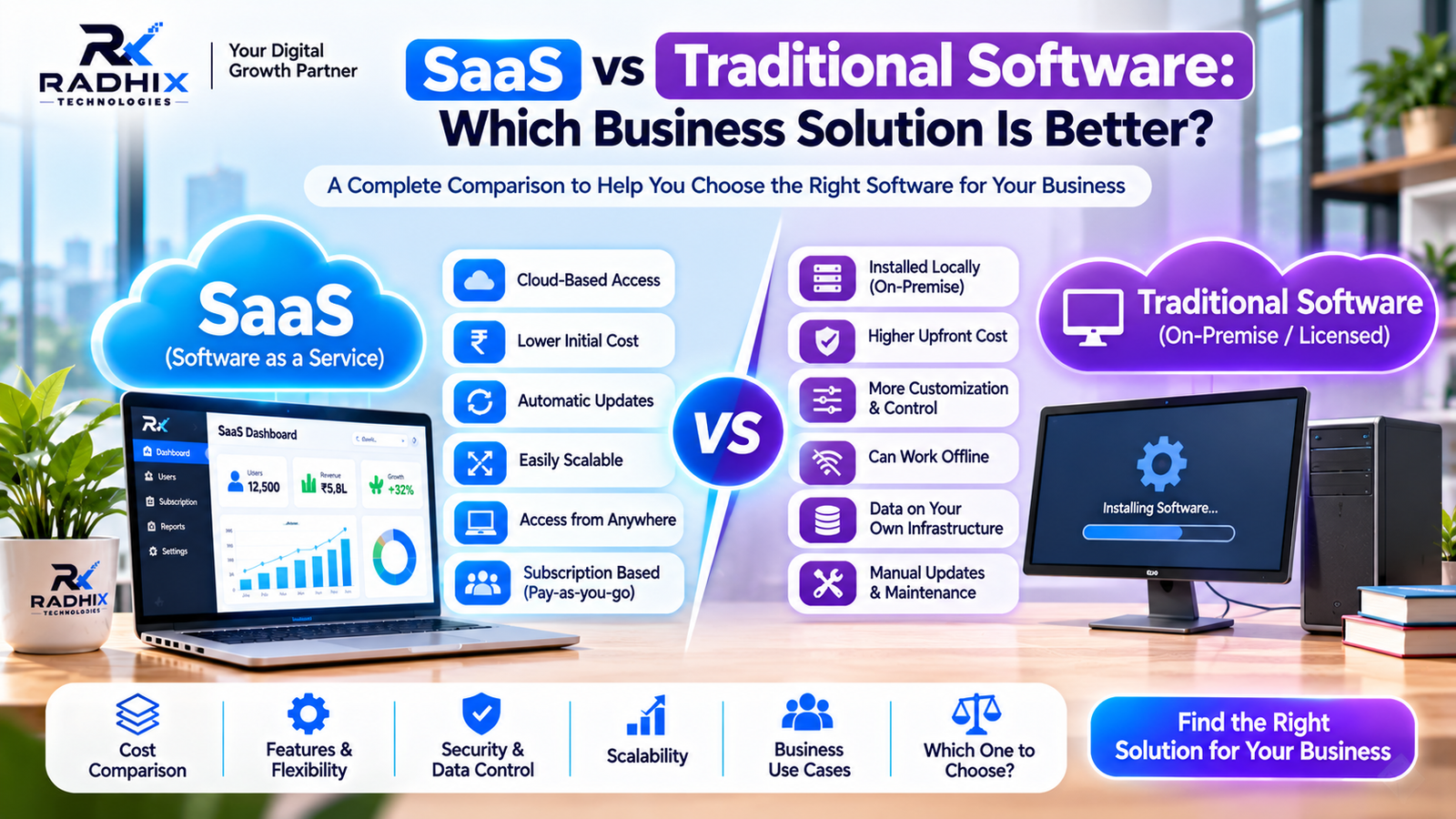
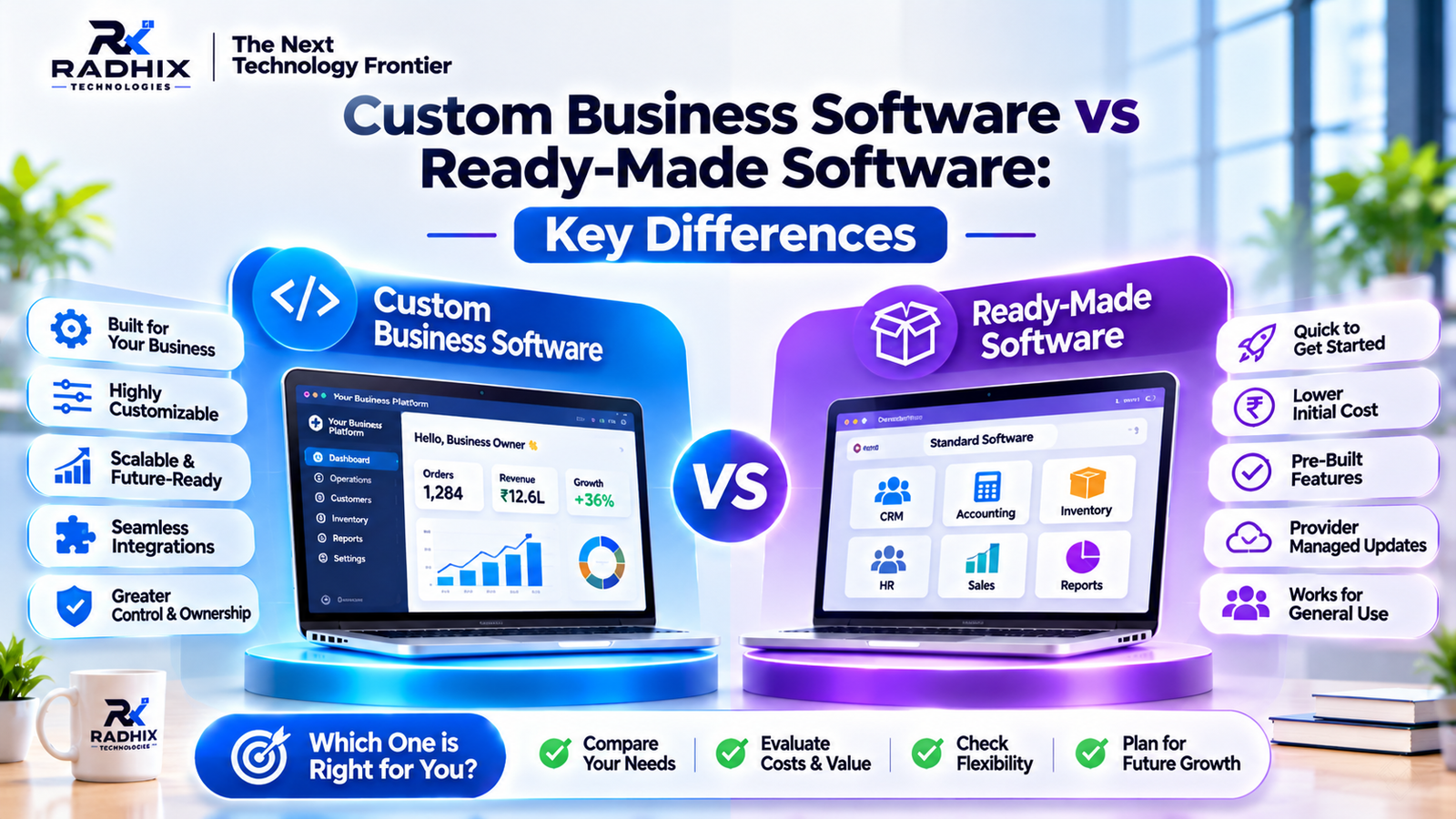
3. Custom Software vs Ready-Made Software: Key Differences
Both solutions help businesses improve their operations, but they differ in development, pricing, flexibility, ownership, and scalability.
Comparison FactorCustom Business SoftwareReady-Made SoftwareDevelopmentBuilt according to requirementsAlready developedInitial CostGenerally higherGenerally lowerImplementationRequires development and testingUsually quickCustomisationHigh flexibilityLimited optionsFeaturesDesigned for specific needsStandard featuresScalabilityCan be planned around business growthDepends on providerIntegrationCan support required integrationsDepends on available integrationsOwnershipDepends on development agreementUsually licensedMaintenanceArranged separately or through a partnerGenerally provider-managedControlGreater control over product roadmapProvider-controlled updates
Important: Custom software does not automatically mean complete ownership. Source code ownership, intellectual property rights, hosting access, and handover terms should be clearly defined in the development agreement.
4. The Real Difference: Does the Software Fit Your Business?
Many businesses make the mistake of selecting software by looking only at its features instead of checking whether those features match their actual workflow.
Consider two examples.
Business A: A Small Retail Store
It needs basic billing, stock tracking, customer records, and sales reports. A ready-made solution may handle these requirements efficiently.
Business B: A Multi-Branch Distribution Company
It needs warehouse-wise inventory, dealer management, different product price lists, approval workflows, sales tracking, and customised reports. A standard tool may not support all these requirements.
This is where custom software becomes valuable.
The best software is not necessarily the one with the most features. It is the one that solves your business problems without adding unnecessary complexity.
5. Cost Comparison: Which Option Is More Economical?
Cost is one of the most important factors when choosing between custom and ready-made software.
Ready-made software generally requires a smaller initial investment. However, businesses may need to pay recurring subscription fees, upgrade charges, or additional fees for premium features and users.
Custom software usually requires a higher initial development budget. Its cost depends on the number of modules, integrations, design complexity, technology, and security requirements.
Cost FactorCustom SoftwareReady-Made SoftwareInitial InvestmentHigherLowerMonthly SubscriptionDepends on hosting and supportCommonly applicableCustom FeaturesBased on agreed development scopeDepends on available plansUpgradesPlanned according to requirementsProvider-controlledLong-Term CostDepends on maintenance and future developmentDepends on subscription and pricing changes
Think beyond the first payment. A solution that looks inexpensive today may become costly if you need multiple subscriptions, additional integrations, workarounds, or manual processes.
Before making a decision, calculate the expected cost over three to five years instead of comparing only the initial price.
6. Flexibility and Customisation: How Much Control Do You Need?
Business requirements change over time. You may introduce new services, expand to additional locations, hire more employees, or start selling through different channels.
Ready-made software offers the features and customisation options permitted by its provider. If a required feature is unavailable, you may need to change your process or use another application.
Custom business software can be developed around your specific requirements.
For example, an e-commerce business may initially need:
- Product management
- Customer registration
- Online payments
- Order tracking
Later, it may require:
- Vendor management
- Multiple warehouses
- Automated order allocation
- Loyalty programmes
- Advanced analytics
A well-planned custom solution can accommodate these changes through additional modules and integrations.
7. Integration With Other Business Systems
Modern businesses use multiple tools for payments, accounting, communication, logistics, customer management, and reporting.
The challenge is making these systems work together.
Ready-made software may offer integrations with selected third-party applications. However, unsupported integrations can create additional limitations.
Custom software can be developed with specific APIs and integration requirements in mind.
For example, a business platform may connect:
- Payment gateways for online transactions
- WhatsApp APIs for customer notifications
- CRM systems for lead management
- Accounting software for financial records
- Logistics APIs for shipment tracking
This can reduce repeated data entry and improve coordination between departments.
8. Security, Data Control, and Ownership
Security should be considered before selecting any business software.
Ready-made software providers generally manage the application's infrastructure and security processes. Businesses should still review data storage, access controls, backup policies, compliance commitments, and vendor terms.
With custom software, security requirements can be incorporated into the architecture and development process. These may include role-based access, encryption, audit logs, secure authentication, and backup mechanisms.
However, custom software is not automatically more secure. Its security depends on development quality, infrastructure configuration, testing, and ongoing maintenance.
Businesses should also confirm who controls the source code, database, hosting account, domain, and third-party service credentials.
9. When Should You Choose Ready-Made Software?
Ready-made software is a sensible choice when your requirements are standard and you want to start quickly.
Choose it when:
- You are running a small business with basic operational needs.
- Your initial investment budget is limited.
- Standard features are sufficient.
- You do not need complex integrations.
- You want the provider to manage updates and infrastructure.
- You want to test a business process before investing in a larger solution.
For many startups and small businesses, ready-made software is a practical starting point.
10. When Should You Invest in Custom Business Software?
Custom software becomes a strong option when standard tools cannot support your business operations effectively.
Consider custom development when:
- Your business follows unique workflows.
- You need multiple dashboards or user roles.
- You manage complex inventory, orders, or approvals.
- Different systems need to work through one platform.
- You want greater control over future feature development.
- Your business is expanding and requires a scalable solution.
- You need a dedicated customer, vendor, employee, or admin portal.
The objective is not to build everything from scratch unnecessarily. It is to develop only the features that create measurable value for your business.
11. A Practical Decision Checklist Before Choosing
Before investing in any software, ask yourself these questions:
- Does the software support all my current business operations?
- Will it handle my expected business growth?
- Can I integrate it with the tools I already use?
- Are there recurring charges or additional user fees?
- Can I access and export my business data?
- What happens if the provider changes its pricing or discontinues the product?
- Do I need custom workflows or specialised dashboards?
- Who will handle maintenance, backups, and technical support?
If most of your requirements are already available in an existing product, ready-made software may be enough.
If important business processes require workarounds or multiple disconnected tools, custom software may provide better long-term value.
12. Why Choose Radhix Technologies for Custom Software Development?
Choosing a software development partner is an important step when planning a custom business solution. The right team should understand your business requirements before recommending a technology or development approach.
Radhix Technologies Pvt. Ltd. provides software and digital development services focused on building business-oriented solutions.
Our development approach focuses on:
- Understanding business requirements and workflows
- Planning suitable software architecture
- Developing responsive web applications and dashboards
- Building custom business management systems
- Integrating APIs and third-party services
- Implementing secure authentication and role-based access
- Providing testing, deployment, and technical support
Whether you need a business portal, CRM, inventory management system, vendor platform, or customised web application, the solution should be planned around your actual operational needs.
Visit Radhix Technologies to explore development services and discuss your project requirements.
Conclusion
Choosing between custom business software and ready-made software is not simply a decision between expensive and affordable options. It is about selecting the right technology for your business model, current requirements, and future plans.
Ready-made software is ideal when standard features are sufficient and quick implementation is important. Custom business software is more suitable when your organisation needs specialised workflows, greater flexibility, dedicated integrations, and long-term control.
Before investing, identify your business challenges, calculate the long-term cost, and evaluate how well each option supports your operations.
The right software should make your business simpler, faster, and more efficient—not force your business to work around technology.
Frequently Asked Questions (FAQs)
1. What is the main difference between custom and ready-made software?
Custom software is developed according to specific business requirements, while ready-made software is pre-built with standard features for a wider range of users.
2. Is custom business software more expensive?
Custom software generally has a higher initial development cost. However, its long-term value depends on maintenance, hosting, development requirements, and how effectively it reduces operational costs.
3. Is ready-made software suitable for startups?
Yes. Ready-made software is often suitable for startups that need standard features, quick implementation, and a lower initial investment.
4. Can ready-made software be customised?
Some ready-made products support configuration, plugins, extensions, and integrations. However, the level of customisation depends on the provider and the software's architecture.
5. Who owns custom-developed software?
Ownership depends on the development agreement. Businesses should clearly define source code ownership, intellectual property rights, database access, and handover responsibilities before starting development.
6. How do I decide which software is right for my business?
Compare your business requirements, available features, total cost, integration needs, scalability, security, and maintenance responsibilities before making a decision.