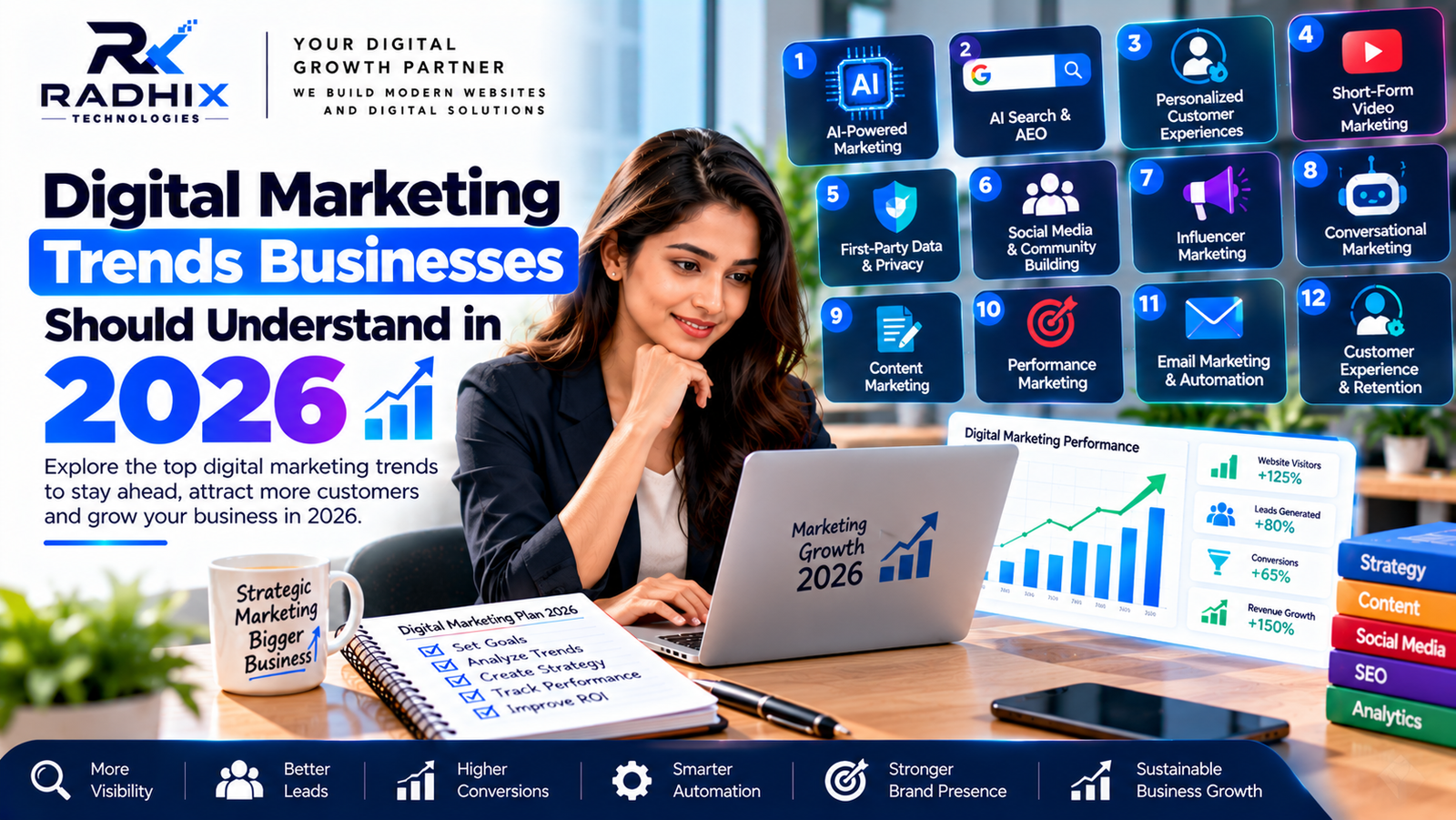
Digital Marketing Trends Businesses Should Understand in 2026
The digital marketing landscape is changing rapidly, and businesses need to adapt to new technologies, customer expectations, and online platforms to remain competitive. In 2026, artificial intelligence, personalized customer experiences, AI-powered search, video marketing, and data-driven strategies are influencing how businesses attract and engage customers.
For software companies, SaaS businesses, startups, and technology service providers, understanding these changes is especially important. Customers now research products across search engines, social media, review platforms, websites, and AI-powered tools before making purchasing decisions.
Traditional marketing methods alone may not be enough to reach modern customers. Businesses need a combination of technology, creativity, useful content, and performance measurement.
In this guide, we will explore the most important digital marketing trends businesses should understand in 2026 and how software and SaaS companies can use them to strengthen their online presence.
What Is Digital Marketing in 2026?
Digital marketing refers to promoting products and services through online channels such as search engines, websites, social media, email, digital advertising, and content platforms.
In 2026, digital marketing is becoming more connected, automated, and data-driven. Businesses are using AI tools to understand customer behaviour, create personalized experiences, automate repetitive tasks, and improve campaign performance.
However, technology alone does not guarantee marketing success. Businesses still need a clear strategy, reliable information, strong branding, and a good understanding of their customers.
For software and SaaS companies, digital marketing also plays an important role in explaining complex products, demonstrating software benefits, generating product trials, and converting potential users into paying customers.
12 Important Digital Marketing Trends Businesses Should Understand in 2026
1. AI-Powered Marketing and Automation
Artificial intelligence is becoming an important part of modern digital marketing.
Businesses are using AI tools to support content creation, customer segmentation, campaign optimization, marketing analytics, and customer communication.
For example, a SaaS company can use AI-powered systems to:
- Analyze customer behaviour.
- Generate content ideas.
- Personalize email campaigns.
- Automate repetitive marketing tasks.
- Support customer enquiries through chatbots.
- Identify patterns in campaign performance.
AI automation can save time and help marketing teams work more efficiently. However, businesses should review AI-generated content to ensure accuracy, originality, brand consistency, and usefulness.
The strongest approach combines AI efficiency with human creativity and strategic decision-making.
2. AI Search and Answer Engine Optimization (AEO)
People are increasingly using AI-powered search experiences and conversational tools to discover information, compare solutions, and find answers.
This is changing how businesses approach traditional SEO.
In addition to optimizing for conventional search engine results, businesses should create content that clearly answers customer questions and provides reliable information.
Important practices include:
- Publishing detailed and helpful articles.
- Answering specific customer questions.
- Using descriptive headings.
- Providing accurate product and service information.
- Demonstrating real industry expertise.
- Organizing website content logically.
- Keeping important information updated.
For example, a SaaS company offering CRM software could publish content answering questions such as:
- What is CRM software?
- How does CRM automation work?
- Which CRM features do small businesses need?
- How can businesses manage customer relationships?
The objective is to make your information useful and understandable across different search and discovery experiences.
3. Personalized Customer Experiences
Customers expect businesses to understand their needs and provide relevant information.
Personalized marketing uses customer preferences, behaviour, interactions, and other appropriate data to deliver more relevant experiences.
Examples include:
- Personalized email recommendations.
- Product suggestions based on user activity.
- Customized website experiences.
- Industry-specific landing pages.
- Relevant onboarding messages.
- Targeted offers based on customer interests.
For SaaS companies, personalization can be particularly useful during the customer journey.
For example, a project management software platform could show different product features to startups, freelancers, and enterprise teams based on their requirements.
Businesses should use customer data responsibly, provide appropriate transparency, and respect privacy preferences.
4. Short-Form Video Marketing
Short-form videos have become an important content format for brands that want to communicate quickly and engage audiences.
Platforms such as Instagram Reels, YouTube Shorts, and other video-based social channels provide opportunities to demonstrate products, explain features, and share educational content.
Software and SaaS businesses can create videos such as:
- Product demonstrations.
- Software tutorials.
- Feature explanations.
- Customer success stories.
- Quick industry tips.
- Frequently asked questions.
- Product update announcements.
For example, a company offering accounting software can create a short video showing how users generate invoices or track business expenses.
Keep videos focused, visually clear, and relevant to the audience. Avoid creating videos solely to follow trends that have no connection to your product or brand.
5. First-Party Data and Privacy-Focused Marketing
Customer privacy and responsible data management are becoming increasingly important in digital marketing.
First-party data refers to information a business collects directly through its own customer relationships and digital channels, such as website interactions, app activity, purchases, and voluntarily submitted forms.
Businesses can use appropriate first-party data to understand their audiences and improve marketing communication.
Examples include:
- Website enquiry forms.
- Newsletter subscriptions.
- Customer purchase history.
- Product usage information.
- CRM records.
- Customer feedback.
For SaaS businesses, first-party data can help understand how customers discover a product, which features they use, and where they need support.
However, data collection should follow applicable privacy requirements, consent expectations, and platform policies.
6. Social Media Marketing and Community Building
Social media is no longer just a place to publish promotional posts. It can also help businesses build relationships, answer questions, share knowledge, and develop communities.
In 2026, businesses should focus on creating meaningful interactions rather than measuring success only through followers and likes.
Useful strategies include:
- Sharing educational content.
- Publishing product demonstrations.
- Answering customer questions.
- Participating in relevant industry discussions.
- Sharing customer success stories.
- Building professional communities.
- Using social media to support customer communication.
For software companies, LinkedIn can be useful for B2B communication, industry insights, and professional networking, while Instagram and YouTube can support visual demonstrations and educational content.
Choose platforms based on where your target audience spends time.
7. Influencer and Creator-Led Marketing
Influencer marketing allows businesses to work with creators who have established relationships with relevant audiences.
In 2026, businesses can explore collaborations with industry experts, technology educators, niche creators, and professional content publishers.
For SaaS and software companies, suitable collaborations may include:
- Software product reviews.
- Tutorials and walkthroughs.
- Feature comparisons.
- Educational webinars.
- Expert interviews.
- Real-world product demonstrations.
For example, a company developing productivity software could collaborate with creators who regularly discuss business productivity, team management, or workflow automation.
Focus on audience relevance, transparency, creator credibility, and genuine product experience rather than follower count alone.
8. Conversational Marketing and AI Chatbots
Customers often want quick answers before choosing a product or service.
Conversational marketing helps businesses interact with potential customers through live chat, messaging platforms, automated chatbots, and other communication tools.
AI-powered chatbots can assist with:
- Answering common questions.
- Explaining product features.
- Sharing pricing information.
- Collecting enquiry details.
- Guiding users through product options.
- Directing customers to support teams.
For SaaS companies, chatbots can also support product onboarding and help users find relevant documentation.
However, businesses should provide a clear path to human assistance when a chatbot cannot solve a customer's problem. Automated responses should not mislead users or make unsupported product promises.
9. Content Marketing and Thought Leadership
Content marketing remains an important way to educate audiences, build trust, and demonstrate industry expertise.
Businesses can publish useful resources that help customers understand their problems and evaluate possible solutions.
Popular content formats include:
- Blog articles.
- Industry reports.
- Case studies.
- Whitepapers.
- Product guides.
- Educational videos.
- Webinars.
- Comparison articles.
For software companies, content marketing can explain how a product works and why certain features matter.
For example, a business offering HR management software could publish articles about employee management, payroll automation, attendance tracking, and HR technology.
Focus on accurate information, original insights, practical examples, and content that answers real customer questions.
10. Performance Marketing and Data-Driven Advertising
Performance marketing focuses on measuring marketing outcomes such as clicks, enquiries, purchases, subscriptions, and customer acquisition.
Businesses can use platforms such as Google Ads, Meta Ads, and LinkedIn Ads to reach specific audiences and evaluate campaign performance.
Important metrics include:
- Cost per click (CPC).
- Cost per lead (CPL).
- Conversion rate.
- Customer acquisition cost (CAC).
- Return on ad spend (ROAS).
- Customer lifetime value (CLV).
- Revenue generated.
For SaaS businesses, advertising campaigns may focus on free trials, product demos, consultation bookings, or software subscriptions.
Businesses should not judge campaign success by impressions or clicks alone. Lead quality, subscription conversions, customer retention, and profitability are also important.
11. Email Marketing and Marketing Automation
Email marketing remains useful for maintaining relationships with potential and existing customers.
Instead of sending the same message to every subscriber, businesses can create relevant email sequences based on customer interests and actions.
Examples include:
- Welcome email sequences.
- Product onboarding emails.
- Free-trial reminders.
- Product update announcements.
- Educational newsletters.
- Subscription renewal notifications.
- Customer re-engagement campaigns.
For SaaS businesses, automated onboarding emails can help new users understand important features and start using the platform effectively.
Businesses should maintain accurate subscriber lists, follow applicable email marketing requirements, and provide clear unsubscribe options.
12. Customer Experience and Retention Marketing
Digital marketing does not end when someone purchases a product or subscribes to a service.
Customer experience and retention are important because existing customers may renew subscriptions, purchase additional services, recommend a product, or become long-term business partners.
Businesses can improve customer experiences through:
- Helpful onboarding.
- Responsive customer support.
- Clear product documentation.
- Regular product updates.
- Personalized communication.
- Customer feedback collection.
- Loyalty and referral programs.
For SaaS businesses, retention is particularly important because recurring subscription revenue depends on customers continuing to use the product.
A good marketing strategy should therefore focus on attracting new customers as well as delivering value to existing ones.
How Software and SaaS Businesses Can Apply These Trends
Understanding trends is only the first step. Businesses need to convert them into practical marketing activities.
Here is an example of how a SaaS company can build a digital marketing strategy for 2026.
Marketing AreaRecommended ActivityBusiness ObjectiveAI MarketingAutomate repetitive marketing tasksImprove efficiencySEO and AEOPublish helpful product-related contentImprove search visibilityVideo MarketingCreate product demonstrationsEducate potential usersSocial MediaShare industry insights and product updatesBuild awarenessPaid AdvertisingPromote free trials and demosGenerate qualified leadsEmail MarketingCreate onboarding sequencesImprove activationChatbotsAnswer common product questionsSupport customer enquiriesAnalyticsMonitor conversions and retentionImprove decision-making
Start with the activities that match your target audience, budget, product maturity, and business objectives.
How to Create a Digital Marketing Strategy for 2026
Businesses do not need to adopt every new marketing trend at once. A focused strategy is often more effective than investing in too many channels without clear objectives.
Follow these steps:
Step 1: Define Your Business Goals
Identify what you want to achieve through digital marketing.
Your goals may include:
- Increasing brand awareness.
- Generating qualified leads.
- Growing software subscriptions.
- Increasing product trials.
- Improving customer retention.
- Expanding into new markets.
Step 2: Understand Your Target Audience
Research your ideal customers, their industries, challenges, budgets, and buying behaviour.
For SaaS businesses, consider whether you are targeting startups, small businesses, freelancers, or enterprise organizations.
Step 3: Select the Right Marketing Channels
Choose platforms that help you reach your audience effectively.
For example:
- SEO for long-term organic discovery.
- LinkedIn for B2B marketing.
- YouTube for product demonstrations.
- Google Ads for search-intent campaigns.
- Email marketing for lead nurturing.
- Content marketing for education and trust.
Step 4: Invest in Useful Content
Create educational and product-related content that helps potential customers understand your solutions.
Focus on quality, relevance, and originality.
Step 5: Use Technology and Automation
Adopt suitable AI tools, CRM platforms, analytics systems, and marketing automation software to improve workflow efficiency.
Ensure that automated activities remain accurate and aligned with your brand.
Step 6: Measure Marketing Performance
Track metrics such as website traffic, qualified leads, conversion rates, customer acquisition costs, subscriptions, and retention.
Review performance regularly and improve campaigns based on reliable data.
Common Digital Marketing Mistakes Businesses Should Avoid in 2026
Even with advanced marketing tools, businesses can waste time and money if they do not follow a clear strategy.
Avoid these common mistakes:
- Using AI without human review: AI-generated information may contain errors or generic content.
- Ignoring customer needs: Marketing should solve customer problems rather than focus only on promoting features.
- Following every new trend: Not every platform or technology is suitable for every business.
- Neglecting SEO: Search visibility remains important for long-term discovery.
- Ignoring data privacy: Customer information should be collected and used responsibly.
- Focusing only on followers: Engagement and follower numbers do not automatically generate revenue.
- Not measuring ROI: Campaign performance should be evaluated against business objectives.
- Ignoring existing customers: Customer support and retention are important for sustainable growth.
- Publishing repetitive content: Businesses should prioritize original insights and useful information.
How Radhix Technologies Can Help Your Business
Radhix Technologies helps businesses strengthen their digital presence through website development and digital solutions.
For software companies, SaaS startups, and growing businesses, a strong online presence can support product awareness, customer acquisition, and business expansion.
Depending on your requirements, digital solutions may include:
- Website development.
- Custom software development.
- SaaS platform development.
- SEO and digital marketing.
- Responsive website design.
- Business automation solutions.
- Digital product development.
Whether you are launching a new software product or improving your existing business website, a well-planned digital strategy can help create a stronger foundation for growth.
Visit https://www.radhix.com/ to explore Radhix Technologies and its services.
Conclusion
Digital marketing in 2026 is increasingly influenced by artificial intelligence, personalized customer experiences, AI-powered search, short-form video, first-party data, automation, and customer retention.
For software and SaaS businesses, these developments create opportunities to explain products more effectively, reach relevant audiences, improve customer experiences, and build stronger relationships.
However, businesses do not need to adopt every trend to remain competitive. The right approach is to understand your audience, select suitable marketing channels, create useful content, use technology responsibly, and measure meaningful results.
Remember: Successful digital marketing is not about following every new trend. It is about using the right strategies and technologies to deliver real value to customers and achieve measurable business goals.
Looking to strengthen your digital presence or develop a software product? Connect with Radhix Technologies to discuss your website development and digital solutions requirements.