How to Get More Leads Through Digital Marketing for Your Business
Introduction
Every business needs a consistent flow of potential customers to grow. However, attracting website visitors or getting social media followers does not always translate into sales. The real goal of digital marketing is to generate qualified leads—people who are genuinely interested in your products or services.
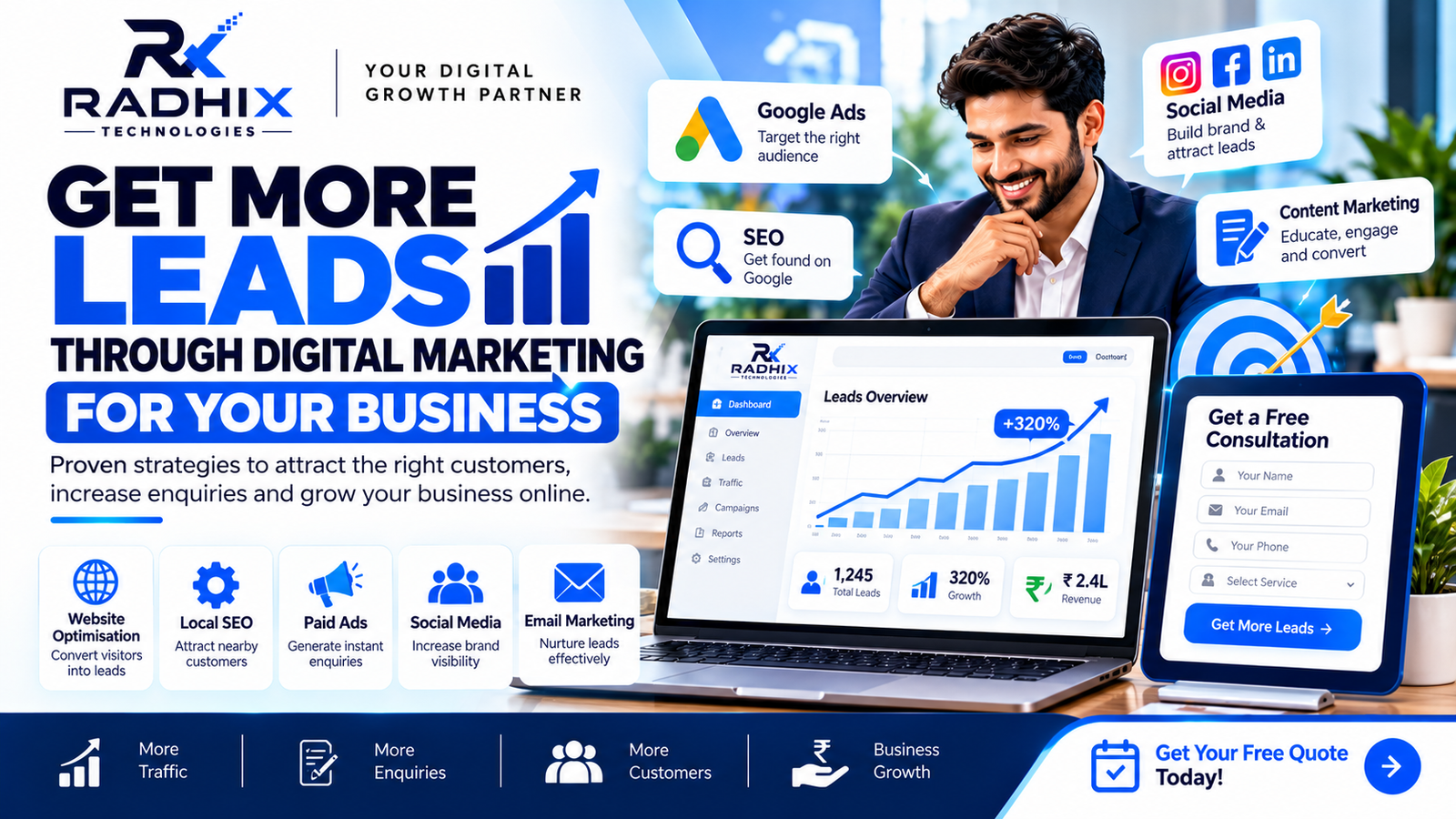
Digital marketing helps businesses connect with the right audience through search engines, social media, paid advertising, email marketing, and content creation. With the right strategy, businesses can improve brand visibility, attract potential customers, and build a stronger sales pipeline.
In this guide, we will explain how to get more leads through digital marketing and how your business can use different online marketing channels to generate better opportunities.
What Is Lead Generation in Digital Marketing?
Lead generation is the process of attracting potential customers and encouraging them to share their contact details or make an enquiry about your products or services.
A lead may be someone who:
- Fills out a contact form on your website.
- Calls your business after finding you online.
- Requests a product demo or service quotation.
- Sends an enquiry through WhatsApp.
- Downloads a useful guide or brochure.
- Registers for a webinar or consultation.
The purpose of lead generation is to turn online interest into meaningful business opportunities.
1. Build a Professional and Lead-Focused Website
Your website is often the first place where potential customers learn about your business. A professional website can help establish trust and encourage visitors to take action.
However, an attractive design alone is not enough. Your website should be designed to convert visitors into leads.
How to Improve Your Website for Lead Generation
- Use clear headlines that explain your services and value.
- Add visible call-to-action buttons such as “Get a Free Consultation” or “Request a Quote”.
- Create separate landing pages for important services.
- Display your contact information prominently.
- Add simple enquiry forms with only the necessary fields.
- Make sure your website works properly on mobile devices.
- Improve loading speed and website navigation.
- Include genuine testimonials, case studies, or portfolio examples where available.
For example, a website development company can create dedicated pages for website development, mobile app development, and digital marketing. Each page should explain the service and guide visitors toward an enquiry.
2. Use Search Engine Optimisation (SEO)
Search Engine Optimisation, or SEO, helps your website appear in relevant organic search results. It can attract people who are already looking for the products or services your business offers.
For example, a business may target keywords such as:
- Digital marketing company in Faridabad
- Website development company in Delhi NCR
- SEO services for small businesses
- Affordable mobile app development services
SEO Strategies to Generate More Leads
Target relevant keywords: Focus on search terms that match your services and customer needs.
Create useful content: Publish blogs, guides, FAQs, and service pages that answer your audience's questions.
Optimise service pages: Explain your services, benefits, process, and next steps clearly.
Improve technical SEO: Work on website speed, mobile usability, indexing, internal links, and page structure.
Use local SEO: Optimise your Google Business Profile, maintain accurate business information, and encourage genuine customer reviews.
SEO can help build long-term visibility and generate enquiries over time. However, results depend on competition, website quality, search demand, and the effectiveness of your strategy.
3. Run Targeted Google Ads Campaigns
Google Ads can help businesses reach people who are actively searching for specific products or services. Unlike organic SEO, paid search advertising can provide visibility soon after a campaign is approved and launched.
For example, a software development company may target searches related to custom CRM software, business website development, or mobile app development.
Best Practices for Google Ads Lead Generation
- Select keywords closely related to your services.
- Create separate campaigns for different service categories.
- Write clear and relevant ad copy.
- Direct users to dedicated landing pages instead of sending everyone to the homepage.
- Use appropriate location and audience targeting.
- Add negative keywords to reduce irrelevant clicks.
- Track calls, form submissions, and other meaningful conversions.
- Review campaign performance and adjust bids, targeting, and landing pages.
Do not judge a campaign only by clicks or impressions. Focus on qualified leads, cost per lead, and the number of leads that eventually become customers.
4. Use Social Media Marketing to Attract Potential Customers
Social media platforms help businesses build awareness, demonstrate expertise, and connect with potential customers.
Depending on your target audience, you may use LinkedIn, Instagram, Facebook, or other relevant platforms.
Social Media Strategies That Can Generate Leads
- Share educational posts related to your industry.
- Publish customer success stories with permission.
- Post product demonstrations and service explainers.
- Share short videos answering common customer questions.
- Use relevant calls to action in your posts.
- Respond promptly to genuine enquiries and direct messages.
- Use lead generation campaigns when appropriate.
- Maintain a consistent posting schedule.
For B2B companies, LinkedIn can be useful for reaching decision-makers. For visually driven products and consumer services, Instagram and Facebook may provide suitable opportunities.
The best platform depends on where your potential customers spend time and how they make purchasing decisions.
5. Create High-Quality Content Marketing
Content marketing helps businesses educate potential customers before they make a purchasing decision. Useful content can build trust, answer objections, and attract people who are researching solutions.
Content Ideas for Lead Generation
- How-to guides and educational blogs
- Industry trends and expert insights
- Product or service comparisons
- Frequently asked questions
- Case studies and project examples
- Checklists, templates, and downloadable resources
- Short educational videos
- Customer problem-solving guides
For example, a digital marketing company can publish a blog about the cost of SEO services in India. Readers who are comparing service providers may then explore the company's SEO services or request a consultation.
Make sure your content offers genuine value rather than simply repeating promotional messages. Include relevant internal links and a clear next step for interested readers.
6. Create Dedicated Landing Pages
A landing page is a focused web page designed to encourage visitors to complete a specific action, such as submitting an enquiry or requesting a quotation.
A dedicated landing page often works better than a general homepage when it closely matches the visitor's search or advertisement.
Essential Elements of a High-Converting Landing Page
- A clear and relevant headline
- A short explanation of the service
- Key benefits and differentiators
- Relevant images or demonstrations
- Trust signals, such as verified reviews or genuine case studies
- A simple enquiry form
- A visible call-to-action button
- Mobile-friendly design
- A privacy notice explaining how enquiry information is handled
Keep the page focused. Remove unnecessary distractions and make it easy for visitors to understand what happens after they submit the form.
7. Use WhatsApp Marketing for Faster Enquiry Handling
WhatsApp can make it easier for potential customers to ask questions and receive information about your services.
Businesses can use WhatsApp to respond to enquiries, share brochures, arrange consultations, and follow up with people who have requested information.
WhatsApp Lead Generation Tips
- Add a WhatsApp contact option to relevant website pages.
- Use a pre-filled message to help visitors start a conversation.
- Respond quickly during business hours.
- Prepare clear answers to frequently asked questions.
- Share relevant information instead of sending repeated promotional messages.
- Use WhatsApp Business features to organise conversations.
- Consider the WhatsApp Business Platform for eligible business messaging and automation needs.
Always respect customer consent and applicable messaging rules. Avoid unsolicited bulk messages, misleading claims, or excessive follow-ups.
8. Use Email Marketing to Nurture Leads
Not every potential customer is ready to purchase immediately. Email marketing helps businesses maintain communication with people who have voluntarily subscribed or requested information.
A useful email strategy can keep your business visible while helping prospects make informed decisions.
Effective Email Marketing Practices
- Send a welcome email after someone subscribes.
- Share useful tips related to the prospect's needs.
- Explain your services and process.
- Provide relevant case studies or educational resources.
- Invite interested prospects to book a consultation.
- Segment contacts based on their interests where appropriate.
- Track meaningful actions such as replies, bookings, and qualified enquiries.
Keep your emails relevant and provide an easy way for recipients to unsubscribe. Avoid purchasing contact lists or sending unsolicited bulk emails.
9. Improve Lead Quality With Better Targeting
More leads do not necessarily mean more sales. If enquiries come from people who cannot afford your service, do not need your solution, or are outside your target market, your sales team may waste valuable time.
To improve lead quality, define your ideal customer before launching campaigns.
Questions to Consider
- Which industries or customer groups do you serve?
- What problems does your product or service solve?
- Which locations do you cover?
- What budget range is suitable for your offering?
- Who makes the purchasing decision?
- What questions do qualified prospects usually ask?
Use this information to refine keywords, advertising audiences, landing pages, and enquiry forms. You can also qualify leads by asking relevant questions, such as the type of service required, project timeline, or business needs.
Keep forms simple and collect only information that is genuinely necessary.
10. Retarget Interested Website Visitors
Some visitors explore your website but leave without submitting an enquiry. Retargeting can help eligible businesses reconnect with previous visitors through advertising, subject to platform policies, consent requirements, and applicable privacy rules.
How Retargeting Can Support Lead Generation
- Show relevant advertisements to eligible previous website visitors.
- Promote a service that matches the visitor's earlier interest.
- Share a useful resource or consultation offer.
- Exclude people who have already converted where appropriate.
- Measure whether retargeting generates qualified leads at an acceptable cost.
Retargeting should support the customer's decision-making process rather than overwhelm them with repetitive advertisements.
11. Track Results With Analytics and Conversion Tracking
Without proper tracking, it is difficult to know which marketing channels generate useful enquiries.
Set up suitable analytics and conversion tracking before increasing your marketing budget. Depending on your website and campaign setup, tools such as Google Analytics 4 and Google Ads conversion tracking can help measure key actions.
Important Lead Generation Metrics
Website conversion rate: The percentage of relevant visitors who complete a desired action.
Cost per lead (CPL): The marketing cost associated with generating a lead.
Qualified lead rate: The percentage of leads that meet your business's qualification criteria.
Lead-to-customer rate: The percentage of leads that become paying customers.
Customer acquisition cost (CAC): The cost of acquiring a customer, calculated using a consistent and clearly defined cost scope.
Return on ad spend (ROAS): Revenue attributed to advertising relative to advertising spend. ROAS does not account for all business costs.
Review these metrics together. A campaign with a low cost per lead may still perform poorly if the leads are unqualified or rarely become customers.
12. Follow Up With Leads Consistently
Lead generation does not end when someone submits a form. Timely, relevant follow-up helps your team understand the prospect's needs and decide whether your service is a suitable fit.
A Simple Lead Follow-Up Process
- Record the enquiry in a CRM or lead management system.
- Send an acknowledgement confirming receipt.
- Contact the prospect within your stated response window.
- Understand the customer's requirements and timeline.
- Share a relevant proposal, quotation, or consultation option.
- Schedule a follow-up when the prospect agrees.
- Update the lead status and record the outcome.
A CRM can help organise enquiries, assign leads to team members, set reminders, and measure how effectively leads move through your sales pipeline.
13. Build a Practical 30-Day Digital Marketing Lead Generation Plan
A structured plan helps businesses focus on improvements instead of trying every marketing channel at once.
Week 1: Set the Foundation
- Define your target customers and key services.
- Review your website and existing enquiry process.
- Set up or verify conversion tracking.
- Identify the most relevant search keywords.
Week 2: Improve Website and SEO
- Optimise important service pages.
- Add clear calls to action.
- Improve mobile usability and page speed.
- Publish or update one useful, search-focused article.
Week 3: Launch Targeted Campaigns
- Test a focused Google Ads campaign if suitable for your budget.
- Publish relevant social media content.
- Create or improve a dedicated landing page.
- Set up an appropriate enquiry-handling process.
Week 4: Review and Improve
- Evaluate lead quality and campaign costs.
- Identify the sources generating relevant enquiries.
- Review landing page and form performance.
- Improve underperforming keywords, advertisements, or content.
- Plan the next month based on the results.
This is a starting framework, not a guarantee of a specific number of leads. The right pace depends on your resources, market, competition, and sales process.
Common Digital Marketing Mistakes to Avoid
Businesses may struggle to generate leads when they:
- Target a broad audience without a clear customer profile.
- Run advertisements without conversion tracking.
- Send all traffic to a generic homepage.
- Use unclear or weak calls to action.
- Focus on traffic instead of qualified enquiries.
- Ignore mobile users and website performance.
- Publish content without understanding search intent.
- Fail to follow up with incoming leads.
- Send unsolicited promotional messages.
- Expect immediate results from every marketing channel.
Avoiding these mistakes can help you use your marketing budget more effectively and create a more consistent lead generation process.
How Radhix Technologies Can Help Your Business Generate More Leads
Radhix Technologies helps businesses strengthen their digital presence through website development and digital solutions. A well-planned digital marketing strategy combines the right website experience with relevant traffic sources, useful content, and effective enquiry management.
Depending on your business goals, a digital growth plan may include:
- Business website development and landing pages
- Search engine optimisation (SEO)
- Local SEO and Google Business Profile optimisation
- Google Ads campaign setup and management
- Social media marketing
- Content marketing and blog creation
- Website analytics and conversion tracking
- Lead capture and enquiry workflow improvements
The most suitable approach depends on your target audience, industry, budget, and growth objectives.
Want to improve your online lead generation? Visit Radhix Technologies to explore digital solutions for your business.
Frequently Asked Questions (FAQs)
1. How can I get more leads through digital marketing?
Start by defining your target audience, improving your website, using relevant SEO keywords, creating useful content, and testing suitable advertising campaigns. Track qualified enquiries and improve the channels that produce meaningful business opportunities.
2. Which digital marketing channel is best for lead generation?
There is no single best channel for every business. SEO may support long-term organic visibility, Google Ads can reach people searching for specific services, and social media can help build awareness and generate enquiries. The right choice depends on your audience and goals.
3. Is digital marketing suitable for small businesses?
Yes. Small businesses can start with focused activities such as local SEO, a well-optimised website, useful content, and targeted campaigns. Begin with a manageable budget and evaluate results before expanding.
4. How much does digital marketing cost for lead generation?
Costs vary based on the industry, target location, competition, channels, agency fees, and advertising budget. Businesses should define a budget, measure the cost of qualified leads, and evaluate whether those leads convert into customers.
5. How long does it take to generate leads through digital marketing?
Paid campaigns may begin generating enquiries soon after launch, but results vary. SEO and content marketing generally require ongoing work before meaningful organic growth may become visible. Lead quality and sales outcomes should be reviewed over time.
6. How do I know whether my digital marketing campaigns are working?
Track qualified leads, cost per lead, lead-to-customer rate, customer acquisition cost, and revenue where reliable attribution is available. These metrics provide a more useful picture than clicks or impressions alone.
Conclusion
Getting more leads through digital marketing requires more than running advertisements or posting on social media. Businesses need a clear understanding of their audience, a professional website, relevant content, effective targeting, accurate tracking, and consistent follow-up.
Start with the channels that best match your customers' needs. Measure the quality of incoming enquiries, improve the customer journey, and invest more in the activities that contribute to real business growth.
With a structured strategy and continuous optimisation, digital marketing can become a valuable source of qualified leads and long-term business opportunities.