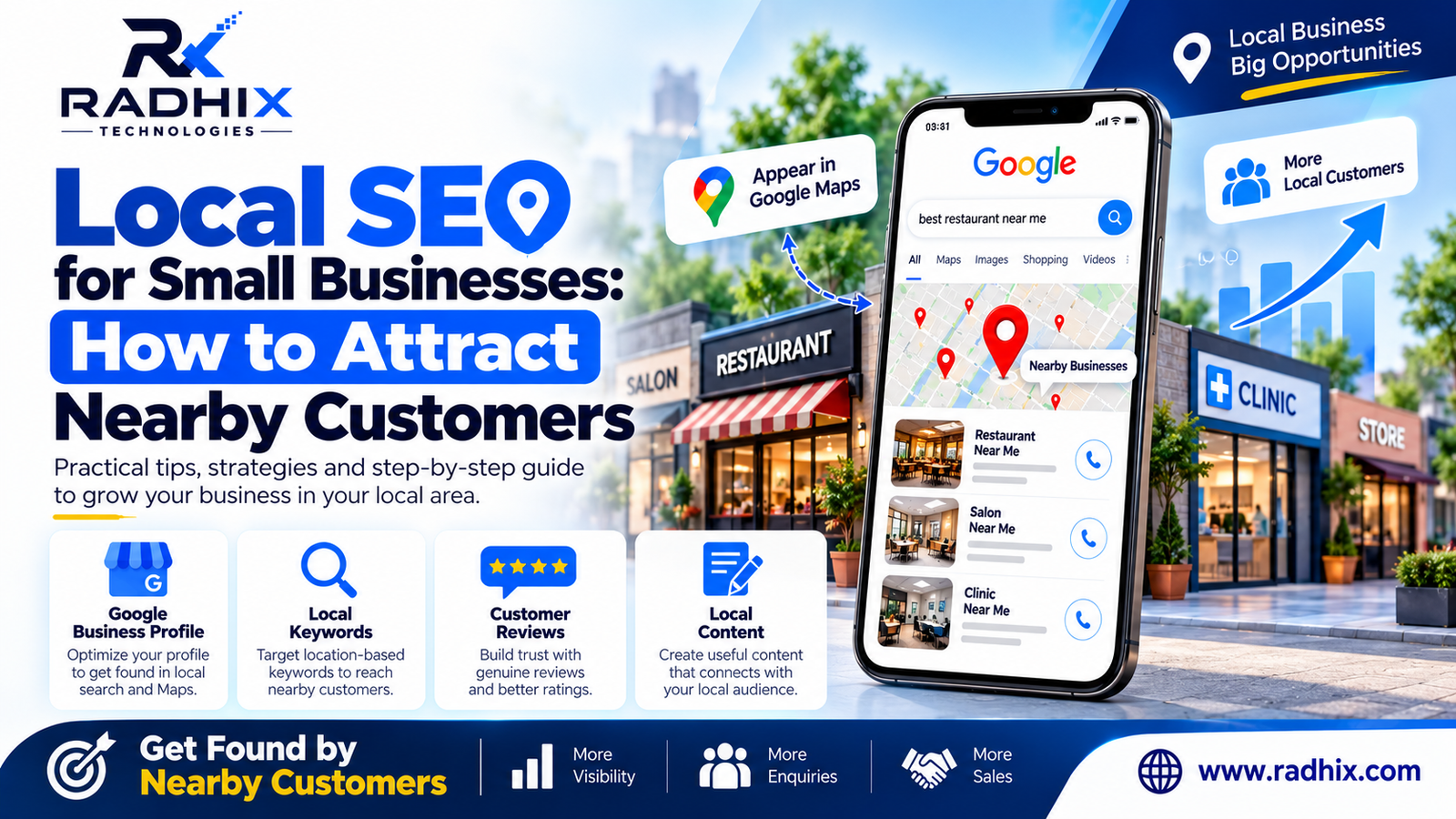
Local SEO for Small Businesses: How to Attract Nearby Customers
If you run a small business, attracting customers from your local area can make a significant difference to your growth. Whether you own a restaurant, salon, retail shop, clinic, consultancy, repair service, or digital agency, your potential customers may already be searching online for the products and services you offer.
For example, someone might search for “best salon near me,” “website development company in Faridabad,” or “plumber near me.” If your business appears in relevant local search results, customers may be more likely to discover your services, visit your website, call you, or request a quotation.
This is where Local SEO for small businesses becomes important.
Local SEO helps businesses improve their visibility in location-based searches on Google Search and Google Maps. It focuses on helping nearby customers discover relevant businesses when they need a particular product or service.
In this guide, Radhix Technologies explains what local SEO is, why it matters, and how small businesses can use practical optimisation strategies to attract nearby customers and build a stronger online presence.
1. What Is Local SEO?
Local SEO, or Local Search Engine Optimisation, is the process of improving your business’s online visibility for searches related to a specific location.
Unlike broader SEO campaigns that may target a national or international audience, local SEO focuses on customers in the areas your business serves.
For example:
- A dentist targeting patients in Faridabad.
- A restaurant attracting customers from nearby neighbourhoods.
- An electrician serving selected areas of Delhi NCR.
- A website development company targeting businesses in Faridabad.
- A clothing store helping nearby shoppers discover its products.
Local SEO can help your business appear in relevant Google Maps results, local search listings, and organic website results.
The objective is not simply to get more website traffic. It is to help the right people find your business when they are looking for relevant products or services.
2. Why Is Local SEO Important for Small Businesses?
Small businesses often operate with limited marketing budgets. Local SEO can help them focus on customers who are more relevant to their products, services, and service areas.
Improve Local Online Visibility
When your business information is complete and relevant to a customer's search, your business has a better opportunity to appear in local search results.
Attract High-Intent Customers
People searching for a service in a particular location may already be considering a purchase or booking.
For example, someone searching for “AC repair service in Faridabad” may need help sooner than someone searching for general information about air conditioners.
Generate Calls and Enquiries
An accurate Google Business Profile can help customers find your phone number, business hours, website, and directions where applicable.
Build Trust and Credibility
Accurate business information, genuine customer reviews, relevant photographs, and helpful responses can help potential customers evaluate your business.
Support Cost-Effective Marketing
You do not pay Google for every click on an organic local search result. However, local SEO still requires time and effort for content, profile management, website improvements, and reputation management.
Compete With Other Local Businesses
A well-maintained online presence can help smaller businesses compete for relevant local searches alongside other businesses in their market.
Local SEO does not guarantee a particular ranking, but it helps make your business information more useful and accessible to potential customers.
3. Set Up and Optimise Your Google Business Profile
One of the most important starting points for local SEO is your Google Business Profile.
This profile can display information about your business on Google Search and Google Maps. Depending on the business type and eligibility, customers may be able to see your location or service area, operating hours, contact details, reviews, photographs, and other information.
Steps to Optimise Your Profile
Step 1: Claim or create your profile.
Visit Google Business Profile and follow the process to create or claim your business listing. Complete Google's verification process when required.
Step 2: Use your real business name.
Enter the name your business genuinely uses in the real world. Do not add unnecessary keywords, locations, or promotional phrases to the business name.
Step 3: Select the correct primary category.
Choose the category that most accurately describes your main business activity. Add relevant additional categories only when appropriate.
Step 4: Complete your business information.
Provide accurate details, including your phone number, website, business hours, services, and address or service area as applicable.
Step 5: Add genuine photographs.
Upload relevant images of your premises, products, services, team, or completed work where appropriate.
Step 6: Keep the information updated.
Update your operating hours, service details, and other information when changes occur.
Step 7: Review profile performance.
Use the available profile performance data to understand how customers discover and interact with your listing.
A complete, accurate profile helps Google and potential customers understand your business. It does not guarantee a top position in search results.
4. Target the Right Local Keywords
Keyword research helps you understand how customers search for products and services in your area.
For local SEO, focus on terms that combine your services with relevant locations or indicate nearby intent.
Examples of Local SEO Keywords
Business typeExample keywordWebsite developmentWebsite development company in FaridabadDigital marketingDigital marketing agency in FaridabadRestaurantBest restaurant in FaridabadSalonUnisex salon near mePlumbingPlumber in FaridabadReal estateProperty dealer in FaridabadDental clinicDentist near meBuilding materialsBuilding material shop in Faridabad
These are examples of search phrases, not claims about their search volume or difficulty.
How to Find Local Keywords
- Think about the questions customers ask before contacting you.
- Research phrases related to your main services.
- Review Google's search suggestions and relevant search results.
- Use Google Search Console to understand queries that already bring visitors to your website.
- Use keyword research tools to investigate search demand and competition.
- Identify the specific locations you genuinely serve.
Use Keywords Naturally
Include relevant local terms in page titles, headings, service descriptions, and website copy when they fit naturally.
Avoid repeating the same city name excessively or creating pages that provide little value beyond changing the location name.
The goal is to create useful information for customers, not to fill pages with keywords.
5. Create Local Landing Pages on Your Website
Your website should clearly explain what your business does, who it serves, and where it operates.
If your business offers multiple services or operates in multiple locations, dedicated landing pages can help customers find the information most relevant to them.
For example, a website development company might have separate pages for:
- Website Development Services
- E-commerce Website Development
- Custom Software Development
- Digital Marketing Services
- Website Development in Faridabad
Each page should contain useful, original information about the service or location.
What Should a Local Landing Page Include?
Clear page title: Describe the service and location accurately.
Helpful service information: Explain what you offer, who it is for, and how the service works.
Local relevance: Include genuine information about the areas you serve or your local experience where applicable.
Contact details: Make it easy for customers to enquire or request a quotation.
Customer proof: Add genuine testimonials, project examples, or case studies when available and permitted.
Mobile-friendly design: Ensure visitors can read the content and use contact options comfortably on their phones.
Do not create dozens of nearly identical location pages if you cannot provide meaningful, location-specific value.
6. Keep Your Business Information Consistent
Your business information should be accurate and consistent across your website, Google Business Profile, and relevant business directories.
Important details include:
- Business name
- Address, where publicly applicable
- Phone number
- Website URL
- Business category
- Operating hours
For example, if your business phone number has changed, update it on your website and relevant listings.
Inconsistent details can confuse potential customers and make it harder for them to contact you.
Where Should You Check Your Listings?
Review your business information on:
- Google Business Profile
- Your official website
- Relevant local business directories
- Industry-specific directories
- Professional association websites, where applicable
- Social media business pages
Focus on reputable platforms that are relevant to your business. Creating a large number of low-quality listings is not a substitute for maintaining accurate business information.
7. Collect Genuine Customer Reviews
Customer reviews can help people evaluate your products or services before making a decision. They also contribute to how prominent a business may appear in local search results.
However, reviews should reflect genuine customer experiences.
How to Encourage More Reviews
Ask customers politely. After completing a purchase or service, invite customers to share honest feedback.
Make the process simple. Share your Google review link through appropriate customer communication channels.
Respond professionally. Thank customers for positive feedback and address negative feedback calmly.
Use feedback to improve. Look for recurring issues or suggestions that can help improve your service.
Avoid incentives for reviews. Do not buy reviews, post fake reviews, or offer rewards in exchange for positive ratings. Follow the applicable platform policies.
How to Respond to Negative Reviews
A professional response can acknowledge the customer's concern and explain how they can contact your business to resolve the issue.
Avoid arguing publicly, disclosing private customer information, or making unsupported claims.
Remember that reviews are only one part of your online presence. Good service and honest communication remain essential.
8. Use Local Content Marketing to Attract Nearby Customers
Publishing helpful local content can give customers more reasons to discover and trust your business.
Instead of publishing only promotional posts, answer questions your potential customers genuinely have.
Local Content Ideas for Small Businesses
A digital marketing agency could publish:
- How Local SEO Helps Small Businesses in Faridabad
- How to Choose a Website Development Company
- Digital Marketing Tips for Local Retail Shops
- How to Improve Your Business's Google Visibility
A restaurant might publish information about its menu, dining options, special opening hours, or locally relevant events.
A building material supplier could create guides explaining material selection, product specifications, or common construction purchasing questions.
Best Practices for Local Content
- Answer real customer questions.
- Use local references only when they are relevant.
- Provide original information and practical advice.
- Add relevant images where they improve understanding.
- Link to related service pages on your website.
- Update content when information becomes outdated.
Consistent, useful content can support your local SEO efforts while helping customers make informed decisions.
9. Make Your Website Mobile-Friendly and Fast
Many people use smartphones to search for nearby businesses, compare services, and contact providers.
If your website is difficult to navigate on a mobile device, potential customers may leave before taking action.
Mobile SEO Checklist
- Use a responsive website design.
- Make text easy to read on small screens.
- Ensure buttons and links are easy to tap.
- Display important contact information clearly.
- Reduce unnecessary scripts and oversized images.
- Fix broken links and navigation problems.
- Use HTTPS to secure connections.
- Test important forms and enquiry buttons.
- Review page performance using tools such as Google PageSpeed Insights.
Website performance is only one part of search visibility, but a fast, usable website can improve the experience for both search visitors and potential customers.
10. Build Local Authority Through Relevant Links and Partnerships
Links and mentions from relevant, trustworthy websites can help people discover your business and may contribute to your website's prominence.
For small businesses, local relationships can provide practical opportunities to build visibility.
Ways to Develop Local Connections
Work with local organisations. Participate in relevant community initiatives or business associations.
Build supplier relationships. Where appropriate, ask partners to include accurate information about your business on their websites.
Share useful expertise. Contribute practical insights to relevant industry publications or local business resources.
Support local events. If your business sponsors an event or participates in a community activity, look for legitimate opportunities to be mentioned online.
Publish useful resources. Create guides or original research that other relevant websites may want to reference.
Focus on genuine relationships and useful contributions. Avoid purchasing spammy links or participating in link schemes intended to manipulate rankings.
11. Track Your Local SEO Performance
Local SEO should be measured against business objectives, not just rankings.
Useful data can help you understand whether your online presence is reaching the right audience and encouraging meaningful actions.
Important Local SEO Metrics
Google Business Profile interactions: Review available data on customer actions, such as calls, website clicks, and direction requests where supported.
Website organic traffic: Use Google Analytics or another suitable analytics platform to understand visits from organic search.
Local search queries: Use Google Search Console to review relevant search queries, impressions, clicks, and page performance.
Qualified enquiries: Track calls, form submissions, bookings, and enquiries that match your target customers.
Lead conversion rate: Measure how many relevant enquiries turn into customers.
Sales and revenue: Where possible, connect marketing activity with completed sales.
Review activity: Monitor customer feedback and respond appropriately.
How Often Should You Review Results?
For most small businesses, a monthly review is a useful starting point. Compare performance over time and investigate meaningful changes rather than reacting to every short-term fluctuation.
Local rankings can vary depending on the searcher's location, competition, and query. A single ranking check does not tell the whole story.
12. Common Local SEO Mistakes to Avoid
Using the Wrong Business Category
Choose categories that accurately describe your real business activities. Irrelevant categories can confuse customers and may violate profile guidelines.
Adding Keywords to Your Business Name
Your profile name should reflect the real-world business name. Unnecessary keywords may lead to policy issues.
Creating Duplicate Business Profiles
Maintain the appropriate profile for your business and follow Google's rules for additional locations or practitioners.
Publishing Fake Reviews
Fake reviews undermine trust and can violate platform policies.
Creating Low-Quality Location Pages
Each location page should provide useful information for customers. Repetitive pages created only to target different city names may offer little value.
Ignoring Customer Reviews
Unanswered feedback can leave customer concerns unresolved. Respond appropriately and use feedback to improve service.
Neglecting Website Updates
Outdated hours, broken forms, incorrect phone numbers, and poor mobile usability can prevent customers from contacting you.
Expecting Instant Rankings
Local SEO takes ongoing effort, and no legitimate strategy can guarantee a specific position in every local search.
13. A Simple 30-Day Local SEO Plan for Small Businesses
If you are new to local SEO, a structured plan can help you make progress without becoming overwhelmed.
Week 1: Fix the Basics
- Claim or verify your Google Business Profile.
- Check your business name and primary category.
- Confirm contact details and operating hours.
- Review your website's contact page.
- Correct any obvious information inconsistencies.
Week 2: Improve Your Website
- Research relevant local keywords.
- Optimise important page titles and headings.
- Improve your main service pages.
- Check mobile usability and page performance.
- Make calls to action clear.
Week 3: Build Trust and Local Relevance
- Upload genuine business photographs.
- Invite customers to leave honest reviews.
- Respond to existing reviews.
- Publish a useful article or local service guide.
- Review relevant local business listings.
Week 4: Measure and Improve
- Review Google Business Profile performance.
- Check search queries in Google Search Console.
- Review website traffic and enquiries.
- Identify pages that need improvement.
- Set priorities for the following month.
This plan establishes a starting point, not a guaranteed ranking timeline. Results depend on your market, location, competition, business category, and implementation.
How Radhix Technologies Can Help
Radhix Technologies helps businesses strengthen their digital presence through website development, custom software solutions, e-commerce development, and related digital services.
For businesses looking to improve their local online presence, a practical strategy may include website optimisation, location-relevant service pages, mobile-friendly design, useful content, and better enquiry pathways.
The right approach depends on your business goals, the areas you serve, your existing website, and your competition.
If your business wants to improve its website and build a stronger foundation for online growth, visit Radhix Technologies to explore our digital solutions.
Conclusion
Local SEO is an important way for small businesses to help nearby customers discover their products and services online.
By maintaining an accurate Google Business Profile, targeting relevant local keywords, creating useful website content, collecting genuine customer reviews, and improving mobile usability, businesses can build a more effective local presence.
The process requires consistency, accurate information, and regular performance reviews. There are no guaranteed rankings, but a well-maintained local SEO strategy can make your business easier to discover and contact.
Start with the basics, focus on your customers' needs, and keep improving your online presence over time.
Frequently Asked Questions
1. What is local SEO for small businesses?
Local SEO is the process of improving a business's visibility in location-based searches on Google Search and Google Maps. It helps relevant nearby customers discover businesses offering the products or services they need.
2. Is local SEO free?
Some activities, such as updating business information, publishing website content, and responding to reviews, can be completed without paying for advertising. However, local SEO may require investment in professional services, content, website improvements, and ongoing management.
3. How do I attract nearby customers through Google?
Maintain an accurate Google Business Profile, use relevant business categories, provide useful website content, encourage genuine reviews, and ensure your contact information is correct. These activities can help customers discover your business, but they do not guarantee a particular ranking.
4. How long does local SEO take to work?
The timeline varies by industry, location, competition, and the condition of your existing online presence. Some improvements may be noticed relatively quickly, while meaningful visibility changes can take longer. Review performance consistently rather than expecting guaranteed results within a fixed period.
5. Do small businesses need a website for local SEO?
A website is not mandatory for every Google Business Profile, but it can provide valuable information about your services, location, expertise, and contact options. A useful website also gives you more control over the information customers find about your business.
6. How important are Google reviews for local SEO?
Reviews help customers evaluate a business and contribute to prominence in Google's local ranking systems. Encourage genuine feedback, respond professionally, and never buy or fabricate reviews.
7. Can I do local SEO myself?
Yes. Many small businesses can begin by improving their business profile, correcting website information, collecting genuine reviews, and creating useful local content. Professional assistance may help when technical SEO, multiple locations, or complex competition requires additional expertise.
8. What is the difference between local SEO and traditional SEO?
Traditional SEO often focuses on improving visibility for a broader range of search queries, while local SEO focuses on searches with local intent. Both can involve website optimisation, useful content, technical improvements, and relevant links.
9. Does local SEO help service-area businesses?
Yes. Businesses that travel to customers, such as plumbers or electricians, may be eligible for a service-area Google Business Profile. They should follow Google's rules for accurately representing their business and service areas.
10. How can I measure local SEO success?
Track relevant profile interactions, organic website traffic, local search queries, qualified enquiries, calls, bookings, and completed sales where measurable. These metrics provide a more useful picture of business performance than rankings alone.