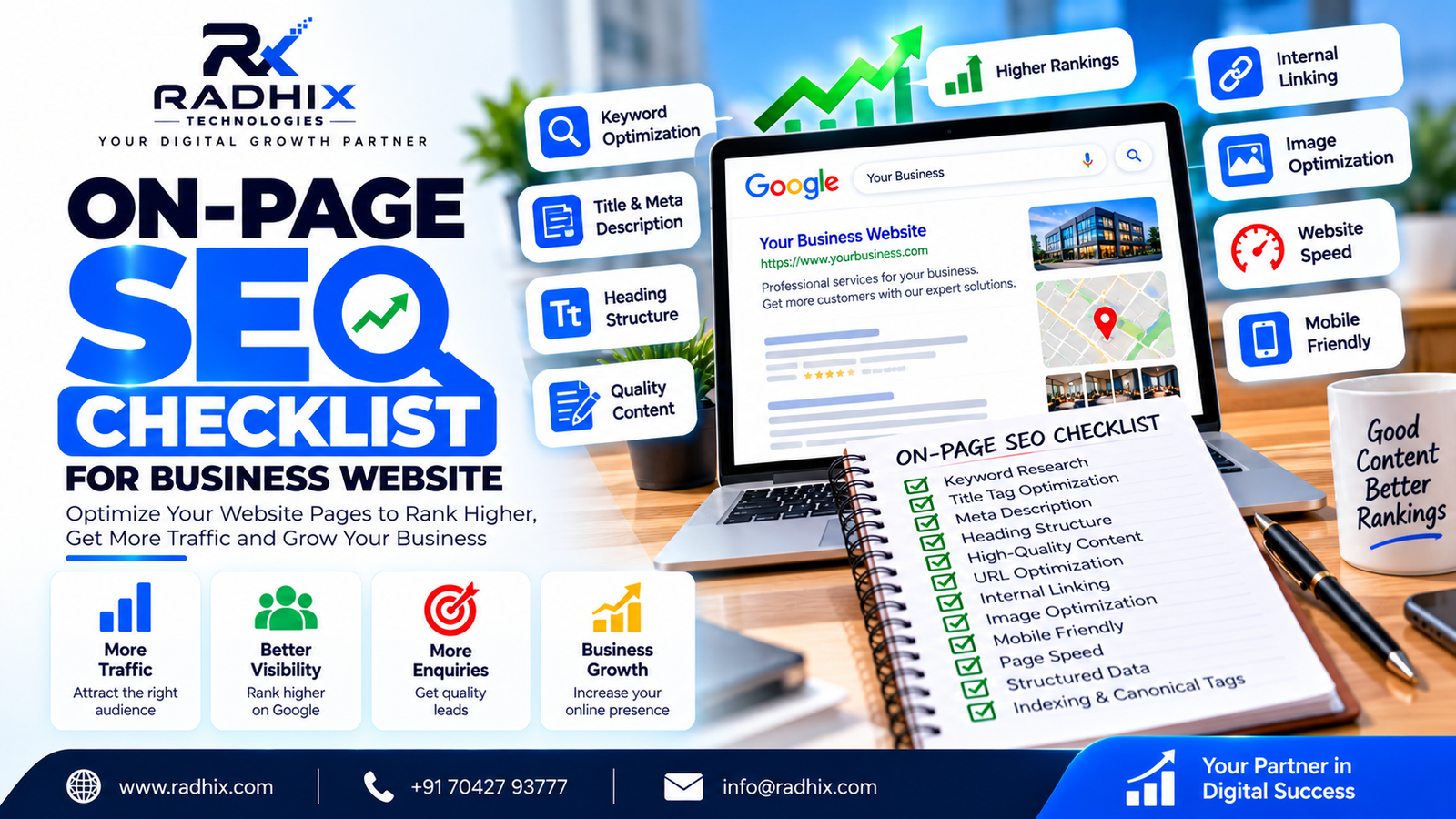
On-Page SEO Checklist for Business Website
Introduction
A professional website is an important part of building a strong online presence, but simply publishing a website does not guarantee that potential customers will find it through search engines. To improve organic visibility, businesses need to make their website content clear, relevant, well-structured, and easy for search engines to understand.
On-page SEO is the process of optimising individual webpages to improve their relevance, usability, and presentation in search results. It includes title tags, headings, content quality, URLs, internal links, images, and other elements that help visitors and search engines understand a page.
In this guide, we will cover a practical on-page SEO checklist for business websites, explain how to implement each step, and highlight common mistakes to avoid.
What Is On-Page SEO?
On-page SEO refers to improvements made directly to a website's pages and content to help search engines understand the topic and help visitors find useful information.
Important on-page SEO elements include:
- Page titles and meta descriptions
- Headings and content structure
- Keyword targeting and search intent
- URL structure
- Content quality and readability
- Internal linking
- Image optimisation and alt text
- Mobile usability and page experience
- Relevant structured data, where appropriate
On-page SEO works alongside technical SEO, off-page SEO, and useful content. No single optimisation guarantees a higher ranking, but a well-organised website creates a stronger foundation for organic search performance.
On-Page SEO Checklist for Business Websites
1. Research Relevant Keywords
Keyword research helps you understand what your potential customers search for when looking for your products or services.
For example, a website development company may target search terms such as:
- Website development company in Faridabad
- Business website development services
- Custom website development
- E-commerce website development
- Affordable website design services
Checklist:
- Identify the primary topic for each important page.
- Research keywords relevant to your products or services.
- Understand the search intent behind each keyword.
- Use specific, relevant long-tail keywords where appropriate.
- Avoid targeting unrelated or misleading keywords.
- Map different primary topics to suitable pages.
- Review existing pages for unnecessary keyword overlap.
Choose keywords based on relevance and customer needs rather than search volume alone.
2. Optimise Your Page Title
The title tag helps search engines and users understand what a webpage is about. It may appear as the clickable headline in search results, although Google can generate a different title link when appropriate.
Best practices:
- Write a unique title for every important page.
- Clearly describe the page's main topic.
- Place the most relevant wording naturally near the beginning.
- Include your brand name where it makes sense.
- Avoid repetitive keywords and misleading claims.
- Keep titles concise and descriptive.
Example:
Instead of: Home | Services | Company
Use: Website Development Services for Businesses | Radhix
The ideal title depends on the page's purpose. There is no universal character limit that guarantees Google will display the full title.
3. Write Helpful Meta Descriptions
A meta description summarises the content of a webpage. Search engines may use it as the snippet in search results, but they can also generate a snippet from the page content.
Checklist:
- Write a unique description for each important page.
- Summarise the page accurately.
- Explain the main benefit or information visitors will find.
- Include relevant keywords naturally.
- Use clear, persuasive language without exaggeration.
- Avoid duplicate descriptions across multiple pages.
Example:
“Explore professional website development services for your business. Discover custom website solutions, responsive design, and features tailored to your requirements.”
Meta descriptions are not a direct Google ranking factor, but a useful description can help searchers understand the page before visiting.
4. Use a Clear Heading Structure
Headings organise your content and make it easier to scan. They also help communicate the relationships between different sections of a page.
Checklist:
- Use a clear main heading that reflects the page topic.
- Organise major sections with descriptive subheadings.
- Use lower-level headings for relevant subsections.
- Keep headings meaningful rather than keyword-stuffed.
- Make sure the page's structure is logical.
- Avoid using headings purely to change text size or appearance.
For a blog, the main title can introduce the topic, while subheadings explain the key points and supporting sections.
A specific heading hierarchy is useful for accessibility and content organisation, but headings alone do not guarantee rankings.
5. Create High-Quality, Search-Intent-Focused Content
Your content should solve the visitor's problem and provide information that matches what they expected to find.
For example, someone searching for “business website development cost” may want to understand pricing factors, project scope, design options, and maintenance requirements.
Content optimisation checklist:
- Answer the main question clearly.
- Provide relevant and accurate information.
- Include practical examples where useful.
- Remove unnecessary repetition and filler.
- Explain industry-specific terms when needed.
- Update outdated information.
- Include original insights or meaningful experience where possible.
- Review grammar, readability, and factual accuracy.
- Add a clear next step for readers where appropriate.
Avoid writing content solely to reach a particular word count. The appropriate length depends on the topic and what users need to understand it.
6. Create SEO-Friendly URLs
A clear URL helps users understand the page topic and makes website management easier.
Best practices:
- Use short, descriptive URLs.
- Include relevant words naturally.
- Separate words with hyphens.
- Avoid unnecessary parameters where they are not needed.
- Maintain a consistent URL structure.
- Avoid creating duplicate pages with different URLs unnecessarily.
Example:
Less descriptive:
radhix.com/page?id=123
More descriptive:
radhix.com/blogs/on-page-seo-checklist-business-website
If a page URL has already been published and indexed, do not change it casually. When a change is necessary, use an appropriate redirect and update relevant internal links and canonical information.
7. Add Relevant Internal Links
Internal links connect related pages on your website. They help visitors discover additional information and help search engines understand how your content is connected.
Checklist:
- Link relevant blogs to related service pages.
- Connect supporting articles to useful guides.
- Use descriptive anchor text.
- Ensure important pages are easy to reach.
- Fix broken internal links.
- Avoid excessive links that distract from the content.
- Link only where the destination provides genuine value.
For example, a blog about on-page SEO can link to a relevant SEO service page or a related article about technical SEO.
Internal links should support the reader's journey rather than simply add keywords to a page.
8. Optimise Images and Alt Text
Images can improve a page's usefulness, but large or poorly described images may affect loading performance and accessibility.
Image SEO checklist:
- Use relevant, high-quality images.