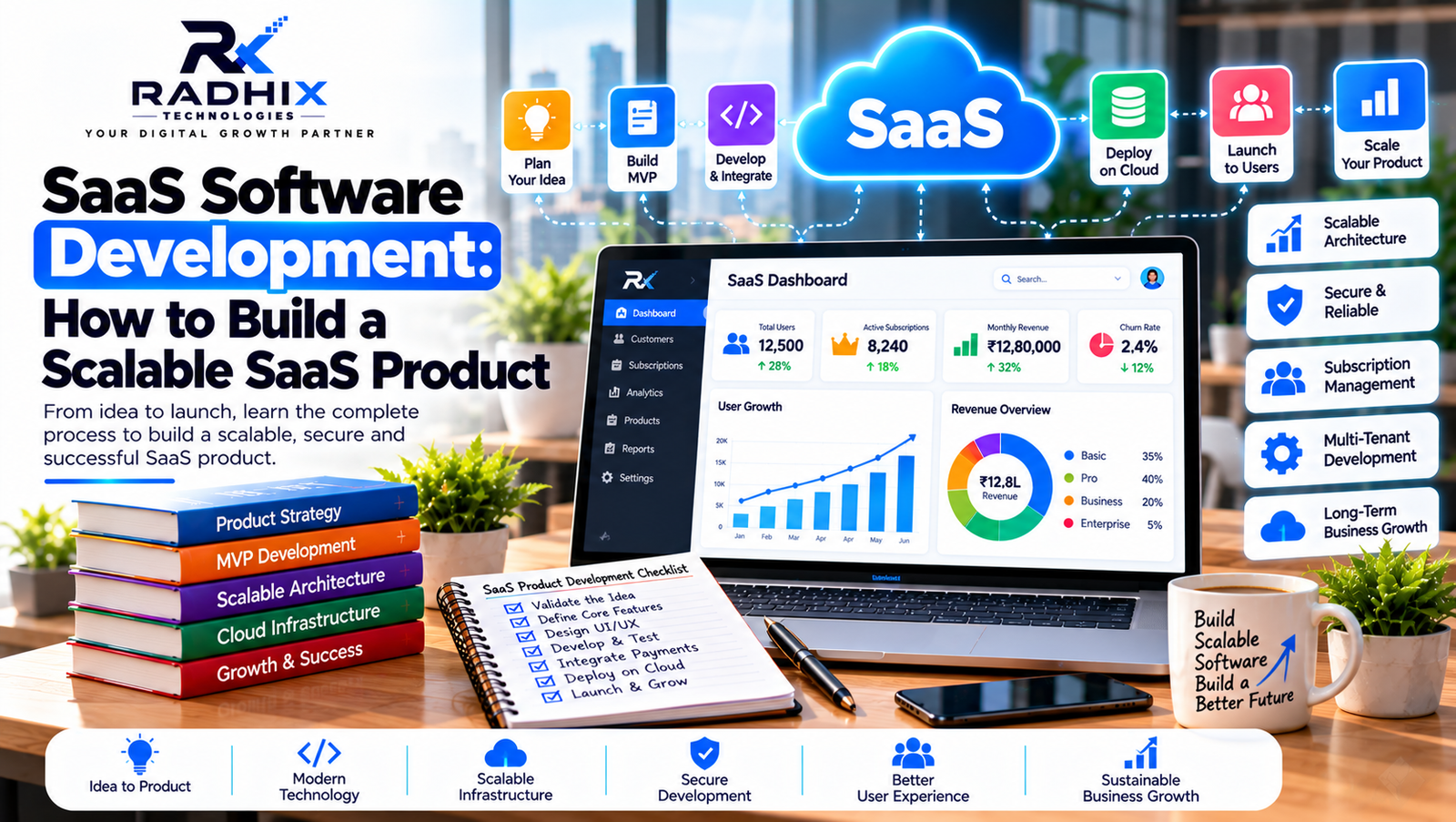
SaaS Software Development: How to Build a Scalable SaaS Product
Software as a Service (SaaS) has transformed how businesses develop, deliver, and use software. Instead of purchasing and installing traditional software on individual computers, customers can access SaaS applications through the internet using a web browser or mobile application.
From CRM and project management platforms to accounting tools, HR systems, e-commerce solutions, and AI-powered applications, SaaS products are becoming an important part of modern business operations.
However, building a successful SaaS product requires more than developing an application and putting it online. Businesses need a clear product strategy, scalable architecture, secure infrastructure, user-friendly design, subscription management, and a reliable development process.
In this guide, we will explain SaaS software development, how to build a scalable SaaS product, the technologies involved, development stages, important features, and common mistakes to avoid.
What Is SaaS Software Development?
SaaS software development is the process of designing, building, deploying, and maintaining software applications that customers access over the internet.
Unlike traditional software, SaaS products are generally hosted on cloud infrastructure and managed by the service provider. Customers typically access the application through subscriptions or other pricing models.
Examples of popular SaaS products include:
- Customer Relationship Management (CRM) platforms
- Project management applications
- Accounting and billing software
- Human Resource Management Systems
- Email marketing platforms
- Online collaboration tools
- AI-powered business applications
A SaaS product can serve individual users, small businesses, or large enterprises depending on its features and architecture.
How Does a SaaS Product Work?
A SaaS application generally follows a cloud-based delivery model.
The service provider hosts the software, manages its infrastructure, maintains the application, and provides access to customers through the internet.
A typical SaaS workflow includes:
- A customer visits the SaaS website.
- The customer creates an account.
- The customer selects a subscription plan, if applicable.
- The system authenticates the user.
- The customer accesses the application dashboard.
- The application processes requests through its backend and database.
- The customer uses the available features according to their permissions and subscription.
- The platform manages billing, renewals, and account access according to its configured rules.
This model allows software providers to manage one product while serving multiple customers.
Why Businesses Are Investing in SaaS Product Development
SaaS development offers several business opportunities when the product solves a genuine customer problem.
1. Recurring Revenue Opportunities
SaaS businesses commonly use monthly, quarterly, or annual subscription plans.
This creates opportunities for recurring revenue, although actual revenue depends on customer acquisition, retention, pricing, and operating costs.
2. Centralised Software Management
Since the application is hosted centrally, the provider can manage updates, infrastructure, and maintenance without requiring customers to install every new version manually.
3. Access From Multiple Devices
Customers can access SaaS applications through supported browsers and mobile devices, depending on the product design.
4. Easier Product Updates
The development team can introduce new features, improve performance, and fix bugs through controlled application updates.
5. Business Expansion Opportunities
A SaaS product can be designed to support additional customers, subscription plans, integrations, and modules as the business grows.
Step-by-Step Process to Build a Scalable SaaS Product
Developing a scalable SaaS application requires proper planning and a structured development approach.
Step 1: Identify a Real Market Problem
Before starting development, identify the problem your SaaS product will solve.
Research your target audience, competitors, existing solutions, and customer expectations.
Consider these questions:
- Who will use the product?
- What problem does it solve?
- What alternatives are customers currently using?
- Which features are essential?
- Why would customers pay for this solution?
A successful SaaS product should provide practical value rather than simply offering a large number of features.
Step 2: Define Your SaaS Business Model
Choose a business model that supports your target customers and product strategy.
Common SaaS pricing models include:
Subscription-Based Pricing: Customers pay monthly, quarterly, or annually.
Freemium Model: Basic features are available free, while advanced features require a paid subscription.
Usage-Based Pricing: Customers pay according to their usage, such as API requests, storage, or transactions.
Tiered Pricing: Different plans offer different features, limits, and support levels.
The pricing model should be aligned with customer value, infrastructure costs, and the product's long-term business objectives.
Step 3: Plan Your MVP
An MVP (Minimum Viable Product) is an initial version of the software containing the essential features needed to validate the product idea.
Instead of developing every planned feature immediately, start with the core functionality.
A typical SaaS MVP may include:
- User registration and login
- User dashboard
- Profile management
- Core product functionality
- Subscription plan management
- Payment gateway integration
- Admin dashboard
- Basic analytics and reporting
Launching an MVP allows businesses to collect feedback and understand how customers use the product before investing in more advanced features.
Step 4: Design the UI/UX
A SaaS platform should be easy to understand and navigate.
A well-designed interface helps users complete tasks without unnecessary complexity.
Important UI/UX components include:
- Simple onboarding
- Clean dashboard layouts
- Responsive design
- Easy navigation
- Clear subscription information
- User-friendly forms
- Helpful notifications
- Accessible account settings
Tools such as Figma can be used to create wireframes, prototypes, and interface designs before development begins.
Step 5: Choose the Right SaaS Architecture
Architecture plays an important role in the scalability, reliability, and maintainability of a SaaS product.
Common architectural approaches include:
Monolithic Architecture: Different application components are developed and deployed as a single application. This can be suitable for an initial product with a manageable scope.
Microservices Architecture: The application is divided into smaller, independently deployable services. This can be useful for complex platforms with separate business domains, but it also introduces additional infrastructure and operational complexity.
Multi-Tenant Architecture: Multiple customers use the same application infrastructure while their data and access remain logically separated.
Single-Tenant Architecture: Each customer receives a separate application environment or dedicated instance, depending on the deployment model.
The right architecture depends on product complexity, security requirements, expected customer growth, and operational resources.
Step 6: Develop the Frontend and Backend
SaaS application development generally involves two major components.
Frontend Development
The frontend is the part of the application that users interact with.
It includes:
- Login and registration pages
- User dashboards
- Subscription interfaces
- Account settings
- Reports and analytics
- Product features and workflows
Backend Development
The backend handles application logic, data processing, authentication, subscriptions, and communication with external services.
It may include:
- API development
- Database management
- User authentication
- Role-based permissions
- Subscription management
- Payment processing
- Notifications
- Administrative controls
Both components must work together to deliver a reliable user experience.
Step 7: Integrate Payment and Subscription Management
Payment and subscription functionality is an important part of many commercial SaaS products.
Common features include:
- Subscription plan selection
- Monthly and annual billing
- Payment gateway integration
- Subscription renewal
- Invoice generation
- Payment history
- Failed payment handling
- Cancellation and refund workflows
- Plan upgrades and downgrades
The application should also manage subscription status and feature access according to clearly defined business rules.
Step 8: Implement Security and Data Protection
SaaS applications may store customer profiles, business records, financial information, and other sensitive data.
Security should be considered from the beginning of development.
Important security measures include:
- Secure authentication
- Role-based access control
- Data encryption in transit and at rest
- Secure API endpoints
- Input validation
- Database access controls
- Regular backups
- Activity logs
- Security testing
- Monitoring and incident response
For multi-tenant SaaS products, tenant isolation is particularly important. One customer's data must not become accessible to another customer through application errors or incorrectly configured permissions.
Applicable privacy and data protection requirements should also be considered based on the target market.
Step 9: Testing and Quality Assurance
Before launching a SaaS product, the development team should test its functionality, security, and performance.
Testing may include:
- Functional testing
- API testing
- User interface testing
- Database testing
- Cross-browser testing
- Mobile responsiveness testing
- Security testing
- Performance testing
- Load and scalability testing
Testing should cover different user roles, subscription plans, customer accounts, and important business workflows.
Step 10: Deploy and Monitor the SaaS Application
After testing and approval, the SaaS application can be deployed to a production environment.
Deployment activities may include:
- Cloud server configuration
- Database setup
- Domain and SSL configuration
- Production environment setup
- Automated deployment pipelines
- Backup configuration
- Application monitoring
- Error tracking
After launch, continuous monitoring helps the team identify performance issues and maintain service reliability.
Essential Features of a Scalable SaaS Product
A professional SaaS platform should include features that support users, administrators, subscriptions, and future expansion.
FeaturePurposeUser AuthenticationSecure account accessUser DashboardCentralised access to application featuresMulti-Tenant ManagementSupport multiple customer accountsRole-Based AccessControl user permissionsSubscription ManagementManage pricing plans and renewalsPayment IntegrationProcess customer paymentsAdmin DashboardManage users and platform operationsAPI IntegrationConnect external servicesAnalytics and ReportsMonitor product usage and performanceNotificationsInform users about important activitiesData BackupSupport data recoveryAudit LogsTrack important system activities
The final feature list should depend on the SaaS product's business model and target users.
Recommended Technology Stack for SaaS Development
Selecting the right technology stack is important for performance, security, maintainability, and scalability.
The following technologies are commonly used in SaaS development:
Development AreaRecommended TechnologiesFrontendReact.js, Next.jsBackendNode.js, Express.js, PythonDatabasePostgreSQL, MongoDB, MySQLMobile AppFlutter, React NativeCloud HostingAWS, Microsoft Azure, Google CloudAPI DevelopmentREST APIs, GraphQLUI/UX DesignFigmaVersion ControlGit, GitHubCachingRedisContainerisationDockerMonitoringCloud monitoring and application monitoring tools
Not every SaaS product needs all these technologies. The development team should select the stack according to application requirements, expected traffic, team expertise, and infrastructure budget.
How to Make a SaaS Product Scalable
Scalability means that a software application can handle increasing users, data, and workloads without unacceptable performance degradation or operational problems.
Here are important practices for building a scalable SaaS platform.
1. Use a Scalable Database Design
Plan database structures carefully and use appropriate indexing, query optimisation, backups, and data management practices.
2. Implement Caching
Caching can reduce repeated database operations and improve response times for frequently accessed information.
3. Use Cloud Infrastructure
Cloud platforms provide infrastructure services that can support changing application requirements.
4. Optimise API Performance
Efficient API design, pagination, request validation, and appropriate response handling can improve application performance.
5. Plan for Increased Traffic
Load balancing, horizontal scaling, background processing, and performance monitoring can help applications manage growing workloads.
6. Build Modular Features
A modular codebase makes it easier to maintain existing features and introduce additional functionality.
7. Monitor Application Performance
Track response times, errors, server utilisation, database performance, and important application metrics.
Scalability is not achieved through technology selection alone. It requires good architecture, testing, monitoring, and continuous optimisation.
How Much Does SaaS Software Development Cost in India?
The cost of SaaS product development in India depends on the product's scope, complexity, technology stack, integrations, security requirements, and development timeline.
Some major cost factors include:
1. Product Complexity: A basic SaaS MVP generally requires less development effort than a multi-module enterprise platform.
2. Number of Features: Advanced dashboards, analytics, automation, multi-tenancy, and subscription management can increase development effort.
3. UI/UX Design: Custom interface design and complex user workflows affect the overall project scope.
4. Third-Party Integrations: Payment gateways, communication APIs, AI services, and external business systems may involve integration and subscription expenses.
5. Cloud Infrastructure: Hosting, storage, bandwidth, backups, and monitoring create ongoing operational costs.
6. Security Requirements: Authentication, tenant isolation, encryption, compliance, and security testing require appropriate planning and resources.
7. Maintenance: Bug fixes, upgrades, monitoring, and new features should be considered in the long-term budget.
For an accurate estimate, businesses should prepare a clear feature list and request a detailed quotation covering development, infrastructure, third-party services, and maintenance.
Common Mistakes to Avoid in SaaS Development
Building a SaaS product involves technical and business decisions. Avoid these common mistakes:
- Starting development without market research.
- Building too many features in the first version.
- Ignoring customer feedback.
- Choosing technology without considering product requirements.
- Not planning for multi-tenant data isolation.
- Ignoring subscription and billing workflows.
- Overlooking application security.
- Skipping load and performance testing.
- Not monitoring cloud infrastructure costs.
- Ignoring customer onboarding and support.
A focused MVP, well-planned architecture, and continuous product improvement can help reduce development risks.
Why Choose Radhix Technologies for SaaS Software Development?
Radhix Technologies Pvt. Ltd. helps businesses transform software ideas into practical digital solutions.
Our development services include:
- SaaS Product Development
- Custom Software Development
- Web Application Development
- CRM and ERP Development
- Multi-Tenant Application Development
- Subscription and Payment Integration
- API and Third-Party Integrations
- Android and iOS App Development
- UI/UX Design
- Software Maintenance and Support
We focus on understanding product requirements, selecting suitable technologies, designing user-friendly interfaces, and developing software according to the agreed scope.
Whether you are a startup planning your first SaaS MVP or an established organisation looking to launch a cloud-based software platform, Radhix Technologies can help you plan and develop your digital product.
Visit Radhix Technologies to explore our software development services.
Conclusion
Building a scalable SaaS product requires a combination of business planning, product strategy, software architecture, user experience, security, and ongoing optimisation.
Businesses should begin by identifying a genuine market problem, defining their target audience, and developing an MVP with essential features. As the product grows, they can introduce additional functionality, improve infrastructure, and optimise performance based on actual user requirements.
Choosing the right SaaS development partner can also make a significant difference in the development journey.
With a clear strategy and the right technical foundation, businesses can build SaaS products that deliver value to customers and support long-term growth.
Frequently Asked Questions (FAQs)
1. What is SaaS software development?
SaaS software development is the process of creating cloud-based applications that customers access through the internet, commonly using subscription-based pricing models.
2. How do I build a scalable SaaS product?
Start with market research, define your MVP, select a suitable architecture, develop secure application modules, implement subscription management, and test performance before launch.
3. What is an MVP in SaaS development?
An MVP is the initial version of a SaaS product that includes essential features needed to launch, validate the product idea, and collect customer feedback.
4. Which technology is best for SaaS development?
Technologies such as React.js, Next.js, Node.js, Python, PostgreSQL, MongoDB, and cloud platforms can be used. The best combination depends on the product's requirements.
5. What is multi-tenant architecture in SaaS?
Multi-tenant architecture allows multiple customers to use the same application infrastructure while maintaining logical separation of their data and access permissions.
6. How much does it cost to develop a SaaS product in India?
The cost depends on features, architecture, integrations, security, design, and development effort. A requirement-based quotation provides a more accurate estimate.
7. How long does SaaS product development take?
A focused MVP may take several weeks or months, while a complex SaaS platform may require a longer development cycle. The timeline depends on the approved scope and resources.
8. Does a SaaS application require regular maintenance?
Yes. SaaS products require ongoing monitoring, security updates, bug fixes, backups, infrastructure management, and feature improvements.
9. Can a SaaS product have both web and mobile applications?
Yes. A SaaS business can offer a web application and companion Android or iOS applications, provided the product architecture and requirements support them.
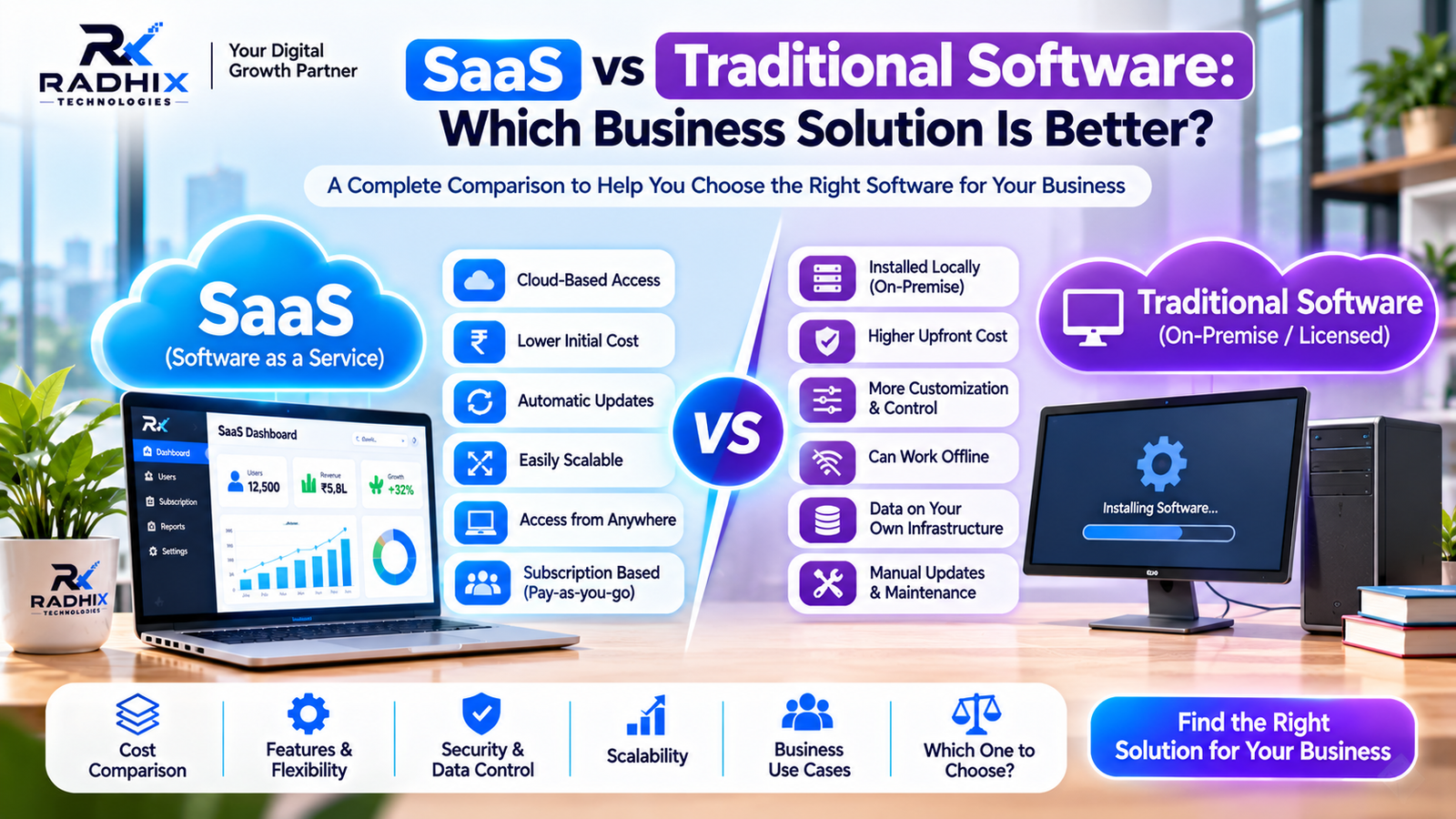
10. What is the difference between SaaS and traditional software?
Traditional software is often installed and managed on individual devices or local infrastructure. SaaS is generally hosted by a service provider and accessed online through a managed cloud-based service.