SEO for Service-Based Businesses: A Step-by-Step Guide
In today's competitive digital world, having a website is not enough to attract customers. Service-based businesses need to make sure that potential customers can find them when searching online for the services they offer.
Whether you run a digital marketing agency, website development company, consultancy, salon, repair service, cleaning business, or professional service firm, Search Engine Optimization (SEO) can help improve your online visibility and attract relevant customers.
For example, when someone searches for "website development company in Faridabad" or "best digital marketing agency near me," businesses with relevant and well-optimized online presence have an opportunity to appear in search results.
But how can a service-based business improve its Google rankings and generate more enquiries?
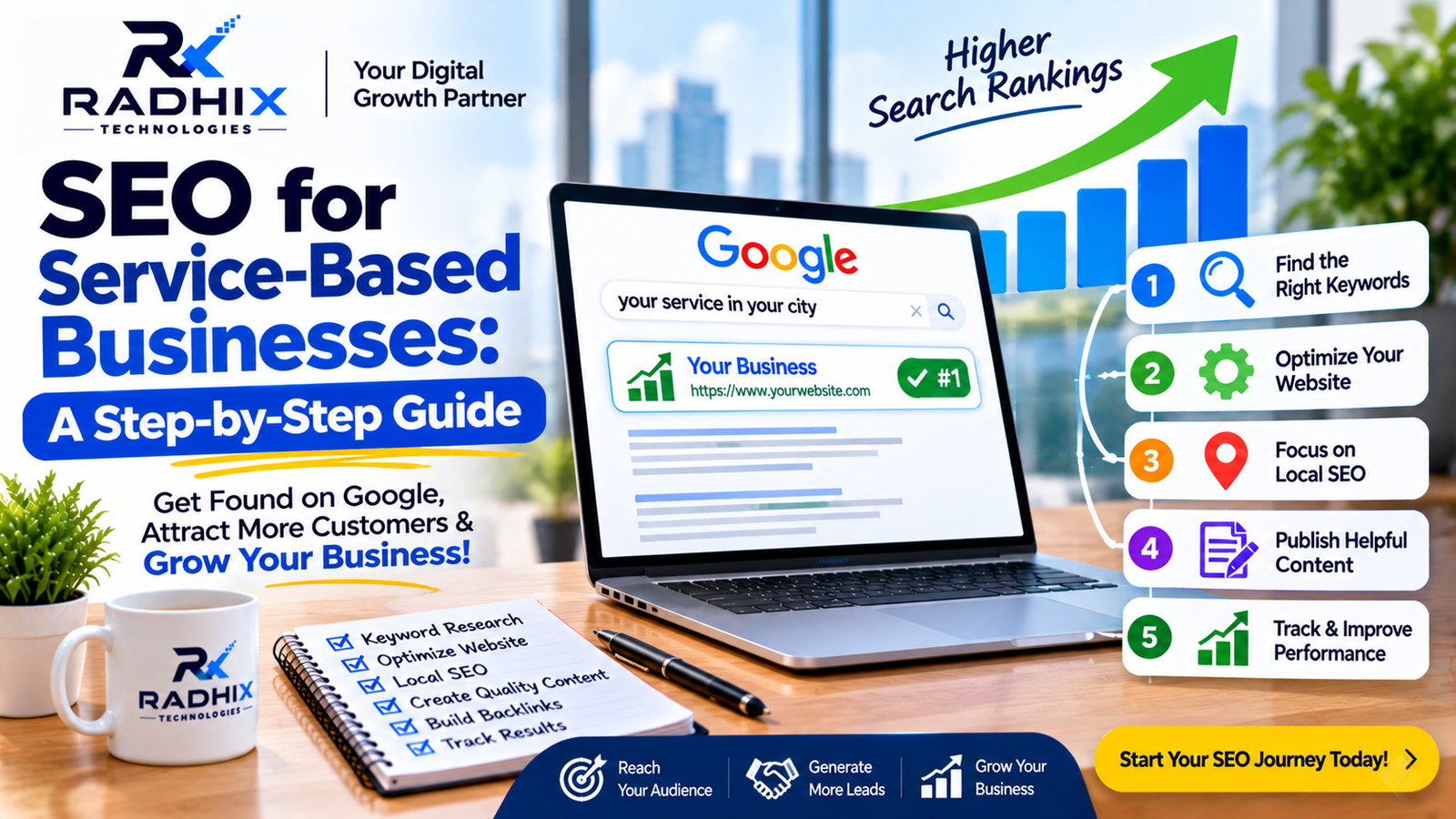
In this guide, we will explain SEO for service-based businesses step by step, covering keyword research, website optimization, local SEO, content marketing, backlinks, and performance tracking.
What Is SEO for Service-Based Businesses?
SEO for service-based businesses is the process of optimizing a website and its online presence to improve visibility in search engine results for relevant service-related searches.
Unlike ecommerce businesses that primarily focus on product pages, service-based businesses need to attract people who are looking for professional assistance, local services, or specific solutions.
For example, a website development company may target searches such as:
- Website development company in Faridabad
- Custom website development services
- Ecommerce website developers
- Affordable website design services
- Professional website development agency
The objective is to connect your business with people who are actively searching for the services you provide.
Why Is SEO Important for Service-Based Businesses?
SEO can support business growth by helping potential customers discover your services through organic search.
Here are some important benefits:
1. Attract Relevant Customers
SEO helps your website appear for searches related to your services. This can bring visitors who are already interested in the solutions you offer.
2. Generate More Business Enquiries
Well-optimized service pages can encourage visitors to contact your business, request quotations, book appointments, or submit enquiry forms.
3. Build Brand Credibility
A professional website with helpful content, clear service information, genuine customer reviews, and a strong online presence can help build customer confidence.
4. Improve Local Visibility
Local SEO can help businesses reach customers searching for services in specific cities, areas, or nearby locations.
5. Support Long-Term Marketing Growth
Unlike paid advertising, which generally requires ongoing spending to maintain paid exposure, useful SEO content can continue attracting organic visitors over time.
6. Understand Customer Needs
Search queries can reveal what potential customers want, what problems they face, and which services they are researching.
SEO for Service-Based Businesses: Step-by-Step Guide
Follow these steps to develop a practical SEO strategy for your service-based business.
Step 1: Understand Your Target Audience and Services
Before starting SEO, identify the services your business offers and the customers you want to reach.
Ask yourself:
- What services does my business provide?
- Who needs these services?
- Which industries do my customers belong to?
- Which locations do I serve?
- What problems do customers want to solve?
- What questions do they ask before choosing a service provider?
For example, a digital solutions company may offer:
- Website development
- Mobile app development
- Digital marketing
- Search engine optimization
- Ecommerce development
- Custom software development
Each service may attract a different audience and require a separate SEO strategy.
Tip: Create a clear list of your main services and identify the most valuable customer groups for each one.
Step 2: Conduct Keyword Research
Keyword research helps you identify the search terms potential customers use when looking for your services.
Start with your main services and expand them into relevant search phrases.
For example:
Main ServiceTarget KeywordsWebsite DevelopmentWebsite development company, custom website developmentSEO ServicesSEO agency, SEO services for businessesMobile App DevelopmentMobile app development company, Android app developersDigital MarketingDigital marketing agency, online marketing servicesEcommerce DevelopmentEcommerce website development, online store development
You can discover keyword ideas using:
- Google Keyword Planner
- Google Search Console
- Google Trends
- Google Autocomplete
- Ahrefs
- Semrush
Evaluate keywords based on search intent, business relevance, competition, and estimated search demand.
Tip: Do not target only broad keywords. Specific phrases such as "ecommerce website development company in Faridabad" may better communicate what a potential customer needs.
Step 3: Create Dedicated Service Pages
One of the most important SEO practices for service-based businesses is creating dedicated pages for individual services.
Avoid putting every service on one general page if each service has a distinct audience and search intent.
For example, a website development company could create separate pages for:
- Website Development Services
- Ecommerce Website Development
- Custom Software Development
- Mobile App Development
- SEO Services
- Digital Marketing Services
Each service page should include:
- A clear and descriptive page title.
- An introduction explaining the service.
- Customer problems and solutions.
- Important features and benefits.
- Your process or working approach.
- Relevant examples or case studies, where available.
- Frequently asked questions.
- A clear call to action.
Tip: Make each service page genuinely useful and unique. Avoid creating multiple pages with nearly identical content just to target different keywords.
Step 4: Optimize Your Website's On-Page SEO
On-page SEO involves improving individual website pages so that visitors and search engines can understand their content.
Important elements include:
Page Titles
Write unique titles that clearly describe each page.
Example:
Website Development Company in Faridabad | Radhix Technologies
Meta Descriptions
Write useful summaries that explain what visitors can expect from the page.
Example:
Explore professional website development services for businesses, including custom websites, ecommerce solutions, and responsive web design.
Heading Structure
Use headings to organize your content logically.
- H1: Main page heading
- H2: Major sections
- H3: Supporting topics
URL Structure
Use short, descriptive URLs.
Example:
radhix.com/services/website-development
Image Optimization
Use descriptive image file names and meaningful alt text. Compress images and choose suitable formats to support website performance.
Internal Linking
Link related blogs, service pages, and useful resources to help visitors discover more information.
Tip: Include keywords naturally. Avoid repeating the same keyword excessively or writing content only for search engines.
Step 5: Focus on Local SEO
Local SEO is particularly valuable for businesses that serve customers in specific geographic areas.
When someone searches for a service near their location, Google may show local business results alongside regular organic results.
For example:
- Website development company in Faridabad
- Digital marketing agency in Delhi NCR
- AC repair service near me
- Interior designer in Gurgaon
To improve local SEO:
Optimize Your Google Business Profile
For eligible businesses, create or claim a Google Business Profile and provide accurate information.
Include:
- Correct business name
- Accurate business address or service area
- Business phone number
- Website link
- Relevant business categories
- Working hours
- Service descriptions
- Genuine business photographs
Maintain Consistent Business Information
Keep your business name, address, and phone number consistent across your website and relevant business listings.
Collect Genuine Customer Reviews
Encourage satisfied customers to share honest feedback. Respond professionally to reviews and address customer concerns appropriately.
Create Useful Location-Specific Content
If your business serves multiple locations, create location pages only when you can provide genuinely useful and distinct information for each area.
Avoid creating numerous duplicate location pages with only the city name changed.
Step 6: Publish Helpful Blog Content
Blogging is an effective way to target informational searches and answer questions that potential customers may have before purchasing a service.
For example, a website development company can publish blogs such as:
- How Much Does Website Development Cost in India?
- How to Choose the Best Website Development Company
- Custom Website Development vs Template Websites
- Why Does Every Business Need a Professional Website?
- How to Improve Website Speed and Performance?
A digital marketing agency can publish:
- How Does SEO Work for Small Businesses?
- How to Create a Digital Marketing Strategy
- Content Marketing vs Paid Advertising
- Keyword Research for Beginners
- How to Improve Google Search Visibility
When creating blogs:
- Research the search intent.
- Write original and useful information.
- Use clear headings.
- Include relevant examples.
- Link to related service pages.
- Update content when necessary.
Tip: Every blog should have a clear purpose and provide useful information to the reader. Avoid publishing thin or repetitive articles simply to increase the number of posts.
Step 7: Improve Website Speed and Mobile Experience
Your website should provide a smooth experience across desktops, tablets, and smartphones.
A slow or difficult-to-use website can frustrate visitors and reduce the chances of enquiries.
Focus on:
- Responsive website design.
- Optimized images.
- Fast server response.
- Reduced unnecessary scripts.
- Simple navigation.
- Readable fonts and text.
- Easy-to-use enquiry forms.
- Secure HTTPS connections.
Use Google PageSpeed Insights to review performance and Core Web Vitals.
Pay attention to loading performance, responsiveness, and visual stability.
Tip: Test your important service pages on mobile devices and fix issues that prevent customers from accessing information or contacting your business.
Step 8: Build High-Quality Backlinks
Backlinks are links from other websites pointing to your website. Relevant and trustworthy links can help people discover your business and contribute to your website's reputation.
Service-based businesses can work toward earning backlinks through:
- Relevant business directories.
- Industry publications.
- Guest contributions to suitable websites.
- Genuine business partnerships.
- Useful industry guides and resources.
- Case studies and original research.
- Local business associations.
Avoid purchasing spammy backlinks or participating in manipulative link schemes.
Tip: Focus on relevance and quality rather than collecting as many backlinks as possible.
Step 9: Add Strong Calls to Action
The purpose of SEO for many service-based businesses is not just to attract website visitors. It is also to convert relevant visitors into enquiries and customers.
Make it easy for people to contact your business.
Useful calls to action include:
- Request a Free Consultation
- Get a Project Quote
- Contact Our Team
- Book an Appointment
- Discuss Your Requirements
- Call Us Today
Place clear calls to action on important service pages and provide convenient contact options.
Also ensure that enquiry forms ask only for the information needed to respond to customers.
Step 10: Track SEO Performance and Improve Your Strategy
SEO should be measured regularly to understand which activities are delivering value.
Use tools such as Google Search Console and website analytics to monitor your performance.
Important metrics include:
MetricWhat It MeasuresOrganic TrafficVisitors arriving through unpaid search resultsSearch ImpressionsHow often pages appear in Google SearchClicksVisits generated from search resultsClick-Through RatePercentage of impressions that generate clicksKeyword RankingsVisibility for relevant search queriesConversion RatePercentage of visitors completing desired actionsQualified LeadsEnquiries from potential customers who fit your target audience
Review your data regularly.
If a service page receives impressions but few clicks, consider improving its title and description. If it receives visitors but few enquiries, review the page content, service information, trust signals, and contact process.
Make decisions based on actual performance rather than assumptions.
Common SEO Mistakes Service-Based Businesses Should Avoid
Many businesses struggle with SEO because they overlook important details.
Here are some common mistakes:
- Targeting irrelevant keywords: Choosing keywords that do not match the services or customers you want.
- Using one page for every service: Failing to provide dedicated information for distinct services.
- Ignoring local SEO: Missing opportunities to reach customers in your service areas.
- Publishing duplicate content: Creating multiple pages with little unique value.
- Neglecting mobile optimization: Providing a poor experience for smartphone users.
- Ignoring website speed: Allowing performance issues to affect usability.
- Using low-quality backlinks: Focusing on link quantity instead of relevance.
- Not tracking conversions: Measuring traffic without understanding whether it generates business enquiries.
- Expecting instant rankings: Treating SEO as a short-term activity instead of a continuous process.
Avoiding these mistakes can help you build a more sustainable SEO strategy.
How Long Does SEO Take for Service-Based Businesses?
SEO results depend on several factors, including competition, website history, content quality, technical health, location, and the consistency of optimization activities.
A new service-based website may start showing early signs of progress within a few months, while meaningful improvements in organic traffic and lead generation may take 6 to 12 months or longer.
A general approach is:
- Months 1–2: Website audit, keyword research, technical SEO, and service page optimization.
- Months 2–4: Content development, internal linking, and local SEO improvements.
- Months 4–6: Performance analysis, content updates, and authority-building activities.
- Months 6–12: Continued optimization, broader keyword coverage, and evaluation of organic leads.
These are planning estimates, not guaranteed timelines. Competitive keywords may take longer, and results vary from business to business.
How Radhix Technologies Can Help Your Business
Radhix Technologies helps businesses strengthen their digital presence through website development and digital solutions.
A well-structured website combined with an effective SEO strategy can help service-based businesses communicate their offerings, improve their online visibility, and create better opportunities to connect with potential customers.
Depending on your requirements, SEO and website-related support may include:
- Website development and optimization.
- Keyword research and SEO planning.
- On-page SEO.
- Technical SEO audits.
- SEO-friendly content planning.
- Website speed and mobile optimization.
- Digital marketing solutions.
Whether you are launching a new service-based website or improving an existing one, a structured digital strategy can help you build a stronger online foundation.
Visit https://www.radhix.com/ to explore Radhix Technologies and its services.
Conclusion
SEO is an important long-term marketing strategy for service-based businesses that want to attract relevant customers through Google Search.
By understanding your audience, conducting keyword research, creating dedicated service pages, improving technical SEO, focusing on local visibility, publishing helpful content, and tracking performance, you can build a stronger online presence.
Start with the most important services and locations for your business. Improve your website step by step, monitor the results, and continue refining your strategy.
Remember: Successful SEO is not just about ranking higher on Google. It is about helping the right customers find your business, understand your services, and take the next step.
Looking to improve your business website and online visibility? Connect with Radhix Technologies to discuss your website development and SEO requirements.