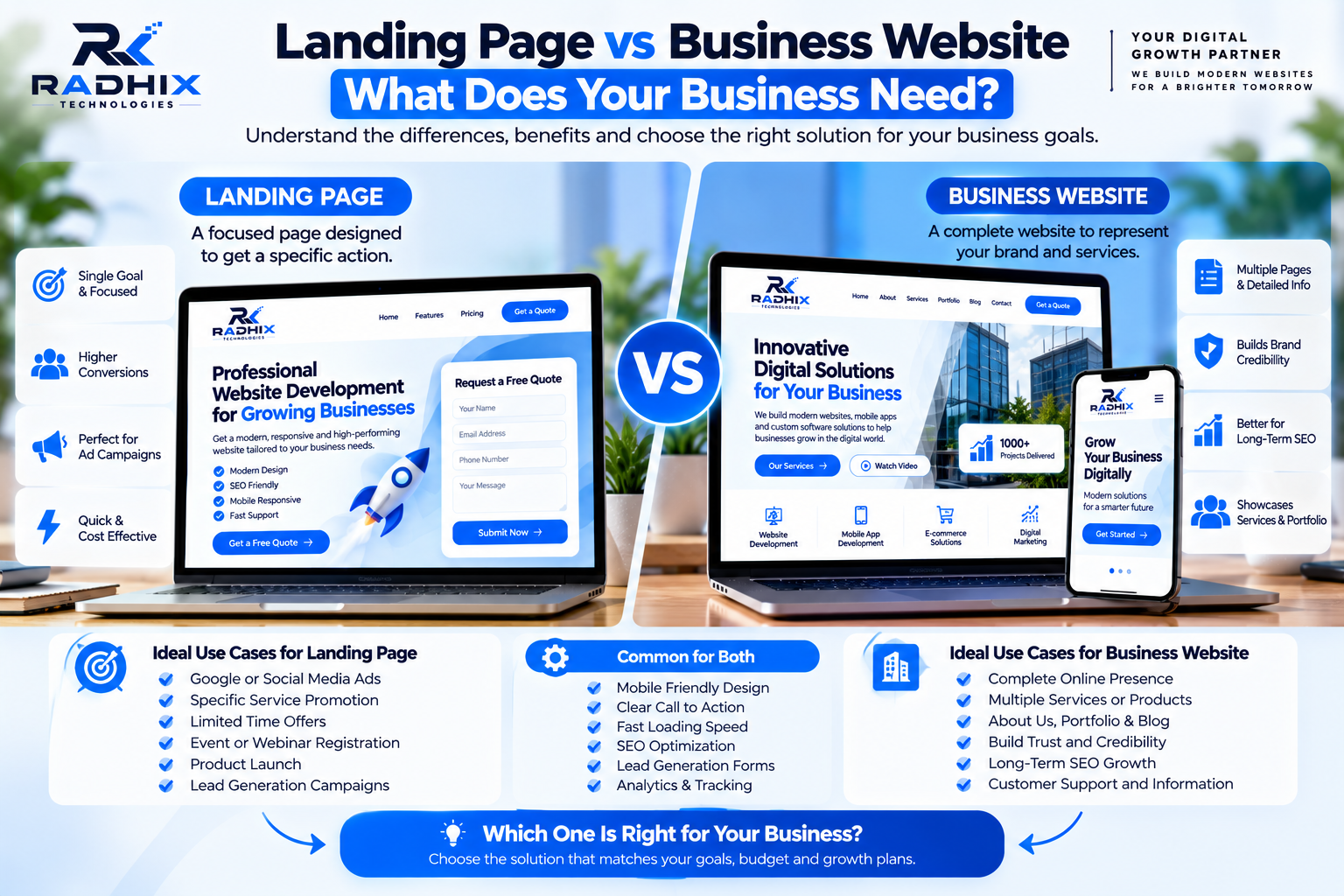
Landing Page vs Business Website: What Does Your Business Need?
In today's digital world, having an online presence is essential for businesses that want to reach more customers, build credibility, and generate leads. But when planning your digital presence, you may face an important question: Should you build a landing page or a complete business website?
Both options can help your business grow, but they serve different purposes. A landing page focuses on one specific action, such as generating enquiries, booking appointments, or promoting an offer. A business website provides broader information about your company, services, products, and expertise.
Choosing the right option depends on your business goals, marketing strategy, budget, and long-term plans.
In this guide, Radhix Technologies explains the differences between landing pages and business websites and helps you decide which solution is right for your business.
1. What Is a Landing Page?
A landing page is a dedicated web page designed to encourage visitors to complete a specific action. This action could be filling out an enquiry form, requesting a quotation, registering for an event, booking a consultation, or purchasing a product.
Unlike a traditional business website, a landing page usually focuses on one offer and one primary call to action.
Key Features of a Landing Page
- A clear and attention-grabbing headline
- A concise explanation of the offer
- Benefits and important information
- A lead generation form or WhatsApp button
- Customer testimonials or trust indicators
- A prominent call-to-action button
- A mobile-friendly layout
- Conversion tracking and analytics
Example of a Landing Page
Imagine that a software development company is running a Google Ads campaign to promote its website development services.
Instead of sending visitors to the company's homepage, it creates a dedicated page titled "Professional Website Development for Growing Businesses."
The page explains the service, highlights its benefits, displays relevant project examples, and includes a form for requesting a quotation.
Because the page focuses on one offer, visitors can quickly understand the service and take the next step.
When Should You Choose a Landing Page?
A landing page may be the right choice when you want to:
- Generate leads from Google or social media ads
- Promote a particular service or product
- Launch a limited-time offer
- Collect registrations for an event or webinar
- Test a new business idea
- Direct visitors towards a specific enquiry or purchase
2. What Is a Business Website?
A business website is a collection of connected web pages that represent your company online. It gives potential customers a place to learn about your business, explore your services, understand your experience, and contact your team.
A professional business website acts as a central destination for customers who discover your company through search engines, referrals, social media, or advertisements.
Key Features of a Business Website
A typical business website may include:
- Home: Introduces your business and its main offerings.
- About Us: Explains your company's background, mission, and expertise.
- Services: Describes your products or services in detail.
- Portfolio: Showcases completed projects and work samples.
- Testimonials: Shares genuine customer feedback.
- Blog: Publishes useful information related to your industry.
- Contact Us: Provides contact details and enquiry options.
- Additional pages: Includes FAQs, pricing, case studies, privacy policies, and other relevant information.
Example of a Business Website
A website development company may offer website development, mobile app development, custom software, e-commerce development, and digital marketing.
A complete business website can have a separate page for each service, helping visitors understand the company's capabilities and find information relevant to their needs.
It can also publish educational blogs, display previous projects, and provide multiple ways to contact the business.
When Should You Choose a Business Website?
A business website is generally more suitable when you want to:
- Establish a professional online presence
- Build trust with potential customers
- Present multiple services or products
- Improve opportunities for organic search traffic
- Publish blogs and educational content
- Showcase your portfolio and expertise
- Support long-term marketing and business growth
3. Landing Page vs Business Website: Key Differences
Although both can support lead generation and sales, their main purposes differ.
FeatureLanding PageBusiness WebsitePrimary purposeAchieve one specific actionRepresent the overall businessStructureUsually one focused pageMultiple connected pagesNavigationMinimal or limitedUsually a full navigation menuContentFocused on one offerCovers different business topicsLead generationFocused on a specific campaignSupports multiple services and enquiriesSEO opportunitiesUsually narrowerCan target different topics across pagesAdvertisingUseful for focused campaignsUseful for brand and service discoveryContent publishingLimited or campaign-specificCan include a blog and resourcesInitial complexityOften simplerDepends on the number of pages and featuresLong-term useOffers and targeted campaignsOngoing business presence
The main difference is straightforward: a landing page encourages a specific action, while a business website allows visitors to explore your company and its offerings.
A landing page can still be optimised for search engines, and a business website can include highly focused landing pages. Neither format guarantees better conversion rates or search rankings without effective content, design, targeting, and optimisation.
4. Which Option Is Better for SEO?
Search engine optimisation helps people discover your business when they search for relevant products, services, or information.
A business website often provides more opportunities for SEO because you can create separate pages for different services, locations, customer needs, and educational topics.
For example, a website development company may publish individual pages for:
- Website development services
- E-commerce website development
- Custom software development
- Mobile application development
- Website maintenance
- Website development cost guides
Each page can address a distinct search intent when it offers useful, original information.
A landing page can also appear in search results if it is crawlable, indexable, relevant, and well optimised. However, a single page generally covers fewer topics than a well-structured multi-page website.
SEO Advantages of a Business Website
- More opportunities to target relevant search queries
- Space for detailed service information
- Opportunities to publish blogs and case studies
- Internal linking between related pages
- Greater flexibility for local and industry-specific content
- More opportunities to demonstrate expertise and answer customer questions
Our recommendation: If your long-term goal is to attract customers through Google searches and build a lasting online presence, a well-planned business website is usually a stronger foundation.
5. Which Option Is Better for Lead Generation?
The answer depends on where your visitors come from and what you want them to do.
A landing page can be especially useful when visitors arrive from an advertisement promoting one specific service or offer. The headline, content, and call to action can match the advertisement, making the next step clear.
A business website can generate leads from multiple sources. Visitors can explore different services, read case studies, learn about the company, and submit enquiries when they are ready.
Landing Page Lead Generation Tips
- Use a clear headline that matches your campaign.
- Explain the main benefits of your offer.
- Keep forms short and easy to complete.
- Add a visible call-to-action button.
- Make the page fast and mobile-friendly.
- Use genuine testimonials or relevant project examples.
- Measure form submissions, calls, and other meaningful conversions.
Business Website Lead Generation Tips
- Add clear contact options to relevant pages.
- Create a dedicated page for each major service.
- Include useful project examples and customer feedback.
- Make contact forms easy to find.
- Provide a clear navigation structure.
- Add relevant calls to action throughout the website.
For the best results, align the page with the visitor's intent rather than assuming one format will always convert better.
6. Landing Page vs Business Website: Cost Considerations
The cost of building a landing page or business website depends on the design, content, functionality, integrations, and development approach.
A simple landing page may require less initial investment because it has a narrower scope. A multi-page business website may cost more because it requires additional content, design work, functionality, and testing.
However, a complex landing page with custom animations, CRM integration, tracking, and advanced forms can also require significant development effort.
Factors That Affect Development Cost
- Custom UI/UX design
- Number of pages and sections
- Content writing and image creation
- Contact forms and lead management
- WhatsApp or CRM integration
- Analytics and conversion tracking
- Search engine optimisation setup
- Hosting, domain, and security
- Ongoing maintenance and support
When comparing quotations, check what is included rather than comparing only the total price. Ask whether content, hosting, analytics, SEO configuration, and post-launch support are part of the proposed scope.
7. Can You Use Both a Landing Page and a Business Website?
Yes. In many situations, using both is a practical digital marketing strategy.
Your business website can serve as your main online presence, while dedicated landing pages support specific advertising campaigns.
For example, a company offering multiple digital services can maintain a main website with pages for website development, software development, mobile apps, and digital marketing.
If the company runs a campaign for website development, it can create a separate landing page that focuses on that service and encourages visitors to request a quotation.
How This Combined Strategy Works
Step 1: Build your main website. Include your company information, services, portfolio, blog, and contact details.
Step 2: Create targeted landing pages. Develop dedicated pages for specific offers, audiences, or advertising campaigns.
Step 3: Drive relevant traffic. Use search engines, paid advertisements, email campaigns, and social media to reach suitable audiences.
Step 4: Measure performance. Track enquiries, qualified leads, bookings, and sales to understand which pages are delivering value.
Step 5: Improve over time. Use real performance data to refine page content, forms, calls to action, and marketing campaigns.
This approach allows you to build long-term brand visibility while also supporting focused lead generation.
8. Which Option Is Right for Different Businesses?
Small Businesses and Local Service Providers
If you are a local service provider, such as an electrician, consultant, salon, or repair company, your choice depends on your goals.
A landing page may be sufficient for promoting one specific service or offer. A multi-page website is more useful when customers need information about multiple services, locations, pricing, or company credentials.
Startups
Startups testing a new product or service may begin with a landing page to collect enquiries, registrations, or early customer interest.
As the business grows, a larger website can provide detailed product information, customer resources, case studies, and support content.
B2B Companies
Business-to-business companies often benefit from a complete website because prospective clients may want to review services, company experience, case studies, and expertise before making contact.
Landing pages can support individual campaigns for specific services or industries.
E-commerce Businesses
An e-commerce business generally needs a suitable online store or commerce website to manage product information, shopping carts, payments, and orders.
Landing pages can complement the store by promoting particular products, collections, or special offers.
Digital Marketing Campaigns
If you are running Google Ads, Facebook Ads, or Instagram campaigns for one offer, a dedicated landing page can help maintain a consistent message from advertisement to conversion.
For businesses running multiple campaigns, separate landing pages may be useful when each campaign targets a different audience or objective.
9. Common Mistakes to Avoid
Before investing in your online presence, avoid these common mistakes:
Choosing only by price: A low initial cost may not meet your long-term requirements. Consider functionality, maintenance, and the value the solution provides.
Using one generic page for every campaign: Visitors from different campaigns may have different needs. Relevant landing pages can provide a more focused experience.
Ignoring mobile users: Your pages should be easy to read, navigate, and use on smartphones and tablets.
Overloading landing pages: Too many unrelated messages and calls to action can distract visitors from the main objective.
Neglecting SEO: Even a conversion-focused page needs appropriate metadata, useful content, and sound technical implementation.
Forgetting analytics: Without measurement, it is difficult to determine which pages and campaigns generate valuable enquiries.
Building too much too soon: Start with the features that support your current business goals and expand when your requirements justify it.
How Radhix Technologies Can Help
At Radhix Technologies, we help businesses establish and improve their digital presence through website development, custom software solutions, e-commerce development, mobile application development, and digital marketing services.
Our approach starts with understanding your business goals, target audience, required features, and budget.
Whether you need a focused landing page for lead generation or a complete business website for long-term growth, the right solution should be designed around your customers and business objectives.
We can help you plan a website structure, create a user-friendly experience, support SEO requirements, and identify opportunities for future improvements.
Planning your next website project? Contact Radhix Technologies to discuss a suitable digital solution for your business.
Conclusion
Choosing between a landing page and a business website depends on what you want to achieve.
A landing page is useful for promoting a specific offer, supporting advertising campaigns, and guiding visitors towards one primary action. A business website provides a broader online presence, explains your services, builds credibility, and creates opportunities for long-term organic visibility.
For many growing businesses, the most effective approach is to use a business website as the foundation and add targeted landing pages when specific campaigns require them.
Before making a decision, evaluate your goals, target audience, budget, marketing channels, and future requirements.
The right digital solution is not necessarily the biggest or most expensive one. It is the one that helps your business serve customers and achieve measurable goals.
Frequently Asked Questions
1. What is the main difference between a landing page and a business website?
A landing page focuses on one main goal, such as generating a lead or promoting an offer. A business website provides multiple pages covering your company, services, expertise, and contact information.
2. Is a landing page enough for a small business?
It can be enough if you are promoting one service, testing an idea, or running a specific campaign. If you offer multiple services or want to build long-term search visibility, a multi-page website may be more suitable.
3. Which is better for Google rankings?
A multi-page website generally provides more opportunities to target different search topics. However, a well-optimised landing page can also rank for relevant searches. Results depend on content quality, technical SEO, relevance, and competition.
4. Is a landing page cheaper than a business website?
A simple landing page often costs less because its scope is smaller. The actual cost depends on design complexity, integrations, content, tracking, and other requirements.
5. Can I add landing pages to my existing website?
Yes. You can create dedicated landing pages within your existing website for advertising campaigns, service promotions, product launches, and lead generation.
6. Do I need a landing page if I already have a website?
Not always. However, landing pages can be useful when you run targeted campaigns that need a focused message and a specific call to action.
7. What should a high-quality landing page include?
A strong landing page generally includes a relevant headline, a clear offer, benefits, trust indicators, a visible call to action, a simple form where appropriate, and a mobile-friendly design.
8. Can Radhix Technologies build both landing pages and business websites?
Radhix Technologies provides website development and digital solutions for different business requirements. The recommended approach depends on your goals, features, budget, and marketing strategy.